Another magnificent triumph from the one and only Orson Welles. Based on the novel by Booth Tarkington, The Magnificent Ambersons tells the tale of a whip smart scion from an aristocratic family who tries to ruin his mother’s happiness. One of course questions whether there was an American aristocracy, perhaps an important family would be a more accurate description. In any case, this is a really terrific film, an unfinished masterpiece. Welles’ work is missing some 43 minutes after RKO decided to publish an alternative cut. I read recently that TCM have joined the search for the lost minutes of this masterpiece, which is very exciting indeed.
Tarkington’s Pulitzer Prize-winning book struck many chords with Welles, himself the Midwestern son of a wealthy inventor (like Joseph Cotten’s character, Eugene Morgan). In fact, he suspected that Tarkington, a friend of Welles’ family, based the spoilt brat and “princely terror” Georgie Amberson Minafer on him — he, too, was called Georgie as a child. Empire
Joseph Cotten … Eugene Morgan
Dolores Costello … Isabel Amberson Minafer
Anne Baxter … Lucy Morgan
Tim Holt … George Minafer
Agnes Moorehead … Fanny Minafer
Ray Collins … Jack Amberson
Erskine Sanford … Roger Bronson
Richard Bennett … Major Amberson
Orson Welles … Narrator (voice)
For a film which is unfinished, the message in The Magnificent Ambersons is conveys loudly, clearly, and dare I say, completely. Joseph Cotton (later starring in Welles’ Citizen Kane) is the perfect antidote to the insufferable George Minafer – who is spoiled rotten and drives the whole town around the bend. His repulsive nature conveys perfectly the critique of the dying old money class as pitted against Eugene Morgan’s much more palatable character bringing in the new money of the motor industry. In a way the film pits old against new. Georgie represents the sternly held but ultimately unfounded set of restrictions, body and mind, which the bourgeoisie impose on itself. This is represented in the physical sense by Georgie repeatedly getting in the way of his mother having a relationship with Eugene, partly I suppose derived from his own desire to marry Eugene’s daughter Lucy but also out of repulsion for Eugene’s innovation and vigour. Of course Georgie goes about any purported positive goal in the worst possible ways and might end up receiving the correct comeuppance by the end of the film…
But it’s a flawed masterpiece, as brilliant a study of social change as Visconti’s The Leopard. We see a rich, Midwestern family in decline from the 1870s into the 20th century as a new commercial, bourgeois society emerges.Welles doesn’t appear but provides an eloquent, seductive voiceover, and the movie is admirably served by several Mercury Company performers from Kane (Agnes Moorehead, Joseph Cotten, Ray Collins) and new recruits (Tim Holt, Anne Baxter). The experimental narrative combines extended takes with sharp montages of social commentary, and veteran Stanley Cortez’s photography is as remarkable as Gregg Toland’s on Kane. Guardian
Let me start by stating that I am obsessed with this album and this band. I have referred to this band as Japan’s answer to Kraftwerk on early listens but really the two were contemporaneous. Why was Kraftwerk so successful when YMO are comparatively unheard of? Perhaps because the former embraced a style and theme and the latter leaned into a fun, futuristic funk and an ‘inherent sexiness’. They combined their clear Eastern style and influence with more Western style song structures which is perhaps why it appealed to me so much. The combination of this with the fun almost high fashion visuals did stagger me.
If you’re a more seasoned gamer you may have come across a sterling example in ‘Rydeen’. Yellow Magic Orchestra’s soaring electro-pop epic, taken from their 1979 album Solid State Survivor, was not only a major influence on the development of early video game music (or “chip tune”) but also appeared directly in titles such as Trooper Truck (1983) and Super Locomotive (1982). More so, the song’s incredible marriage of propulsive rhythm and sugar rush melody laid out the blueprint for what was to become an era defining sound not only in Japan but in western countries such as the UK – where cheap Japanese electronics were being retuned to the post-punk atmosphere. Classic Album Sundays
After the drums of the first track, Technopolis, one immediately feels as though they are in for a thrilling ride. This is the apex of Japanese synth pop. Catchy ‘melody’, rapid fire changes and an overall sense of urgency tying the track together. YMO manage to produce an almost otherworldly sound here.
Absolute Ego Dance follows, and provides a quieter but still very punchy track. Listen to the bass line throughout, which I feel underpins the bizarre frond-like dispersal of sound throughout the film. The high pitched synth takes over about one third through. Try to listen and separate what you are hearing. This is multi-layered and complex, while maintaining high energy and infectious rhythm.
Front and back cover
Rydeen, as you will have red above, was featured in several video games, including Sega’s Super Locomotive. The beginning of the track on the album does sound like a train. This is my favourite track on the album. In fact I would go as far as to say this is one of the best, most infectious and appealing synth pop tunes of all time. It was indeed the band’s most successful single. The bridge about halfway through the track lends itself to a terrifically energetic and highly complex final section of the song. So many layers!
Castalia is comparatively mysterious and dark, but still showcases a mastery of synth. The track provides us with a good bridge between the height of energy in the opening tracks and those in closing. When trying to focus on work and needing drive, I tend to skip this track, however I have deigned to listen to it while composing this review.
Behind the Mask is another highlight of the album, the soaring bassline which emerges one minute in and the trippy ethereal backing transport one to another plane, almost. For all its esoteric feel, the track is still incredibly strong and multi-layered.
The band’s decision to deliver their lyrics in English (with help from translator Chris Mosdell) spoke to their ambition to be known as a globalised band, accessible to as wide a range of people as possible. Having grown up in a post-war Japan that was both coming to terms with its isolated past and anticipating its precarious future, its not hard to understand how American imports of jazz, rock, funk, and folk records might have represented a break from the troubles of their parents’ generation. Ibidum
Day Tripper is an audacious cover of a Beatles track which is sure to at once delight and horrify the band’s western audience. High energy, colourful, creative and ultimately alive. This song is emblematic of the ambitions of the album.
Insomnia is the third of three especial highlights on the album for me. The cascading echoing synth is a testament to the capacity of this genre of music. The imaginative strength it must have taken to compose something of this scale baffles me. We know Ryuichi Sakamoto, one of the founding members of YMO, has gone on to compose a variety of soundtracks, notably for the Oscar winning film the Revenant.
In summary, Solid State Survivor is a remarkable, alive, durable album. It brims with adventure and is striking in its agelessness. A true technicolour thrill. YMO had a brief but shining span and have had an enormous impact on this reviewer.
Directed by Orson Welles and starring a magnificent Anthony Perkins, The Trial is a superlative interpretation of Der Prozess by Franz Kafka. The film was released in 1962. Welles wrote the screenplay as well as directing the film, which shows in its unique style, perspective and voice. The Trial tells the story of Joseph K, accused of something – bit we do not know what – and is subjected to a trial – but the court processes are not clear. It is a masterful interpretation of the novel and captures all its haunting nightmarish disquiet. In terms of further context, Sight and Sound voted Citizen Kane as the greatest film of all time in their 1962 annual review, likely giving Welles a well needed boost of confidence in the making of this film.
The blackest of Welles’ comedies, an apocalyptic version of Kafka that renders the grisly farce of K’s labyrinthine entrapment in the mechanisms of guilt and responsibility as the most fragmented of expressionist films noirs. Perkins’ twitchy ‘defendant’ shifts haplessly through the discrete dark spaces of Welles’ ad hoc locations (Zagreb and Paris, including the deserted Gare d’Orsay), taking no comfort from Welles’ fable-spinning Advocate, before contriving the most damning of all responses to the chaos around him. The remarkable prologue was commissioned from pioneer pinscreen animators Alexandre Alexeieff and Claire Parker. Timeout
There are so many outstanding moments in this film it is difficult to find one or even three standouts. It is shot in a similar way to Citizen Kane, with a focus on wider shots and perspective, as can be seen by the cover photo I have chosen, showing the first scene in the film where Joseph K is at what I suppose would be the preliminary Hearing in his trial saga. A lot of the scenes were shot in the Gare d’Orsay in Paris, after it shut down as a working train station but before it became the Museum D’Orsay, which now houses some magnificent Van Goghs, among other tremendous works, which I remember being very moved by visiting as a child. I wonder how my perception would alter now.
Another quite haunting scene for me was when Joseph meets Titorelli the painter, who informs him all about the nefarious Court’s practices. This scene is preluded by Joseph K meeting the girls outside the artist’s studio who follow him. You can see them at either side of the hallway following Joseph K as he leaves Titorelli’s studio in the above photograph. This for me captures the almost choking claustrophobia of the book and film. The fundamental hopelessness of Jospeh’s cause is highlighted in this scene especially. Titorelli tells Joseph of the rules of the Court, while being badgered by dozens of young girls outside, who are also agents of the Court, and escapes them through a corridor which leads directly to the Court. I found it utterly extraordinary.
I shan’t go further to avoid spoilers but this is a truly special film, as indeed most of Orson Welles’ films are (Magnificent Ambersons is a must watch, even with pat of it still missing to this day). Beautifully shot, Anthony Perkins is radiant as Joseph, Welles is superlative as the useless lawyer and the whole thing is a beautiful translation of the airlessness of the novel.
My apologies for the poor photographs in advance, it has been a long time since I have been able to review an eatery and I have somewhat lost the habit of photographing the goods as it were. However, Pizza Punks in Newcastle has to be one of the more novel pizza places I have had the pleasure of visiting. I ordered two pizzas, the margherita, of course, and a mushroom and truffle pizza, both of which were absolutely splendid. The former is pictured below.
The margherita, as you will know, if the original pizza and by far, in this reviewer’s opinion, the best. The old ones really are the best, one might say. The mozzarella was high quality and cut in large slices rather than being grated, which grates me in turn. The ‘red sauce’ spoken of in the menu tasted like San Marzano sauce but I may be wrong. There was, regrettably, no basil as advertised on the menu, but I can forgive Pizza Punks for this anarchic decision.
The truffle mushroom pizza, pictured above, contained just truffle mushrooms, white sauce and garlic & rosemary potatoes, sliced very finely indeed. It also featured some excellent mozzarella slices again, likely sliced from a larger block of dried mozzarella, which tends to make the best pizza cheese. Now the flavour here was beautifully balanced – it is ludicrously easy to overdo the truffle and overpower your customer but Pizza Punks stayed well within the status quo on this occasion.
Turning to more conventional British pizza habits, a pepperoni was ordered. This one had a little extra on it in the form of some Nduja spicy sausage, which added a not too unpleasant kick. The basil on this pizza was also a welcome addition by comparison to my own pizza. Most of the time I am wary of processed pork but this was a special pizza so I made an exception. Delicious, quite spicy but overall well balanced.
The final pizza I shall mention which was ordered was the above aberration, the hamburger pizza. Now, before you unsubscribe, know this: I did not order it! In its defence, the pizza did taste exactly like a cheese burger. Why you would want one food to taste like another is beyond me. I will not dignify this pizza with a serious review but I think it is about time I spoke about the dough. Pizza Punks utilises a beautiful Neapolitan style pizza dough which is a lot more fluffy than the typical roman pizza dough which is flat and typically more robust in texture. The dough at Pizza Punks was superb, no question about it, as you can see from the above photographs.
See the menu above.
Overall, I am very impressed with this delightful novel pizzeria. Some of the pizzas are less acceptable than others but otherwise the concept is good, the quality is high and the ingredients are excellent.
As summer and relative freedom loom, I thought it might be agreeable to share with you one of my favourite bike rides. Cycling has been a necessary pass time for me throughout the various lockdowns. Getting out on my own and seeing the beautiful sights quite close to home has given me the energy I needed to face week after week of confinement. My cycle, as you will see, is a road bike. This means I also have the thrill of worrying about being run over by an errant driver, which is refreshing in view of the more commonly petrifying COVID concerns.
I jest of course, generally speaking drivers are careful not to come anywhere near you. It is imperative to wear a good quality helmet, have blinking lights and high visibility outer wear, however. My directions will jump about a little, rest assured there is a satnav guide tour at the bottom of this post.
Our tour begins, as it must, near New Street Station. I would cycle up Holloway Head, turning onto Bath Row and through Edgbaston Park Road, taking a right onto Somerset Road then left onto Farquhar. Once at University there is a right turn down a leafy path which cuts through to the Barbery centre and then onto Quinton Road. From the end of Quinton Road, I would turn left onto California Way and take the third exit at the roundabout to get on West Boulevard. West Boulevard is a dual carriageway so take extra care here. After about two hundred metres turn left onto Woodgate Valley Country Park. This paved path, pictured above, goes on for some 3.5km and is delightful and traffic free.
St Kennelm’s Church
Now comes the difficult bit, Lapal Road South leads you to Manor Way, which is again a dual carriageway/ highway so be sure to take extreme care here. Thankfully this only goes on for a few hundred metres, the roundabout takes us off this dangerous road and through Blackberry Lane and Hasbury. The former has a punishing sudden incline so do watch out for that.
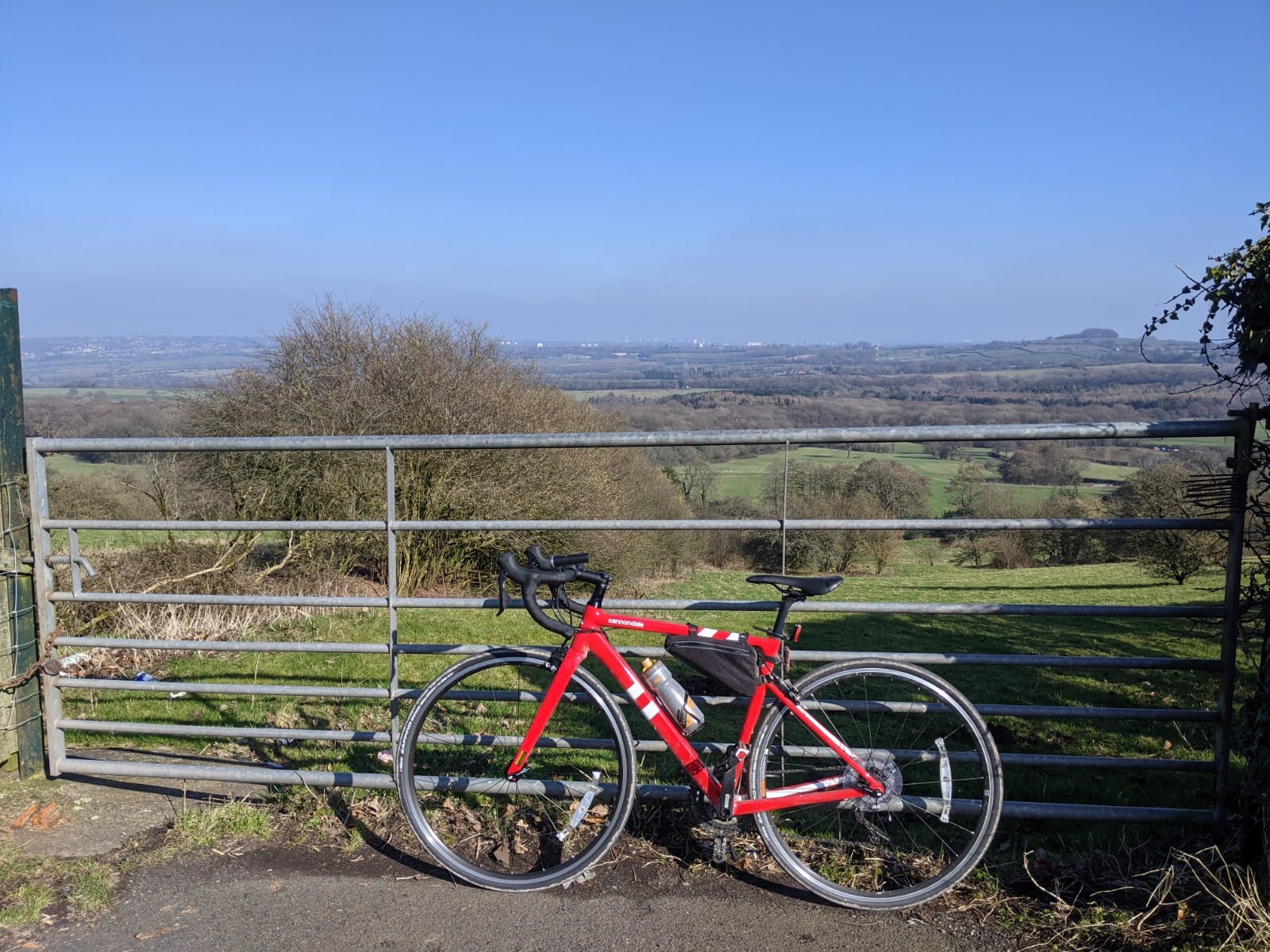
Onto the cause way and turning left onto Hagley Wood Lane, you will find yourself faced with a 11-12% gradient incline. this is the real test of the ride. I have so far managed to make it up 90% of this without stopping, hopefully with my new cleated pedals I will be able to do the full thing without difficulty. the views at the top, pictured, are staggering. Take some time to see Birmingham from afar.
Downhill most of the way from there. St Kennelm’s Road and Dark Lane, where I hope to live, are peaceful gently descending and ascending in turn. The legs may be a bit tired from the menacing climb to the top of Clent but otherwise the rest of the ride is pleasant. Old House Lane and New Town Lane are wonderful countryside roads. Yew Tree Lane and Egg Hill Lane the same. The latter has a sterling view of Bartley reservoir, which is not too far should you wish to have a brief detour. I have presumed that I would wish to do so hence have included it on the tour, embedded below.
From there, onto Shenley Fields Road and Gibbins Road, we begin to feel familiar territory. The Tour then takes us onto the protected Blue Cycle Path from Selly Oak to the town centre, where the trip began and will end.
Overall, this tour is a standard 40km tour which should take no longer than 2 hours if you are cycling at pace. I have found it to be uniquely freeing and challenging at the same time. This is an excellent way to get out of dodge and not have to go too far to see some truly stunning countryside.
If you are a keen cyclist, do download the Komoot app.