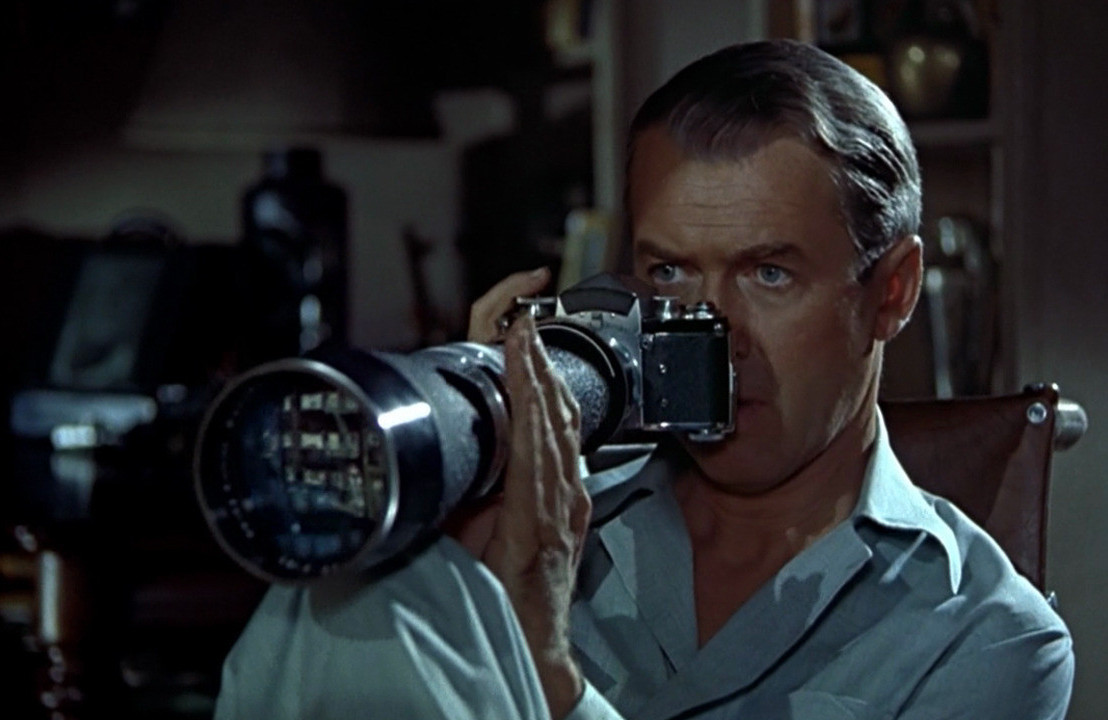
Empire refers to this film as flawless and essential. I could not agree more. Rear Window is a film which I watched with my jaw on the floor throughout. Like after Cabaret, I sat stupefied as the credits roll, questioning the magnitude of what I have just witnessed. Rear Window tells the story of a wheelchair bound photographer, Jeffries (Stewart), who has nothing to do in his convalescence but spy on his neighbours. He becomes convinced that one of them, Thorwald (Burr) has murdered his bedridden wife and… well… gotten rid of her in a bed of flowers. Lisa, (Kelly) his girlfriend, and Thelma (Ritter) his maid assist him in their investigations.
James Stewart … L.B. ‘Jeff’ Jefferies
Grace Kelly … Lisa Carol Fremont
Wendell Corey … Det. Lt. Thomas J. Doyle
Thelma Ritter … Stella
Raymond Burr … Lars Thorwald
Made in 1954, this propelled Alfred Hitchcock from everyday master of suspense to a position as titanic public figure, popular entertainer and true artist. He made great films before and after, but Rear Window showed he could take a gimmick premise and transform it into a movie at once accessible to a mass audience and deep enough to be worth dozens of reviewings and critical analyses. Empire
The concept of this film is so à propos for the past miserable year. A man locked away in his apartment, unable to do anything but spy on his neighbours. We have a derelict council building and hotel which charges by the hour (probably) opposite our rear window which does not make for especially tantalising viewing. Jeffries is lucky that he has such entertaining neighbours. From Miss Torso to the couple who sleep out on their balcony, the fascinating and tragic Miss Lonely on the ground floor and the struggling composer above and the wonderful lady who lowers her dog down on a winch, to do its business in the garden. See a picture of Jeff’s view below.
This film is a remarkable work of atmosphere and demonstrative of Hitchcock’s undeniable genius. The whole film is shot from the perspective of Jeffries with the exception of one scene where Hitchcock breaks away from his perspective logic. This is the scene where Lisa is looking up at the woman on the fire escape about two third in, who is scorning her neighbours. I shall not tell you what for but will say this scene is likely among the most suspenseful in the film. Follow this link for an excellent article on Hitchcock’s understanding of the language of cinema in Rear Window.
I’m not much on rear window ethics.
Lisa
Although it is filmed entirely from one room, the film is never once dull. The blinding star power of Grace Kelly is visible in her every movement. The strength of the script, written by John Michael Hayes based on Cornell Woolrich’s 1942 short story “It Had to Be Murder”, is astounding at every turn. The initially frustrated exchanges between Steward and Kelly are superb, followed by their joint enthusiasm for the case they are pursuing. Add in the cynical nurse Thelma and the even more disbelieving Det. Lt. Thomas J. Doyle (Corey), both reluctant to provide assistance, and you have yourself a winning film. The plot is dense and unfolds slowly in a manner reminiscent of 12 Angry Men. Each piece of evidence is adduced slowly to provide a full picture of the events transpired.
Overall this is powerful and perverse movie which tells of the lengths to which humans will go when locked away and intrigued. It is simultaneously about voyeurism, justice, and human nature. Rear Window is an enduring masterpiece which continues to have a strong effect on you long after you have watched it. This is a film which will stay with you forever.
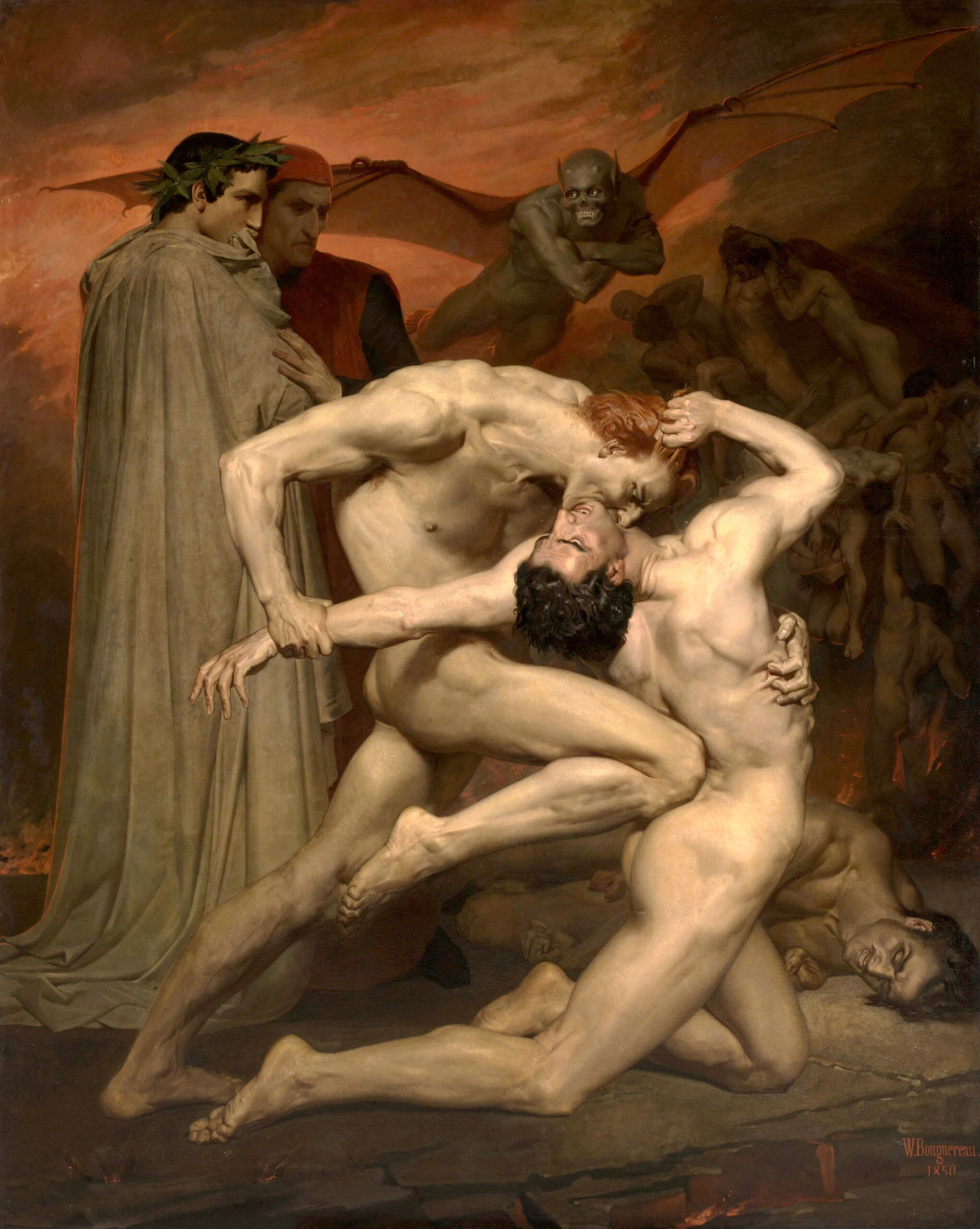
William Bouguereau (1825-1905) was a French academic painter. His works comprised mostly mythological themes and modern interpretations of Classic scenes. His most famous work is of course the Birth of Venus (seen below), painted in 1979. There is a bit of nudity in this piece so please scroll very fast if you do not wish to be startled. The piece I will be discussing today is Dante and Virgil, painted in 1950 when the artist was just 25. It shows a scene from the Inferno where Capocchio, and Gianni Schicchi are fighting. The former is biting the later rather aggressively.
Having failed on two occasions to win the Prix de Rome (1848 and 1849), Bouguereau was hungry for revenge. His early submissions to the Salon reveal this fierce desire to succeed. After his ambitious Equality before Death (1849), the young man aimed to create an impression once again. He put forward an even larger painting inspired by Dante whose work was much loved by the Romantics and who captured all its dramatic beauty. This painting was inspired by a short scene from the Inferno, set in the eighth circle of Hell (the circle for falsifiers and counterfeiters), where Dante, accompanied by Virgil, watches a fight between two damned souls: Capocchio, a heretic and alchemist is attacked and bitten on the neck by Gianni Schicchi who had usurped the identity of a dead man in order to fraudulently claim his inheritance. Museé D’Orsay
Dante and Virgil can be seen in the background witnessing this horrifying scene. The theme of terribilita and horror is one to which Bouguereau would not return. But what a painting! The devil/ demon floating in the background, the anguished look of Dante and Virgil and the mound of tortured souls to the right makes for quite a frightening scene. Of course the main attraction, as it were, are the two fighters in the central foreground. The bite itself is quite beautifully executed. One can see by the exaggerated contortion of the cheek muscle and throbbing vein in the biter’s forehead that he is putting a lot of effort into this act of facial vandalism. The muscles and tendons as well as the poses themselves are exaggerated by Bouguereau to maximise the principle themes in this painting. This is the artist pushing the boundaries of the medium. Notice how the muscles are almost distorted form the strain in a most unnatural way. the interplay between shadow and light added with the mound of souls in the right background is quite startling.
Overall this was a striking piece which I could not quite take my eyes off of when I first saw it. It is masterly done and daring for someone so young. This is a testament to the talent of Bouguereau, I hope you enjoyed it as much as I did.
Living and dying In Chinatown Yes they’re living and dying down in old Chinatown In Chinatown, you better look around Man, you don’t stand a chance if you go down in Chinatown
Chinatown is Thin Lizzie’s 1980 triumphant offering to the altar of music. While not as strong as their opus Jailbreak, it is uniquely thin Lizzie and stands out among their albums as one of the most colourful musically and visually. I was first introduced to Thin Lizzie by my father, of course, who pointed out Phil Lynot, their lead singer, played the part of the Parson in Jeff Wayne’s War of the Worlds, which I had the distinct pleasure of seeing live at the Resorts World Arena in 2018 for Pater’s birthday.
Phil Lynott – bass guitar, lead vocals, guitar
Scott Gorham – guitar, backing vocals
Snowy White – guitar, backing vocals
Brian Downey – drums, percussion
Darren Wharton – keyboards, backing vocals
I shall focus on a few highlights within this album. The most notable track is probably the title track. Chinatown itself is a remarkable work. From the opening chords to the drumming and Lynott’s unmistakable voice. This is a rip roaring rock tune for the ages. The beautiful guitar in the opening and the bridge are indicative of the skill and musicianship of Gorham and White. Note the precise and delightful supporting drum from Wharton throughout. This is just fab!
Other new songs on Chinatown ranged from the rousing, mid-paced determination of opener “We Will Be Strong,” the more carefree, acoustic-backed rocker “Having a Good Time” (another descendant of “The Boys are Back in Town”), the conversely dramatic “Genocide (The Killing of the Buffalo)” (featuring a particularly impassioned Lynott vocal), the heartbreakingly tender and regretful “Didn’t I” and, finally, the rather iffy, half-reggae, half-forgettable amalgam of “Hey You.”
But the album’s piece de resistance was its menacing and sinister single, “Killer on the Loose,” which caused quite a bit of controversy when certain media associated it to the ongoing furor across the British Isles over a serial killer known as the “Yorkshire Ripper,” but nevertheless reached No. 10 in Britain and No. 5 in Ireland. Chinatown, meanwhile, performed well enough in the U.K. but not as well as recent efforts; it barely registered in the U.S. and didn’t show much life even when the band descended there for a short tour, after wildly acclaimed passages through Japan, Australia and New Zealand. Ultimate Classic Rock
Sweetheart is a great passionate track with some top shelf vocals. I think however that I agree with UCR in saying that the moribund hit of the album has to be Killer On the Loose. In spite of its morbid subject matter it is the one I find myself muttering many weeks after listening to the album. The baseline, the recurring motifs, the fantastic breathless vocals just add up to make a superb hit. Try and get the chorus out of your head!
My final highlight has to be Genocide (Killing of a Buffalo) which features some impassioned vocals and a sort of vegetarian utopian vision where buffala mozzarella is a thing of the past. Some stunning guitar work throughout and once again the drumming is so impressive.
Overall, this 1980 offering is an absolute gem and worth a place in anyone’s vinyl collection. It is constant high powered fun with some top notch musicianship thrown in for good measure. Enjoy it, perhaps after watching the film Chinatown!
As you may recall, I’ve been searching for the greatest films ever made recently. My search brought me across this wonderful offering by director extraordinaire Roman Polanski (Rosemary’s Baby, Repulsion, Knife in the Water), paired with Jack Nicholson (One Flew Over the Cuckoo’s Nest, The Shining), the script of Robert Towne and the production of Robert Evans made for an exquisite film. Towne’s Oscar winning script includes one of the most iconic proclamations towards the end by the female protagonist (Faye Dunaway), but I won’t spoil this for you!
Actor Jack Nicholson, director Roman Polanski, writer Robert Towne, producer Robert Evans: four friends, four gifted individuals, men of substance and substance abuse. Early ’70s Hollywood belonged to these people and their kind. They were given relatively large budgets, and a fair amount of artistic freedom, and told to go and make movies. Empire
Chinatown tells the tale of a private eye supposedly engaged to discover whether the head of the Los Angeles Water Board is having an affair by his wife. It is discovered quickly that all is not what it seems. Empire describes this film as a “never bettered noir masterpiece” and one can see why. There is refinement to a genre which has been explored many times, including a constant and notable cynicism, perhaps on account of the Nixon presidency ending in 1974, the year the film was made. This provides a strong undercurrent to the shady actions of the police officers. I kept asking myself, what on earth does Chinatown have to do with this film? It was not until the final line in the film that I understood. Chinatown has everything to do with this film.
Alongside Nicholson, Chinatown features career-best performances from Faye Dunaway – who notoriously clashed on set with director Polanski – and legendary film-maker John Huston, who played sinister landowner Noah Cross. Polanski himself had a cameo as a stiletto-wielding hoodlum who slices Nicholson’s nose open. The Guardian
An exquisite triumph of film making, considered the best film ever made by the Guardian. I do not agree with this, Yasujirō Ozu’s Tokyo Story is probably the greatest film ever made in my opinion. Subjectivity is one of the greatest joys of taste. In President Biden’s words, “you can disagree with me, and that’s fine”.
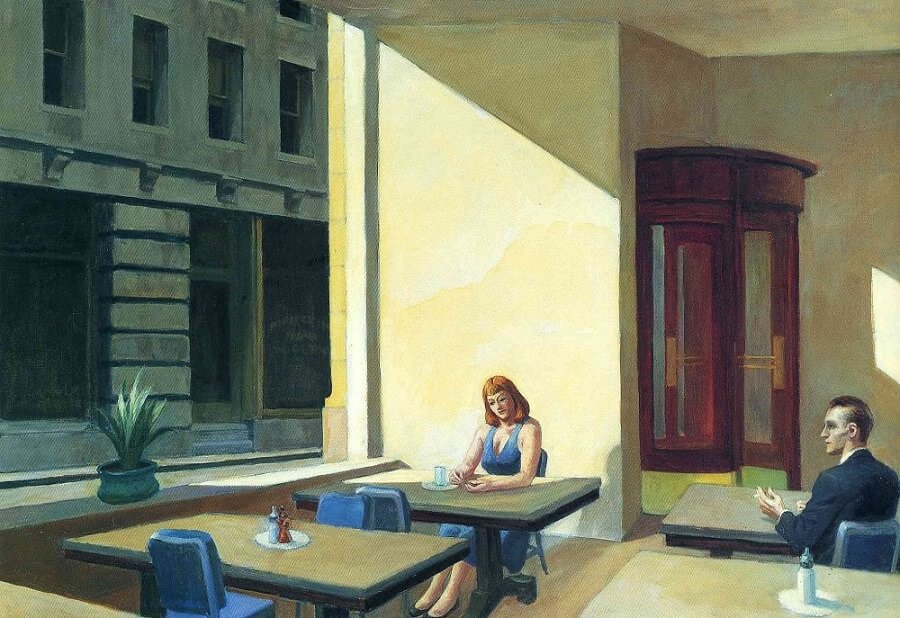
It is not difficult to find examples of social distancing in Edward Hopper’s works. This blog has explored Office in a Small City, which is a reality I face daily being one of about three people working in my office. Hooper (1882-1967) is one of the great American artists to have ever lived. He is most widely known for his oil paintings but was also highly proficient at watercolours and etchings, having produced over 800 works during his career. Hopper seems to be the perfect artist for this time of extreme alienation, isolation and loneliness. Del Ray Artisans, who are hosting an exhibition called After Edward Hopper: Themes of Solitude and Isolation” describe the themes in Hopper’s works as being profoundly American in that they represent “perseverance, fortitude, diversity, and an egalitarian spirit in spite of adversity, impoverishment, and social injustice.” Del Ray Artisans. With this in mind, we shall examine Hopper’s wonderful Sunlight in a Cafeteria, painted in 1958.
Hopper lived from 1882 to 1967, but his paintings have an emotional resurgence today. As the world moved into 2021, the pandemic has come with it. Many Americans could not or chose not to see families and friends for the holidays, afraid that contact would spread the virus. We did not throw parties on New Year’s Eve, instead staying in our homes with our dinners and our countdown shows. We have spent the better part of a year like this: isolated.
Isolation is what Hopper’s paintings capture so well. In 1927’s Automat, a woman sits by herself at a small table. She already has her coffee, and, though there is another chair at the table, we cannot know if she is waiting for someone, or if that someone will ever arrive. 1930’s Early Sunday Morning shows a series of storefronts in the daytime, all dark, all empty. In Room in New York, painted in 1932, a woman and man sit in a room, together but also somehow apart. He’s reading a paper. Her back is mostly to him while she half-heartedly tinkers with the piano. In my personal favourites, Morning Sun from 1952 and Office in a Small City from 1953, a woman on a sun-kissed bed and a man in a small office, respectively, sit alone and stare out of their windows at the world, or at least the little parts of the world that they can see. New Statesman
Sunlight in a Cafeteria 1958
Hopper depicts two individual diners in a cafe in a quiet side street. They are not being waited on, despite the broad daylight and lack of other customers to attend to. The perspective of this scene is taken from the inside of the diner. In these ways Sunlight in a Cafeteria is the direct mirror image of Nighthawks. This is an interesting painting for Hopper. This does not depict a lone figure of figures isolated but instead depicts two people on the cusp of communication. How interesting that Hopper chose the moment before the first contact between two presumably single lonely people (in a cafe on their own). The woman’s hair is quite dazzling and together with her dress represent a splash of colour in the centre ground of the painting. I would add that the wonderful symmetrical shade detail is also meant to highlight her. Perhaps we are seeing this painting through the perspective of the potential lover about to speak to her.
Hopper is a master of subtle allusion. We see a man and woman seated at separate tables in a sunny cafeteria. They are the only customers. What interests the artist is the suspenseful moment before a first tentative contact is made, the mental and emotional forcefield that can arise between two strangers. Edward Hopper
Having mentioned Nighthawks above, I must draw your attention to Kelly MacConomy’s Covid Nighthawks reimagined, below, which presents a splendid scene. MacConomy must have wondered how to make Hopper’s work more lonely. Perhaps reflecting on the Government response to COVID19 was the only way. This is an observation, not a criticism. This is not a political blog!
Kelly MacConomy’s Covid Nighthawks reimagined
Together these two paintings exemplify some of what I imagine must be the national mood throughout the lockdowns this last year. They are wonderful, insightful and terribly affecting.