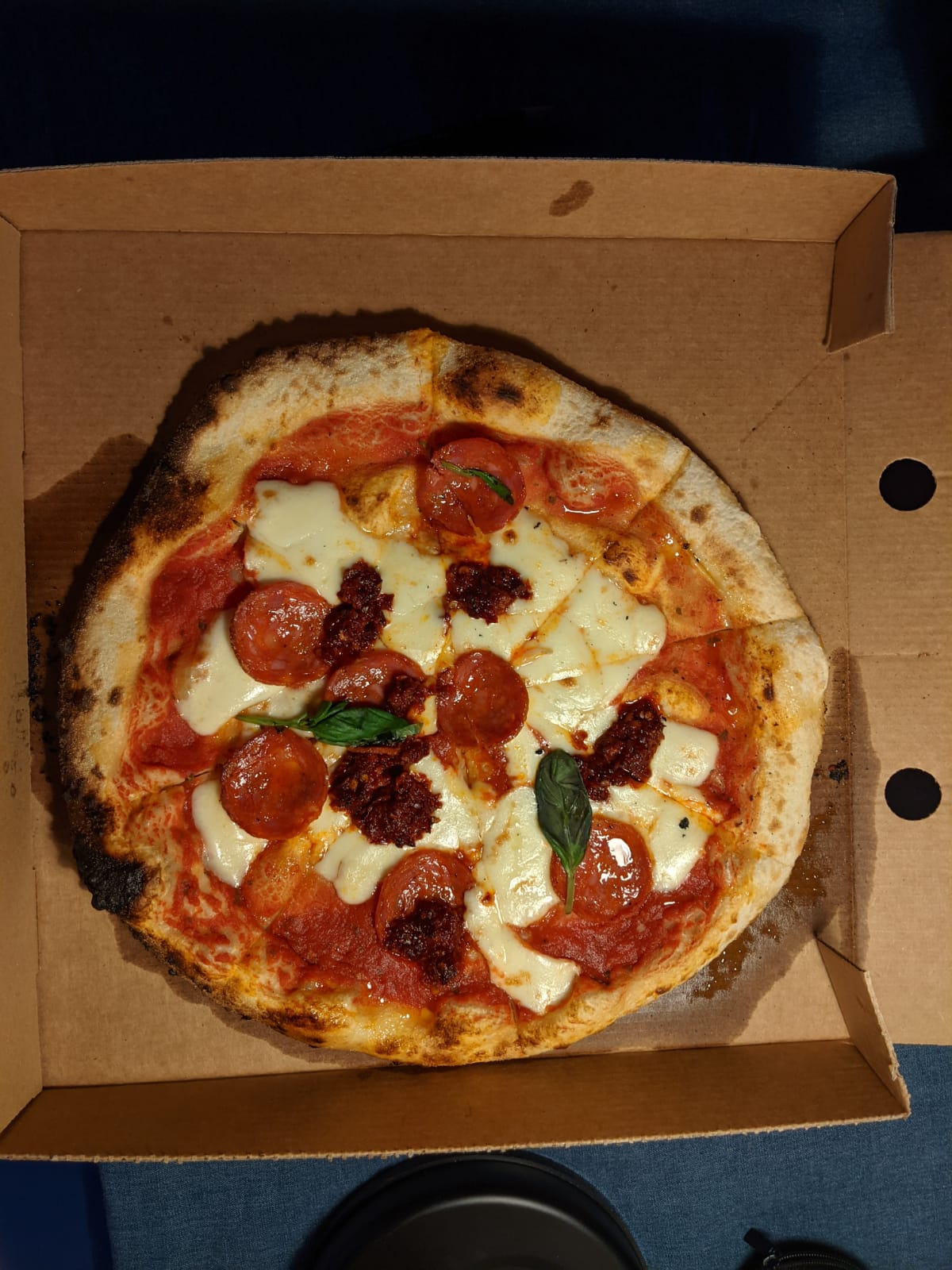
My apologies for the poor photographs in advance, it has been a long time since I have been able to review an eatery and I have somewhat lost the habit of photographing the goods as it were. However, Pizza Punks in Newcastle has to be one of the more novel pizza places I have had the pleasure of visiting. I ordered two pizzas, the margherita, of course, and a mushroom and truffle pizza, both of which were absolutely splendid. The former is pictured below.
The margherita, as you will know, if the original pizza and by far, in this reviewer’s opinion, the best. The old ones really are the best, one might say. The mozzarella was high quality and cut in large slices rather than being grated, which grates me in turn. The ‘red sauce’ spoken of in the menu tasted like San Marzano sauce but I may be wrong. There was, regrettably, no basil as advertised on the menu, but I can forgive Pizza Punks for this anarchic decision.
The truffle mushroom pizza, pictured above, contained just truffle mushrooms, white sauce and garlic & rosemary potatoes, sliced very finely indeed. It also featured some excellent mozzarella slices again, likely sliced from a larger block of dried mozzarella, which tends to make the best pizza cheese. Now the flavour here was beautifully balanced – it is ludicrously easy to overdo the truffle and overpower your customer but Pizza Punks stayed well within the status quo on this occasion.
Turning to more conventional British pizza habits, a pepperoni was ordered. This one had a little extra on it in the form of some Nduja spicy sausage, which added a not too unpleasant kick. The basil on this pizza was also a welcome addition by comparison to my own pizza. Most of the time I am wary of processed pork but this was a special pizza so I made an exception. Delicious, quite spicy but overall well balanced.
The final pizza I shall mention which was ordered was the above aberration, the hamburger pizza. Now, before you unsubscribe, know this: I did not order it! In its defence, the pizza did taste exactly like a cheese burger. Why you would want one food to taste like another is beyond me. I will not dignify this pizza with a serious review but I think it is about time I spoke about the dough. Pizza Punks utilises a beautiful Neapolitan style pizza dough which is a lot more fluffy than the typical roman pizza dough which is flat and typically more robust in texture. The dough at Pizza Punks was superb, no question about it, as you can see from the above photographs.
See the menu above.
Overall, I am very impressed with this delightful novel pizzeria. Some of the pizzas are less acceptable than others but otherwise the concept is good, the quality is high and the ingredients are excellent.
As summer and relative freedom loom, I thought it might be agreeable to share with you one of my favourite bike rides. Cycling has been a necessary pass time for me throughout the various lockdowns. Getting out on my own and seeing the beautiful sights quite close to home has given me the energy I needed to face week after week of confinement. My cycle, as you will see, is a road bike. This means I also have the thrill of worrying about being run over by an errant driver, which is refreshing in view of the more commonly petrifying COVID concerns.
I jest of course, generally speaking drivers are careful not to come anywhere near you. It is imperative to wear a good quality helmet, have blinking lights and high visibility outer wear, however. My directions will jump about a little, rest assured there is a satnav guide tour at the bottom of this post.
Our tour begins, as it must, near New Street Station. I would cycle up Holloway Head, turning onto Bath Row and through Edgbaston Park Road, taking a right onto Somerset Road then left onto Farquhar. Once at University there is a right turn down a leafy path which cuts through to the Barbery centre and then onto Quinton Road. From the end of Quinton Road, I would turn left onto California Way and take the third exit at the roundabout to get on West Boulevard. West Boulevard is a dual carriageway so take extra care here. After about two hundred metres turn left onto Woodgate Valley Country Park. This paved path, pictured above, goes on for some 3.5km and is delightful and traffic free.
St Kennelm’s Church
Now comes the difficult bit, Lapal Road South leads you to Manor Way, which is again a dual carriageway/ highway so be sure to take extreme care here. Thankfully this only goes on for a few hundred metres, the roundabout takes us off this dangerous road and through Blackberry Lane and Hasbury. The former has a punishing sudden incline so do watch out for that.
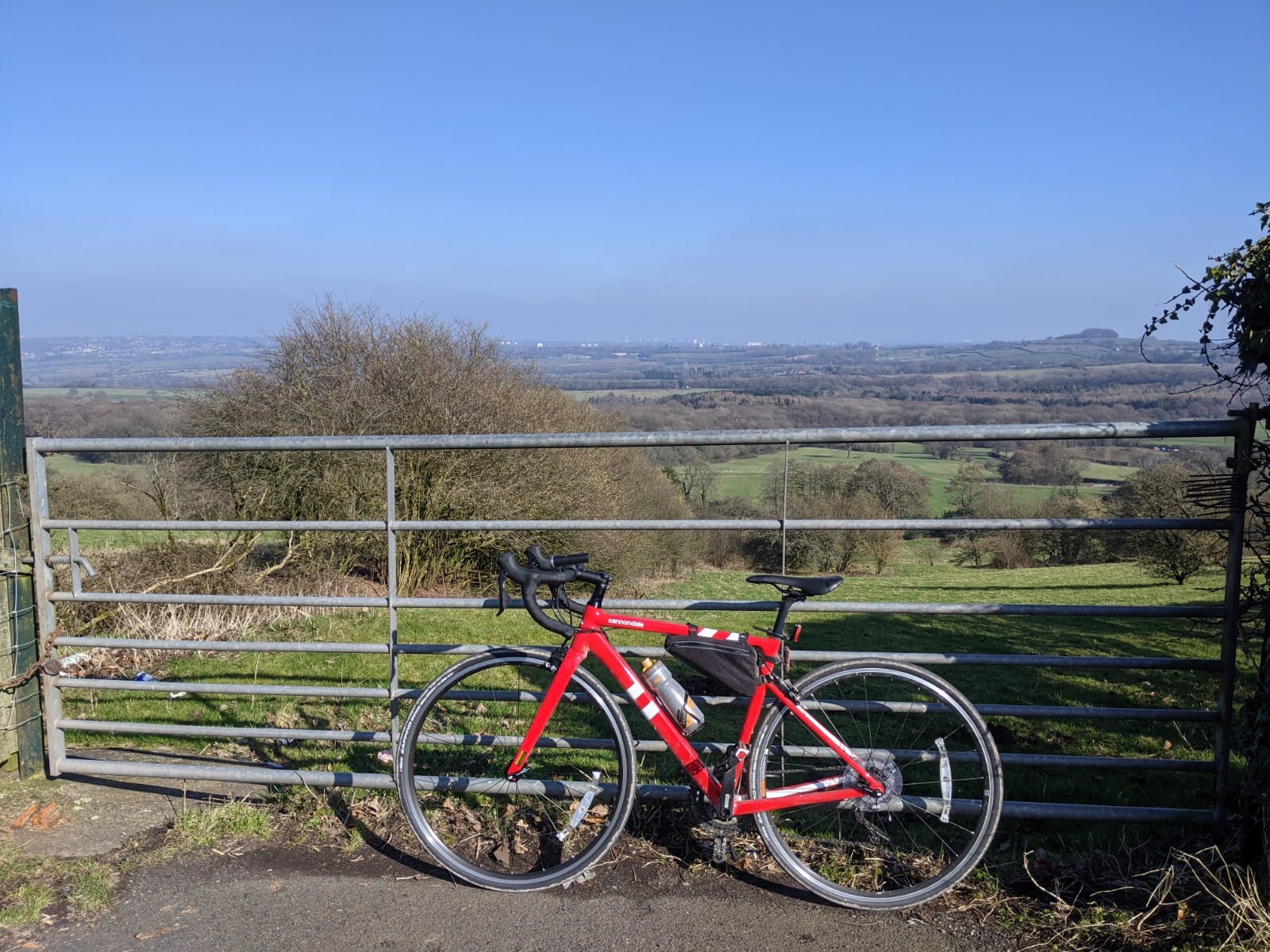
Onto the cause way and turning left onto Hagley Wood Lane, you will find yourself faced with a 11-12% gradient incline. this is the real test of the ride. I have so far managed to make it up 90% of this without stopping, hopefully with my new cleated pedals I will be able to do the full thing without difficulty. the views at the top, pictured, are staggering. Take some time to see Birmingham from afar.
Downhill most of the way from there. St Kennelm’s Road and Dark Lane, where I hope to live, are peaceful gently descending and ascending in turn. The legs may be a bit tired from the menacing climb to the top of Clent but otherwise the rest of the ride is pleasant. Old House Lane and New Town Lane are wonderful countryside roads. Yew Tree Lane and Egg Hill Lane the same. The latter has a sterling view of Bartley reservoir, which is not too far should you wish to have a brief detour. I have presumed that I would wish to do so hence have included it on the tour, embedded below.
From there, onto Shenley Fields Road and Gibbins Road, we begin to feel familiar territory. The Tour then takes us onto the protected Blue Cycle Path from Selly Oak to the town centre, where the trip began and will end.
Overall, this tour is a standard 40km tour which should take no longer than 2 hours if you are cycling at pace. I have found it to be uniquely freeing and challenging at the same time. This is an excellent way to get out of dodge and not have to go too far to see some truly stunning countryside.
If you are a keen cyclist, do download the Komoot app.
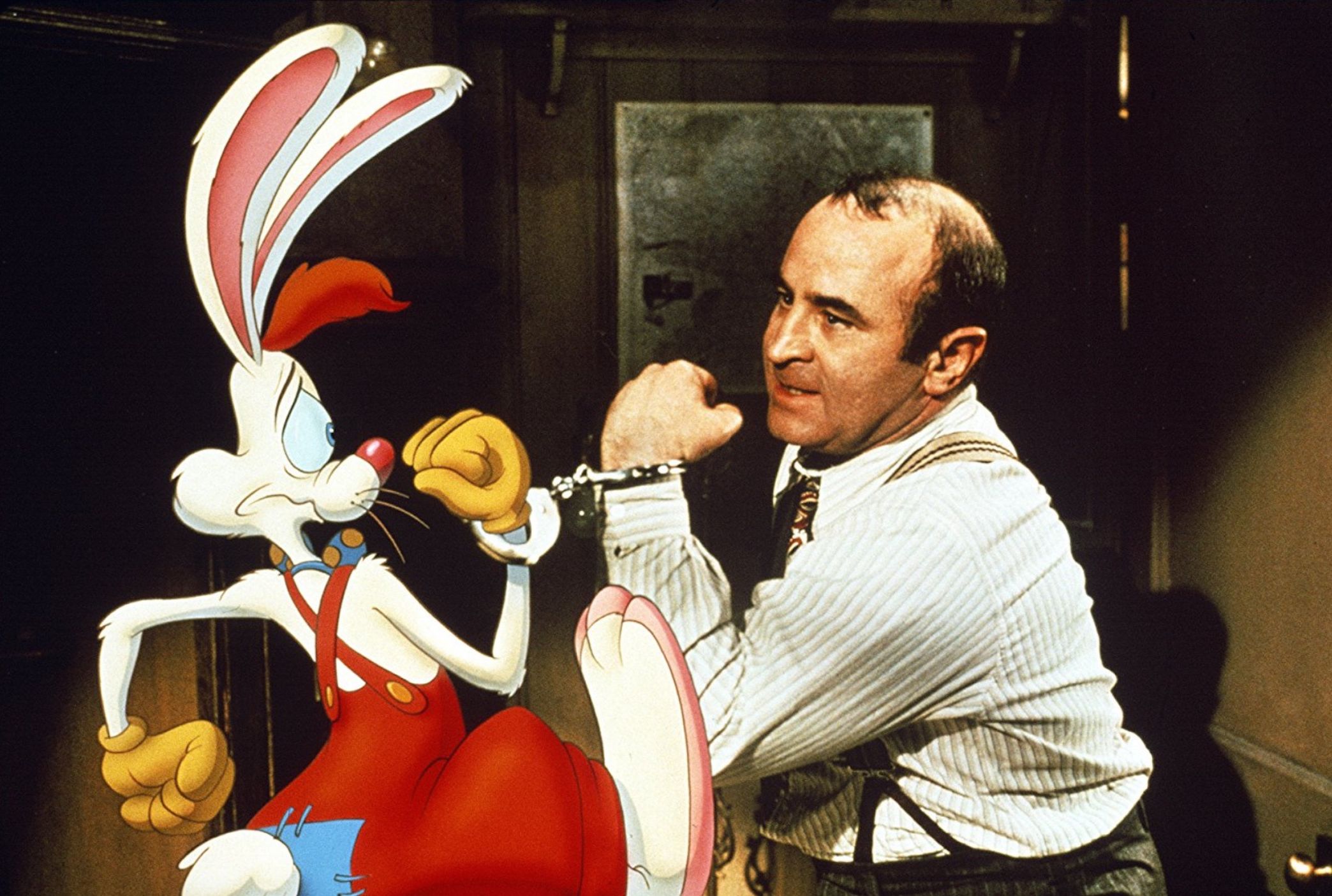
Goodness me where to begin? The film was based on Gary K. Wolf’s dark novel Who Censored Roger Rabbit?, which tells the story of detective Eddie Valiant investigating the murder of Roger Rabbit. This exquisite animated feast follows the story of this self same detective (Bob Hoskins) as he seeks to clear Roger Rabbit’s name (Charles Felischer), following his framing for a murder he did not commit, and reunite him with his wife Jessica Rabbit (Kathleen Turner).
Part animation, part film noir, part slapstick comedy, part mismatched buddy movie, part postmodern treatise, director Robert Zemeckis’ and executive producer Steven Spielberg’s valentine to the cartoon heroes of their youth is all astonishing technical know-how in the service of infectious exuberance and pure wonder. Empire
While the film was made in 1988, it was set in 1947, the golden age of cartooning. The costumes, set design and beautiful animation are a true show of strength from Disney. Throughout the film they are showing you quite plainly ‘this is what we can do’. The opening scene’s disaster sequence where Baby Herman was crawling around the kitchen with Roger in tow, trying to avoid injury seemed to go on forever and included a head spinning amount of mishaps. Then something extraordinary happens, the cartoons step out of the animated world and into the real world, seamlessly. Zemeckis’ genius and the raw capabilities of the animation of Disney come alive at this point.
Where Roger Rabbit still amazes today is in just how much the cartoons feel part of the real world, rather than being pasted into it. Nifty mechanical effects (robotic arms, intricate wirework, sets built six feet off the floor to accommodate puppeteers) enabled props to be moved by cartoon characters – who were added in later – giving the dailies the appearance of an Invisible Man movie. Empire
Christopher Lloyd (Back to the Future) plays an extraordinary villainous figure in this film as Judge Doom. His litany of mafia mongooses follow him as he exacts his twisted version of justice on all those in his path. He is the perfect dark anti-hero to the colourful camp excitement of Roger Rabbit throughout the film. I noticed that the plot had a slight nod to Chinatown, the latter being the apex of the film noir genre. And this brings me to an important point, while being visually staggering throughout, and playful and fun, Who Framed Roger Rabbit remains an excellent, well paced, character rich film. Above all the visual brilliance and noise, the tension and plot development is kept tight throughout. This is a testament again to the director’s genius.
There is much more to be said for this film but the best thing to do would be simply to watch it.
Following on from a highly enjoyable 5 Favourites post in March, I have decided to make the feature a running one.
Sparks – Propaganda
The brothers Mael find themselves in a series of tricky situations for the cover of their 1974 album, Propaganda. The middle sleeve is the photograph I used for the cover of this post, but these two can also be found gagged and bound in the back of a car on the back cover of this wonderful album. The album itself is an astonishing and flawless work of art, please do listen to it.
Supertramp – Crisis, What Crisis?
These three famous words, misattributed to Labour leader Jim Callahan in 1979 during the Winter of Discontent ( who actually said “I don’t think other people in the world would share the view [that] there is mounting chaos”), were the inspiration for the dramatic cover you see above. Although if we look back further the line was Zinneman’s 1973 film The Day of the Jackal. Anyway, the cover itself is quite striking. The background was a still taken from a Welsh mining town which brings home the point the cover is trying to make even more.
Thomas Dolby – Aliens Ate My Buick
This is one of my favourite albums ever, it is flawless start to finish, inventive and novel. It is the kind of album which leaves you feeling like you’ve been missing something your entire life when listening for the first time. But in terms of the album artwork, this 1950s comic book esque cover with Dolby and his girl in the foreground is just great. Aliens are destroying buildings and eating his nice Buick, while nicely dressed people are running for their lives. It’s just great. The back cover is even better, the faint outline of the car and some fiery traces, at a drive in movie about aliens stealing cars is totally inspired.
The Kick Inside – Kate Bush
“…and then I find it out, when I take a good look up. There’s a hole in the sky, with a big eyeball, calling me….come up and be a kite, and fly a diamond night…” Kite, Kate Bush
Jay Myrdal was the photographer who gifted us with this wonderful cover. The idea is said to have come from Pinocchio, when Jiminy Cricket floats past the whale’s eye using his umbrella like a parachute (Kate Bush News). Kate, a then relative unknown, came to Myrdal’s studio, driven by her father with a car full of wooden sticks and yellow material. The rest, as they say, is history.
Grace Jones – Hurricane / Dub
Another one of Jean Paul Goude’s masterpieces and lessons in photography, the cover of Hurricane / Dub shows Grace in 2008, then 60 years old, wearing a rhinestone studded bowler hat and smoking a cigarette. The open mouth and position of the head are reminiscent of the cover of Slave to the Rhythm, which we will certainly cover later. This stunning hat was the focal point of the below performance in 2010, where Grace became a self styled disco ball. Having seen Grace live myself (a quasi-religious experience), I can understand why the crowd absolutely lost their minds.
John Phillip Simpson (1782–1847) was a British portrait painter. Until his death he was a frequent exhibitor at Royal Academy and was even the appointed painter to Portuguese royalty. Today I want to talk about a piece of his which has moved me rather. I wanted to include this in Black History Month back in February but almost feel it is more impactful being seen as a stand alone piece some weeks later. After all, the issues highlighted in Black History Month are suffered year round.
Despite enduring critical neglect and eventual obscurity, Simpson was a gifted artist, capable at times of venturing beyond the parameters of society portraiture and his position as a studio assistant. And in one particular work, The Captive Slave, John Simpson produced a painting of iconic status, which can be regarded today as his masterpiece and as a worthy emblem of the aims and achievements of the Abolition Movement.
Britain did not abolish slavery until 1833, some six years after The Captive Slave was painted. Plantations in the far reaches of the British Empire were still profiting from slave labour when this was painted and those profits, of course, made their way directly to London. With this in mind, let us have a look at the above painting. Take some time to examine it. The subject is a black man, chained at the wrists, looking into a dark negative space surrounding him. He seems to be looking towards the source of the light which reflects on his brow, perhaps a window outside the scope of the canvas. His chest is exposed which puts him in even more of a vulnerable position. There is a wetness in his eyes which seems to indicate tears have been shed. And in contrast to the above, he is wearing a striking orange jumpsuit which shocks us with colour.
The colour of the jumpsuit is very effective in highlighting the shocking captivity that this slave finds himself in. This painting hit me with some force. Simpson has used a mastery of technique to convey a deeply human portrait of the slave, which renders his captivity all the more shocking to the viewer. He, and the millions of others in his position, were people, not merchandise, as was believed at the time this was painted. This belief is conveyed beautifully in a striking way by Simpson.
Striking hand detail from The Captive Slave
The model Simpson used for this striking painting is said to have been Ira Frederick Aldrige, a famous Shakespearian actor of the time, pictured below, who had several notable performances including one as Othello and another as King Lear. Overall I am struck by this painting. It is a masterpiece and iconic (in the old sense of the word) emblem of the abolition movement. It stirs so many emotions and allows the modern viewer to reflect on the horrifying racial injustices which are still pervasive in modern times.
This post was not intended to make broad generalisations about a deeply complex issue, or to push any semblance of an agenda, but rather to share a beautiful, meaningful and sadly contemporarily potent piece of art. My sincere apologies if this did not come across in the above.
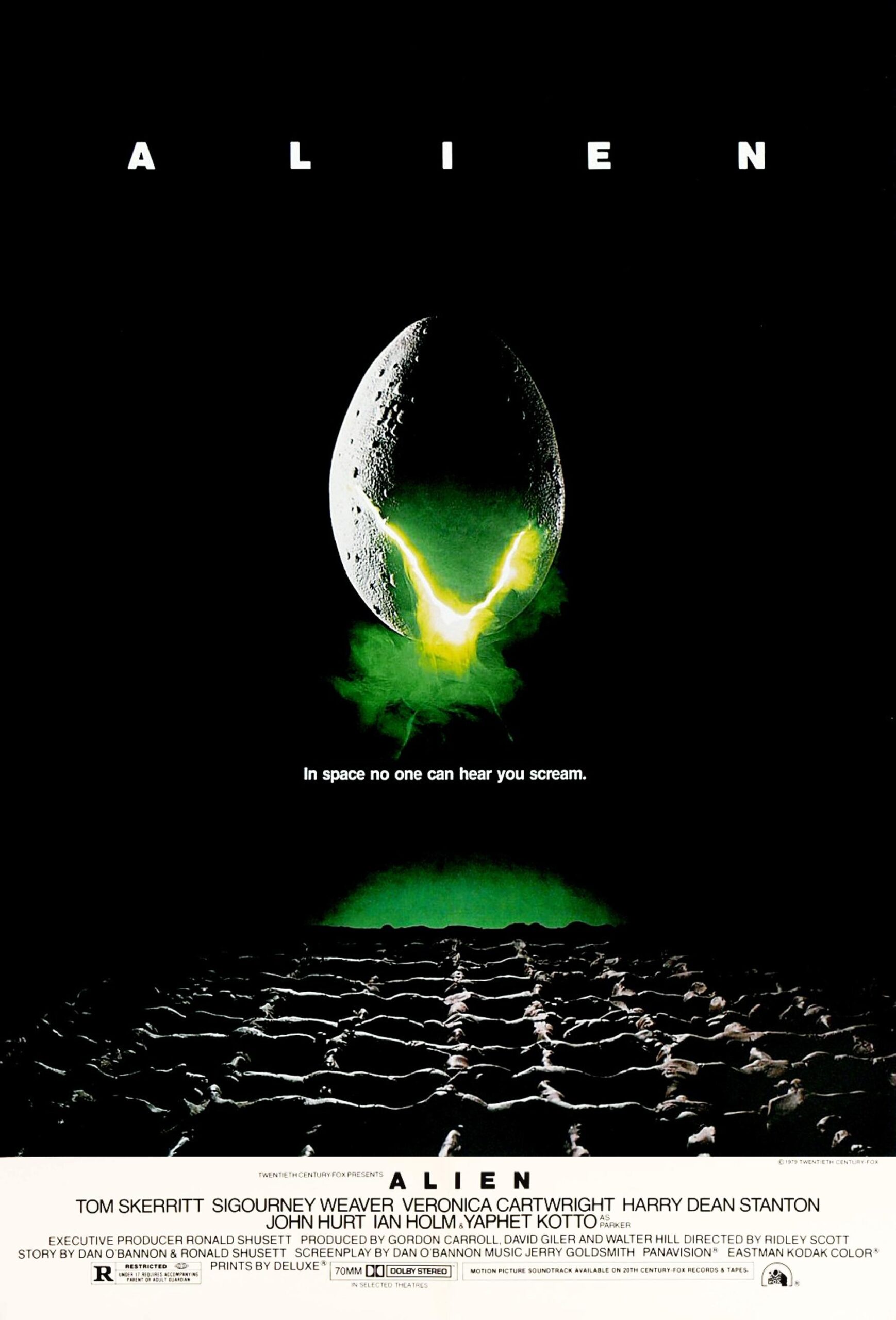
The plot of Alien is relatively simple: The crew of a towering 800 foot long commercial towing ship, the Nostromo, are tasked with investigating what appears to be a distress signal from an alien planet. The crew investigates this but, unbeknownst to them, bring an extremely dangerous alien life form onto their ship. One by one they are picked off…
Scott, aided by his special effects team, headed by Brian Johnson and Nick Allder, and many others who deserve to be mentioned but can’t be, creates in the confined space of his main set a sweaty little world on its own that responds ideally to his obsessive close-ups and restless, magnifying style. Hurt has said that it was more a matter of reacting than acting, and one can well understand what he means. His own performance makes one miss it when it’s gone. And that of Sigourney Weaver, as one of the two women astronauts, is also consistently watchable (with a bigger slice of the cake). Derek Malcolm
Tom Skerritt … Dallas
Sigourney Weaver … Ripley
Veronica Cartwright … Lambert
Harry Dean Stanton … Brett
John Hurt … Kane
Ian Holm … Ash
Yaphet Kotto … Parker
Bolaji Badejo … Alien
From the beginning Alien is otherworldly in its subject matter, set and striking visuals. The derelict alien ship which is investigated is as large as a building. Its vaulted insides are just as towering. The uniform rows of hibernating eggs, covered by an ominous coloured fog make for terrifying viewing. One can only imagine what the 1979 audience must have felt, before the SAW series of ‘films’ desensitised the public to horror.
However, the crew stayed small (seven, plus cat), the alien stayed medium-sized (no bigger than the man who played him, supple Masai tribesman Bolaji Badejo) and the story stayed simple: ship lands on planet in response to an SOS that turns out to be a warning; alien infects one of the crew; alien kills the rest of the crew one by one. It’s Ten Little Indians in space. Empire
Alien is a triumphant film in many regards, from its sensational design aspect, plot and the acting itself. The late great Sir Ian Holm (Bilbo Baggins, no less) is a phenomenon as the sociopathic, robotic follower of procedure, calm even in the face of his screaming colleagues. Sigourney Weaver as Ripley is of course a marvel as the jaded bad-ass survivor against all odds, increasingly bedraggled with every passing minute of the film. John Hurt’s role may be one of the most compelling but is unfortunately too brief, however superb its denouement.
To describe Alien as a triumph chiefly in terms of its look is not to underplay its dramatic strengths, it’s just that ordinary filmgoers tend to nod off if you pay tribute to designers (art directors Roger Christian and Les Dilley, production designer Michael Seymour, FX team Brian Johnson, Nick Allder, Carlo Rambali… wake up!) Empire
And talk about an ending! Alien for me scores 10s across the board. Even now some 42 years later, it packs a punch.