Perhaps the title of this album should be altered to Changed Forever, as this is how I feel listening to Love. Possibly one of the most diverse rock band of its time, Love enjoyed limited commercial success but their third album, Forever Changes, is now recognised as one of the finest rock records of the 1960s. Forever Changes, written in the Summer of Love (and released in the Autumn of the Clinic?) was about anything but love. The album captured something of the opposite sentiment to that espoused by the pastiche hindsight heavy retrospectives about the era. And it was recorded in only 64 hours!
The best record to come out of such turmoil—Love’s 1967 record Forever Changes—is ambitious and prescient, reflecting the cultural shift of the dying ’60s, while tapping into the paranoia that would soon permeate much of American culture in the next decade. Both lyrically and musically, Forever Changes is a snapshot of a turbulent America. AV Club
The opening track, Alone Again Or features the heart rendering line:
You know that I could be in love with almost everyone,
I think that people are the greatest fun,
and I will be alone again tonight, my dear
This sets the album up as being one concerned with isolation in an otherwise plenteous time of choice. “and I will be alone agains tonight my dear” recurs throughout the track, reinforcing the point. The trumpets are gorgeously combined with strings to make for a sumptuous, longing bridge. The guitar work, while repetitive, is precise and pleasantly tuneful.
Arranged By – Arthur Lee (tracks: A2 to A4, A6 to B5), Bryan Maclean (tracks: A1, A4), David Angel (tracks: A1, A4)
Artwork [Front Cover] – Bob Pepper
Bass – Ken Forssi
Cover, Design – William S. Harvey
Guitar – John Echols
Guitar, Vocals – Arthur Lee, Bryan Maclean
Orchestrated By – David Angel (tracks: A2 to A4, A6 to B5)
Percussion – Michael Stuart*
Photography By [Back Cover Photo] – Ronnie Haran
Producer – Arthur Lee, Bruce Botnick
Supervised By [Production Supervisor] – Jac Holzman
A House Is Not a Hotel features some stellar acoustic and bass guitar and vocals from Arthur Lee. The lyrics are a stellar rebuke of the turmoil of war, likely aimed at the discontent fomented by the US war on Vietnam. The guitar solos are just extraordinary throughout. They clash and are disjointed but work beautifully.
Andmoreagain, which I initially thought was a place in Wales, is a more thoughtful, introspective track than the more rock orientated previous track.
The Red Telephone is reminiscent of Syd Barret’s Pink Floyd but is rather more devastating in its subject matter, tackling race, imprisonment and death. The crooning lyrics are somewhat at odds with the dark subject matter, much like the first track on the album. The softness of the guitar is such to highlight the devastating lyrics. In terms of production value, this is off the scale. Violins sit perfectly at ease with the acoustic and bass guitar, managing to sound sumptuous without attacking your ears.
Sitting on a hillside
Watching all the people die
[…]
They’re locking them up today
They’re throwing away the key
I wonder who it will be tomorrow
You or me?
The next song provides some comparative light relief but still captures what Pitchfork refers to as “purgatory characterized by paranoia and grievance”, reflecting the mood of the nation at the end of the 1960s. Maybe the People Would Be the Times or Between Clark and Hilldale bids farewell to audiences. The AV Club referred to this track as characterising the futility of the sentiments espoused by the typical view of the Summer of Love. It is worth noting that Arthur Lee was convinced of his imminent death hence wrote this album as a final farewell, haunted by the inevitable spectre. This comes through in this track, especially notable when listening to him singing along to the trumpets, very much driven by the beauty of the music.
Eventually, he became convinced that his death was looming and that Forever Changes would be his final statement to the world. So he became a rank perfectionist, expressing all his unhappiness, fear, blame, and hope not only in his dark, discomfiting lyrics, but in the music itself, which draws from rock, pyschedelia, folk, pop, classical, and even mariachi. Ultimately, the album belongs to none of those genres.
[…]
This is the truer sound of late-1960s Los Angeles, which was neither a trippy paradise nor a Lizard Kingdom, but a purgatory characterized by paranoia and grievance. Pitchfork
Live and Let Live features a number of 12 string guitars layered together in a way that is meant to disorientate the listener. Somehow Lee has managed to turn the subject matter into the internal monologue of a man planning to shoot a bluebird with a pistol as it was trespassing on his land, a clear and vocal criticism of the US encroaching in Vietnam, perhaps.
You Set the Scene closes the album in a typical upbeat arrangement, masking a greater profound message. That message being that life is short and should be lived with love (sentiment, not the band), depth and purpose. The triumphant horns at the end of this track close the album exactly as it should be closed and leave one almost gasping at the magnitude of what has just been heard.
This is the only thing that I am sure of And that’s all that lives is gonna die And there’ll always be some people here to wonder why And for every happy hello, there will be goodbye There’ll be time for you to put yourself on
Everything I’ve seen needs rearranging And for anyone who thinks it’s strange Then you should be the first to want to make this change And for everyone who thinks that life is just a game Do you like the part you’re playing
This is an album which seeks to expose the lie of the Summer of Love. Love use ingeniously cheery arrangements and devastating lyrics to highlight the disparity between what was heard during this tumultuous summer and what was actually happening. It is a work of profound genius, which has rather changed my life. Forever Changes absolutely lives up to its title and has changed me forever. I hope it will have a similar effect on you, dear reader.
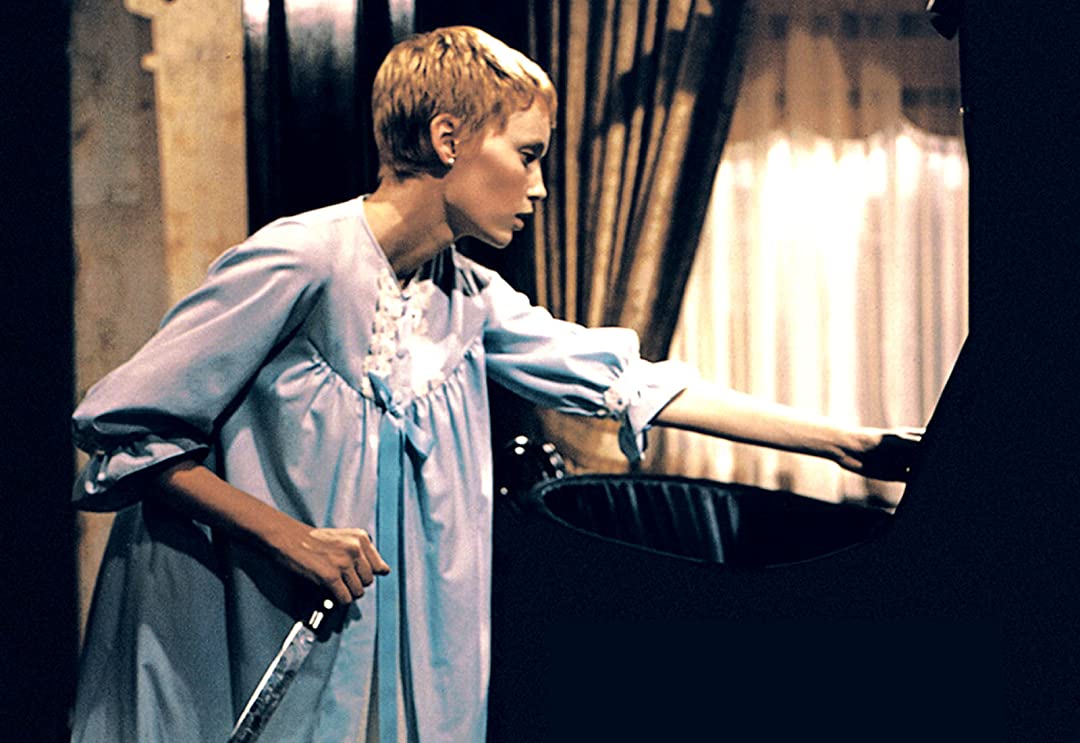
In my quest to discover the best films ever made, I came to learn that this 1968 satanic offering is considered the height of horror. Watching it, one can see why. Rosemary’s Baby tells the tale of husband Guy Woodhouse (Cassavetes), a down on his luck actor, moving in with his new wife Rosemary (Mia Farrow), who move in to the exclusive Branford building which has rather an unpleasant history of witchcraft and cannibalism, among other things. The couple hope to have a baby. And they shall have one too.
During her longed-for pregnancy (after dreaming that she’d been raped by something monstrous), oddities, miseries and weirdness accrue before Rosemary realises the Castevets lead a witches’ coven. She becomes convinced they want to sacrifice her baby to the Devil, and that her husband has agreed to help them in return for professional success. Empire
Allow me to confirm, as is mandatory, that the director of this film is not a terribly nice man, in my opinion and that of the Los Angeles County Superior Court. I should like to speak about this film and his direction separately from his atrocious acts if at all possible. Whatever we think about the director, and one is right in not thinking very much of him personally, this is a startling work. Filmed partly at the iconic and recognisable Dakota Building at 1 West 72nd Street, where John Lennon was shot, don’t you know, Rosemary’s Baby is a triumphant screen adaptation of the Ira Levin novel upon which its script is based. Interestingly, having now read the novel, the point must be made that prior to this novel, horror happened elsewhere, on Haunted Hill or in Hill House, for example. Rosemary’s Baby was the first instance of truly home-grown horror, which must have petrified audiences at the time.
Levin went even darker: What if he took the birth of Jesus and turned the whole tale upside down? What if God was not only dead but the devil lived? Vanity Fair
Polanski and producer William Castle succeed in keeping an air of mystery and deep unease throughout the film, the shocking truth is not revealed until the very last scene. In the interim, we are left feeling the increasing tension that Rosemary must have felt, unable to trust anyone in her environs, not even her husband. At all times something is afoot but Rosemary cannot quite put her finger on it. Her shyness and compliance is possibly a large contributing factor to her sorrows.
The film revolves around Farrow, who is in all but a very few shots. Polanski slyly exploits her mannered childishness. Even before she gets pregnant she wears shapeless little smocks and flat, little girl shoes. When she has her hair trendily cropped at Vidal Sassoon (one of the film’s ubiquitous, precise notations of a cultural signpost for the year of the story, 1965-66) she is even more pathetically waifish. […] Easily led, Rosemary repeats parrot-fashion other characters’ statements and allows herself to be utterly dominated. Empire
A personal highlight was Ruth Gordon playing the wife Castevet, with outrageous fashions, pronunciation and sinister undertones. It is no surprise she won an Oscar for this performance. This is a stellar horror and ranks very highly indeed.
Dyonysus, otherwise known as Bacchus, is the god of, wait for it: grape-harvest, winemaking and wine, of fertility, orchards and fruit, vegetation, insanity, ritual madness, religious ecstasy, festivity and theatre in ancient Greek religion and myth. The frenzy he induces is referred to as bakkheia. The Romans also referred to him as Liber, meaning free. Partaking in his wine and ecstatic dancing is said to free the reveller and in turn be possessed by Bacchus himself. Caravaggio’s work was commissioned by Cardinal Del Monte, owner of the Palazzo Madama in Rome. This palace is now the home of the Italian Senate. I walked past it frequently on my way to Gelateria Giolitti when living in Rome.
Why have I chosen Bacchus? Well in many ways I thought this enigmatic rendering of the god of wine (etc) was and is all of us during this third and ostensibly final lockdown. We are one and all indulging in excesses of our favourite vices (wine in the case of Bacchus), looking invitingly out into the infectious wilderness, waiting for someone to come and visit us. Our youth is fleeting and evaporated in a seemingly lost year, as exemplified by the rotting apple and overripe pomegranate, which Caravaggio here uses to hint at the theme of vanitas, which I talked about in the Boy with Bubble post a few weeks ago. The message is clear, youth is fleeting, wine is plentiful, why not give yourself away to excess and abandon while you can? I suspect that this will be a theme of the roaring 20s-esque resurgence of base hedonism which is to capture the world come July.
But what Caravaggio characterized was a body dedicated to sensuality rather than a soul infected with Christianity. The sly, dreamy eyes speculate on carnal things and promise gratification of the senses, not of the spirit, as “love cools without wine and fruit.” Yet the possibility of an underlying moral, bizarre as it may seem and contradicted by appearances, cannot be totally ignored. The touches of corruption in the still life – the wormhole that has spoiled the apple, the pomegranate that has burst from overripeness – hint again of the Vanitas theme, that the boy is triumphant only in his youth, which will vanish as quickly as the bubbles in the carafe of freshly poured wine. Caravaggio
The homoerotic themes are evident in Caravaggio’s Bacchus. Whether this was the maestro vocalising his own homosexual desires (bedding younger men was acceptable in 1596) or insinuating that Cardinal Del Monte was partial to them is up for academic debate. Either way the sensuality which comes through is striking. The feeble effort to make himself decent, the inviting gaze and proffering of the wine goblet are together masterfully rendered. I am always agog at how Caravaggio seems to present the finger nails of his subjects so successfully also, as an aside. The Carmen Miranda-esque headpiece is also fantastic.
“An explosion of fantasy, energy and playful eroticism”
Overall I think this is becoming one of my preferred paintings. I will see if I can have a fridge magnet made of it. It is the perfect subject for excess and abandon and I imagine Cardinal Del Monte was thrilled with it. Bacchus currently resides in the Uffizi art gallery in Florence.
12 Angry Men is mandatory viewing for legal people. This was the first film to show the legal process solely from the perspective of the jury. It pertains to a murder case, ostensibly open and shut. The jury are set to deliberate on the fate of the young man accused of murdering his father. Eleven of the twelve jurors are convinced of his guilt, it falls to the twelfth, Juror 8, to convince them there is room for reasonable doubt.
Martin Balsam … Juror 1
John Fiedler … Juror 2
Lee J. Cobb … Juror 3
E.G. Marshall … Juror 4
Jack Klugman … Juror 5
Edward Binns … Juror 6
Jack Warden … Juror 7
Henry Fonda … Juror 8
Joseph Sweeney … Juror 9
Ed Begley … Juror 10
George Voskovec … Juror 11
Robert Webber … Juror 12
I should think that director Sydney Lumet took inspiration from Rear Window, released three years prior, in deciding whether to go ahead with an insular single room set film, quite uncommon at the time. I don’t imagine the heroic Tommy Wiseau would have been born for some decades when this film was released in 1957. In concept, this is not the most exciting prospect. This is a drama set in one room about the deliberations of a jury. What makes it so special?
On paper this courtroom drama had little to get excited about – a one room setting, a dozen old-timers spouting off, a first-time director, a non-event. But on film, 12 Angry Men is transformed into a superlative brew of acting prowess and dynamite direction, and could stand as a screenwriting masterclass in the development of character and plot without resorting to the big stunts, grandiose locations or special effects. Empire
The tension begins with Fonda, the runaway star of this picture, putting his hand up to signify his not guilty plea. He is then predictably seized upon by the rest of the group, Cobb in particular (Juror 3), whose vocal dissent and energy are mesmerising to watch. His performance is the direct opposite of Fonda’s, who is the picture of calm, quietly but effectively dissecting each piece of evidence the other jurors took as read. Fonda’s character is an architect by trade but seems to have the nose of a detective. This is the only criticism that can be made of an otherwise flawless, consistent and engaging drama.
Cobb losing it at Fonda
The overarching theme for me seems to be male fragility under pressure. There is an added urgency to proceedings, as it were, by it being at once the hottest and seemingly wettest day of the year. The jurors are incrementally sweating and more uncomfortable throughout the film as a result of the storm happening outside the window. There is no relief inside the juror’s room aside from one wall mounted fan which is discovered rather late in the film. Lumet demonstrates his genius once again by including this. The added element lends itself to increasingly hostile jurors, some of whom simply wilt under the pressure of the heat and cave to Fonda’s arguments.
Overall, it should be noted that there are no special effect, no novel camera work and no changes of room (aside from one bathroom break) in this film. Yet it remains a watershed moment in cinematic history on account of its compelling characters and robust, flawless script. This is rightly one of the greatest films ever made and a personal favourite of mine.
Nick, neé Saint, tasked me with presenting five of my favourite album covers. Now I listen to a lot of music and see a lot of album covers hence this was a uniquely difficult challenge but I have narrowed it down to 5 favourites (of many). This is a sample range and not necessarily indicative. I have many more to share, which I may do in further posts, but my client instructed me to provide you with 5 and you shall be provided 5. In no particular order then:
The Stranglers – Rattus Norvegicus
I saw a rat on my way home this evening after considering the task Nick had set me and decided it was a sign. Why do I like this? It encapsulates the Stranglers for me. They are in a gloomy country house which is badly lit. Dave Greenfield and Jean Jaques Burnell are at the forefront with Jet Black and lead singer Hugh Cornwell in the background almost. There are four horrifying stuffed animals around the archway which give an added eery feel to the cover. This was what the Stranglers were about, shocking excellence. A much needed and powerful serum at a time when Abba’s Greatest Hits were at the top of the charts.
Peter Gabriel – Plays Live
I bought the vinyl of this album when I was in Newcastle in the Before Time. I bought it on a whim and at my father’s direction. I showed him the cover and said ‘this is pretty cool’, to which he responded ‘this is one of the best live albums ever’. He was correct of course. In and above being a spectacular, colourful, angular and precise cover, with the perfect font, the album is staggering. San Jacinto in particular sticks to mind. What stellar makeup!
ELO – Out of the Blue
Birmingham’s best band, of three, ELO set the bar high for album covers. Frequently space themed and invariably explosions of colour, they rank highly in the spectrum of cover art. I chose Out of the Blue partly because it is my favourite ELO album, with Live at Wembley a close second, but also because this is the first I heard on vinyl. I still have my tattered copy here and listen to it frequently. This is a dazzling, finely conceived, beautiful piece of art, in and above everything else.
Kraftwerk – Tour De France
This was and continues to be one of my favourite albums for revision or knuckling down and getting some work done. Recently I have using Electric Cafe/ Techno Pop as my album of focus but this remains the best album cover of this monumental band for me. The colourful, precise nature of this cover makes it so striking. The brilliant decision of using the colours of the French flag, supporting the Tour de France concept, with the four members of Kraftwerk cycling through the white band blows my mind. Much like the track in the album, the cover is aerodynamic.
Grace Jones – Island Life
Finally, it would be remiss of me not to mention Jean Paul Goude’s photographic masterpiece cover of Grace Jones’ Island Life. This was the last record of hers released on the Island label and is a compilation of her tracks from her albums Portfolio, Muse, Fame, Warm Leatherette, Living My Life, Nightclubbing and Slave to the Rhythm. This cover is iconic for many reasons, the simplicity of the background, the tiny mike, the shocking red garment and of course the striking impossible pose. Having invested in a number of Goude’s books, I happen to know how Goude made this photograph possible but won’t spoil it for you. I will say that that is not Grace’s bottom… Overall, a stunning gob smacking iconic and unforgettable cover.
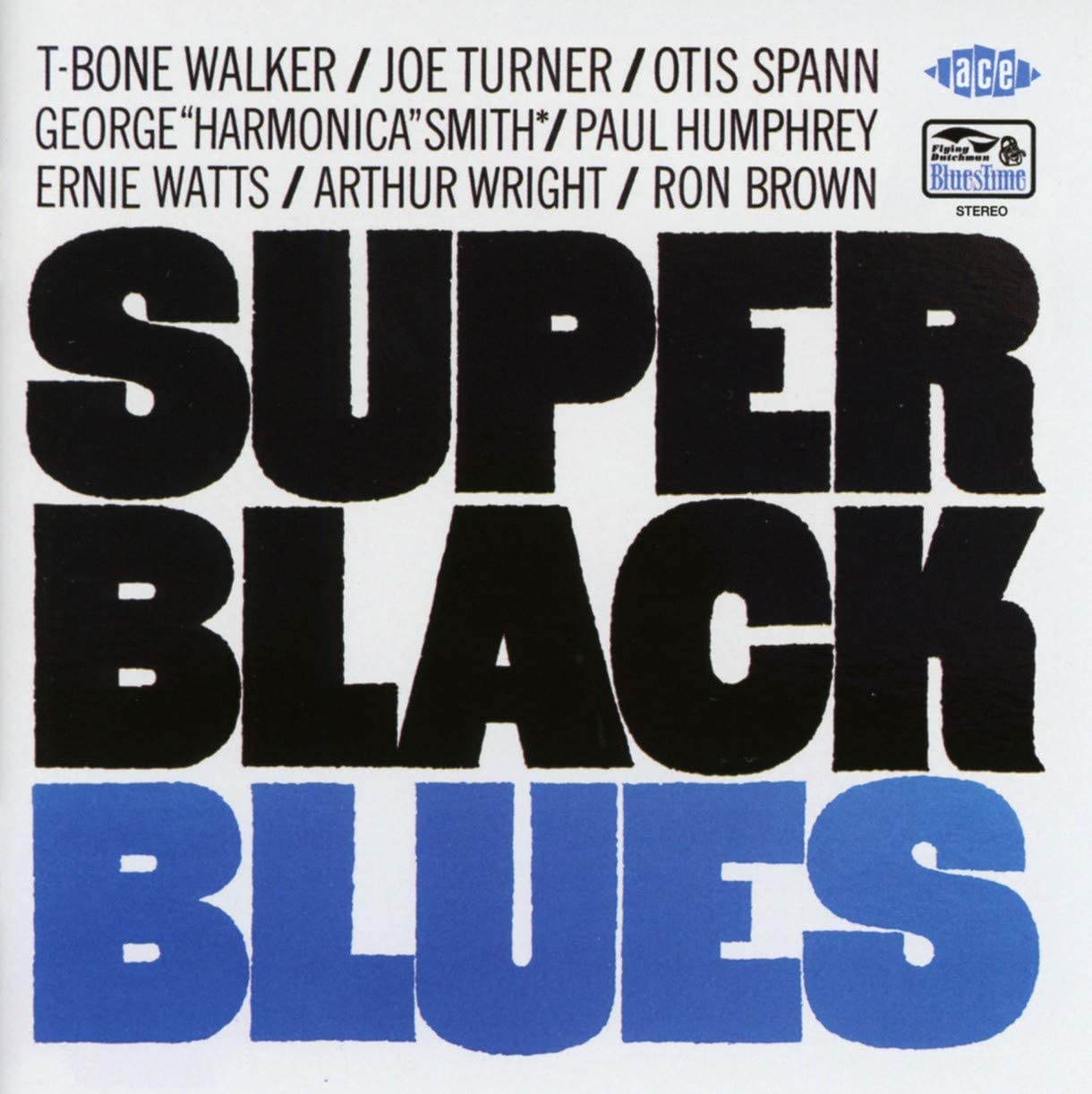
Flying Dutchman records was my musical find of the month. I have a huge amount of gratitude for Bob Thiele, the head of the label, who is responsible for the release of albums such as T Bone Walker’s Every Day I Have the Blues, Otis Spann’s Sweet Giant of the Blues, Gil Scott-Heron’s iconic Pieces of Man (originally released on RCA then later by Flying Dutchman) and, of course, this month’s plat du jour, Super Black Blues. Super Black Blues features stellar performances by Blues pionners T-Bone Walker, Joe Turner and Otis Spann, each of whom I love independently. You can imagine what a joy it was for me to discover they had released an album together. Though only four tracks long, this album packs a punch and left a permanent mark.
Paris Blues 14:00
Here Am I Broken Hearted 3:45
Jot’s Blues 8:11
Blues Jam 10:56
The album opens with a 14 minute blues feast about the city near where I grew up, Paris. T-Bone opens with some solid sober vocals, backed by the fabulous piano playing of Otis Spann (listen to Sellin’ My Thing for him at his best). There is a notable confidence with the instrumentality throughout this album but especially clear here. There is an exceptional pace throughout which makes this long track seem shorter. Listen for example between the 5.40 mark to the 6.00 minute mark. The guitar and drums here are just breathtaking. This is evidently perfection in the arrangement of the track as a whole. Listen also at the 10.30 mark, where George Smith’s harmonica skills intertwined with the piano are just so beautiful to hear.
T-Bone Walker − vocals, guitar
Joe Turner − vocals
Otis Spann − vocals, piano
Ernie Watts − tenor saxophone
George “Harmonica” Smith − harmonica
Arthur Wright − guitar
Ron Brown − bass
Paul Humphrey – drums
Here Am I Broken Hearted is a relief in that it is under four minutes. This is a more traditional blues piece with subject matter fitting of the genre. The introduction of Ernie Watts on the saxophone at the beginning of this track is not inconsequential. The slower pace of this song does not make it any less impressive. Here you have a group of extremely talented musicians celebrating their craft and doing so remarkably. Listen to Ron Brown on bass here, his playing is superlative.
Jot’s Blues opens with some playful, lulling guitar work which pulls the listener straight into the trap of excellent bass and piano. Otis’ vocals are buttery smooth and piercing here. He is almost wailing throughout, stretching out the notes to intone his grief at his estranged spouse. The music picks up beautifully at 2.50, just listen to that piano and how the bass and drums are giving it space to flourish. There is an unspoken symbiosis of excellence here which I have seldom heard in blues albums. Near the 5.00 minute mark, Joe Turner comes in and sings beautifully in a manner reminiscent of Fats Waller’s That Ain’t Right. The recurring motif established by the drums and saxophone provide a beautiful support for the closing section of the track. This closing section has alternating vocals and is supported by a superb recurring motif on piano, with flourishes towards the end which prove exceedingly effective.
Blues Jam is, as it states on the proverbial tin, a lengthy jam session. The musicians here really come into their own and leave us with a splendid parting shot. The track opens with some stellar guitar, piano and bass. I mentioned the harmonica playing of Mr Smith earlier, it comes back with a vengeance here.
I woke up in the morning with the blues all around my bed
I didn’t have nobody to hold my aching head
The pacing and saxophone/ piano combination from 4.20 to 5.05 is a real toe tapping experience. This is blues jamming at its finest. Watch the picking up from 6.30. One can’t help but get up and dance. The quality of this music is unquestionable. I hark on about symbiosis and musicianship but it is truly stellar here. Jut listen to how it ends from 9.45 to 10.57. The floury and energy of it!
“Goodnight y’all,
Lovely party”
Overall, this album took me completely by surprise. Nick (neé Saint) had sent it to me some months prior but I did not remember or realise the significance of this album. It is only now that I have discovered it again by myself (with suitable scolding from Nick) that I realised how good this was. The breathtaking talent of Walker, Turner and Spann is visible and on spectacular form. The backing musicians and singularly talented and selected for their exceptional skill. This album is a sensational and strongly worded love letter to Black musicianship. It is overflowing with extraordinary talent which oozes out of every note.