Blue Öyster Cult (yes that is spelled correctly), otherwise abbreviated to BÖC, are an American hard rock band. Secret Treaties is their third studio album and was released in 1974. Interestingly, Patti Smith of all people was involved in the lyricism of this album. She was dating Allen Lanier at the time and almost joined the band herself. I am glad she did not or we may never have had Horses and Waves, both stellar albums by Ms Smith. Secret Treaties is comprised of 8 stellar golden tracks which, as the Vinyl District describes: “puts Blue Öyster Cult’s strengths to the forefront–their surprising deft touch and penchant for melody, their decidedly off-kilter sense of humor, and the virtuoso skills of both Dharma and Lanier”.
[T]he roots of the group date back to 1967 to a psychedelic group called Soft White Underbelly, which featured Albert Bouchard (drums), Allen Lanier (keyboards, guitar), Donald “Buck Dharma” Roeser (guitar), Andy Winters (bass), and Les Braunstein (vocals, AKA Les Vegas) and operated under the guidance of manager/producer Sandy Pearlman. Braunstein departed in 1969 and was replaced by Eric Bloom. The band changed their name to The Stalk-Forrest group shortly after. Later, Winters was fired and replaced by Albert’s younger brother, Joe. The band released their debut album in 1972.
All the members contributed to the songwriting but lyrics were often provided by people outside of the group, including Sandy Pearlman, rock scribe Richard Meltzer, poets Patti Smith (Lanier’s longtime companion) and Jim Carroll, and science fiction author Michael Moorcock, amongst others. Eric Bloom served as the band’s primary lead vocalist, but Donald Roeser sang what are arguably the band’s most famous songs, including “(Don’t Fear) The Reaper”, “Godzilla”, and “Burnin’ For You”. The Bouchard brothers also contributed lead vocals. Discogs
Career of Evil is considered the weakest track on the album, which is just as well as it is the first we hear and get out of the way. I thought the central repetitive riff was very nice indeed and the solo was unexpected and hit me across the face. The piano and drums, which are a common thread throughout the album, combine and play off of one another beautifully. One of the greatest parts of this album is the production value and excellent seamless transitions between tracks. This also highlights the deftness of the overall sequencing within the album, which thoroughly impressed me.
Dominance and Submission transitions seamlessly from Subhuman and provides us with a superb riff. The bridge before the final solo is excellent rock and roll. The solo itself is staggering.
But the most hilarious fact about the lyrics is that Blue Öyster Cult HAD HELP. No, not NEED HELP, you got it right the first time. And if that don’t take all, it was the fair hands of Patti Smith, “Crawdaddy” scribe Richard Meltzer and BÖC producer Sandy “Give The Clash Enough Mott” Pearlman what took part in collaborating with the Öyster boys on ‘em. In fact, there’s not a single song absent from one of the above-mentioned outsider’s input, and I suspect not only because Patti and Cult keyboardist/guitarist Alan Lanier were romantically linked at the time, but it also secretly afforded all parties involved the freedom to take even bigger chances than normal, figgering if it all blew up in everybody’s faces and it all waxed foolish for some reason there’d always be somebody else to finger for its failure. Head Heritage (Mr Julian Cope’s fabulous blog)
Let’s talk about the lyricism of ME 262, to which Copey alludes above.
Goering’s on the phone to Freiburg Say’s Willie’s done quite a job Hitler’s on the phone from Berlin Say’s I’m gonna make you a star
I found myself replaying these several times and muttering “what the…?”. The track title refers to the Messerschmitt Me 262 airplane, which can be seen on the cover of the album. The energy throughout this track is top shelf. Using the sounds of bomb dropping, goose stepping and war sirens is so wonderful. Thus endeth side 1.
Side 2 opens with Cagey Cretins. This track includes a wonderful segment of keyboard reminiscent of Dave Greenfield’s electrifying play style in the Stranglers. The lyricism, guitar mastery, flow and energy of this track is reflective of the symbiotic drive seen throughout the album as a whole.
Harvester of Eyes follows from the shocking transition of the former track, and provides eery vocals, guitar work and some stellar solos. The end of the track’s bridge and slowing pace followed by a music box (?!) – totally unexpected.
The final two tracks steal the show once again. The opening aggressive piano of Flaming Telepaths, above, marks the aggression of the overall track, which is carried on throughout.
I’m after rebellion // I’ll settle for lies // Is it any wonder // My mind is on fire?
Finally, Astronomy exemplifies the high level of BÖC’s musicianship. The track is in striking in how different the tone is from the other tracks in the album. It takes its time and languishes with us. In the end, the album culminates in a staggeringly energetic final floury and closes.
Overall, my three takeaways from this album are as follows:
This is a triumph of sequencing, every track is where it should be and flows together seamlessly
There is an amazing and consistent drive and energy throughout the album
BÖC exhibit a high level of competency and confidence throughout. It is clear they cannot believe they have been given the opportunity to make such music and are going to have maximum fun with them.
What you did was impulsive, capricious and melodramatic, but it was also wrong – Catherine O’Hara as Moira Rose
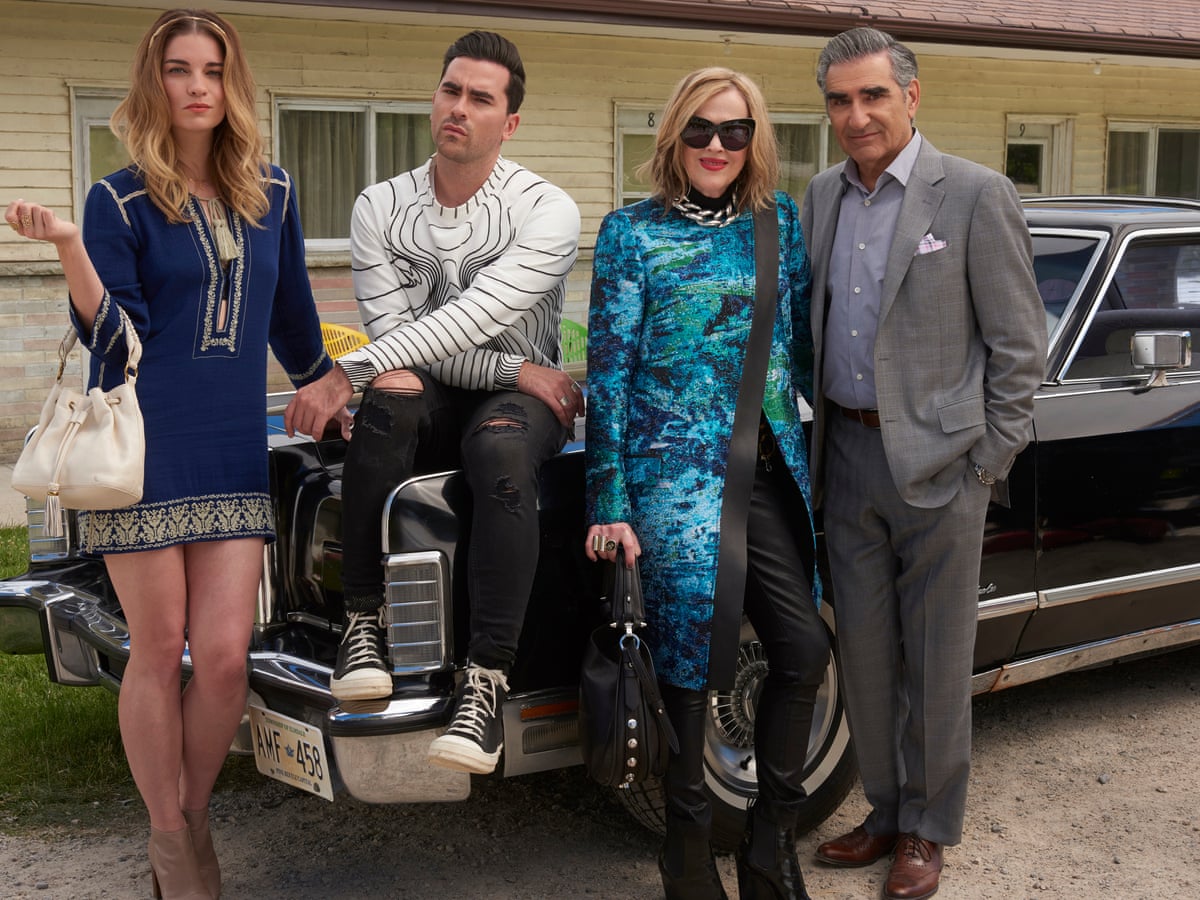
From Season 1 to Season 6, I find it difficult to encapsulate in words the immense love I have for this show. Comedy legends Dan and Eugene Levy have gifted the world with a golden collection of hilarious, heartfelt and lasting laughs. For the sake of brevity I shall only address the sixth season of the show in this post, and keep it as brief as possible to avoid spoilers. It goes without saying that Season 6 builds on the various happenings of Season 5 so there will be spoilers ahead. This post will be published some weeks after the extraordinary performance of Season 6 at the Emmy Awards. Eugene Levy and Catherine O’Hara won outstanding lead actor and actress in a comedy series, Daniel Levy and Annie Murphy won outstanding supporting actor and actress in a comedy series, and the show itself took home the award for best comedy series, and quite rightly too.
The general premise of he show is that a rich Jewish family lose their riches when one of their business partners screws them over. The federal government seized all of their assets aside from one small town called Schitt’s Creek. The family then moved to the town’s Motel where they remained until their fortunes improved. Season 6 of Schitt’s Creek picks up where Season 5 ended, on a dazzling finale showing the cast doing a performance of my favourite musical Cabaret (and doing it splendidly at that) and the announcement of David Rose’s engagement to his boyfriend Patrick. Season 6 follows the story of the wedding planning and the wedding itself, as well as Moira’s resurgence to television fame, the downfall of Alexis and Ted’s relationship and the expansion of the Rosebud Motel empire.
Without speaking at length about each episode, I shall give you a few of my season highlights. the first episode sees David, Stevie, Alexis and Patrick looking for wedding venues. They find the perfect venue, only to find out gleefully that the first Sunday of every month is heavily discounted. There is an opening coming up for the coming Sunday and David is on the cusp of accepting when the group hears the screaming wails of pigs being slaughtered on a neighbouring farm. The noise and stench prove too much for the gang who continue on their search for a suitable venue.
Another highlight for me was Episode 7, Moira Rosé, where Moira returns to Herb Ertlinger’s winery to have a specialist wine named after her, following the success of her recent film venture, The Crows Have Eyes 3: The Crowening. Mr Ertlinger appears first in Season 1 with an equally disastrous visit as the one in Season 6. A clip from the Season 1 episode, Wine and Roses, is featured below. The Season 6 episode is for me demonstrative of the reasons I love Schitt’s Creek. It is first and foremost a comedy. The writing is stellar, the story arc is beautifully executed but the crux of the show is to show simply and without prejudices an alternative way of life. This is keenly demonstrated by the touching scene where Johnny Rose and Patrick have a heart to heart while watching football on the television, something Johnny is clearly not well versed in. The scene conveys perfectly that Johnny loves his son enough to put himself in an uncomfortable position speaking to his soon to be son-in-law, and that Patrick loves David enough to poke fun at Johnny by partially ignoring him in favour of the game. Patrick knows that Johnny is too polite to interject hence Patrick can confront the inevitable talk on his own terms, which he does. In the end the two have a frank and almost tear inducing conversation which ends with the mutual understanding that both just want David’s happiness. All of this is done without an iota of preaching or suggesting the viewer should feel one way or the other, it just is. And that is the most beautiful thing about Schitt’s Creek.
Seeing Henry Czerny in Episode 7 as Alexis’ new lover and Johnny Roses’ stern talk with him was also a big highlight for me. Both he and Eugene Levy are actors I have a huge respect for and their performance is dazzling.
My final highlight of this dazzling Season is of course the final episode. Catherine O’Hara, when asked about her favourite episodes, said the first one (Season 1 episode 1) and the last one (Season 6 Episode 14). I can concur though I would highlight Season 1 episode 2 as one of the strongest in the show overall. This episode has everything, it has romance, comedy, plot finalising and a suitable cliffhanger making the viewer wonder about the future of the splendid characters in the series. It also has the most iconic Moira Rose outfit of the whole show but I will not spoil this for you.
Sadly the show ends its six year run here, just as it has garnered global recognition and suitable reward at Emmy level. In a way it is better for it to end now. It has fostered a love within its fan base which has been incrementally built up over the last six years hence its appreciation has solid grounding. It is poetic in a way for the show to end now at the peak of its fame. Please watch all the seasons if you have time. I am firmly of the belief that the sixth season is the best one. See below a highlights reel of the first five.
M and I are horror aficionados, and were pleasantly surprised with this 2019 offering. My first instinct when I have enjoyed a film is to check Empire for their invariably scathing review. This film did not fare well with the discerning male critics, and I do share some of their criticisms, but overall I thought this was a well wrought, impressively produced and tantalising piece of horror. The premise is this: six ostensibly random people meet and try to solve a series of escape rooms to obtain a prize of £10,000. It soon becomes apparent that they are in fact trying to survive.
After a flash-forward to a character in deep doo-doo, the set-up is a little mechanical, introducing us one by one to the (thinly drawn) key players as they are invited to the game via a little black box bearing the old Cannon films logo. So we meet shy but genius maths (physics, as it happens) student Zoey (Taylor Russell), cynical millennial Ben (Logan Miller), dedicated escape roomer Danny (Nik Dodani), scarred Iraq War vet Amanda (Deborah Ann Woll), blue-collar trucker Mike (Tyler Labine) and smarmy financial whizz Jason (Jay Ellis). Empire
I’m afraid that the character depth in this film does not go much deeper than the above block quote. However, what the characters lack in dimension and depth is more than made up for in set design. Without spoiling each wondrous room for you, I shall concentrate my praise on one room only. This was the enormous bar room with an oversized jukebox playing a distorted version of Petula Clark’s ‘Downtown’ on repeat. This bar was not as it seemed however, it was upside down! The escapees had to climb their way through the room and solve the riddle as the floor/ ceiling was falling away beneath them. This made for jaw dropping graphics but also thrilling watching.
I do not necessarily agree with Empire that the lack of character dimension sufficiently hampered the film so as to lower it to a 2* rating. This is to be expected of this type of horror. With the possible exception of the first Saw movie (horror icon James Wan’s co-directorial debut, please note), the character development and backstory are always secondary to the elaborate torture scenarios devised for them. Overall this was a fast paced, visually staggering offering to the altar of horror and I would be remiss not to recommend it to you. It is streaming on Netflix at the time of writing.
Manet (23 January 1832 – 30 April 1883) was a French Modernist painter often referred to as the father of modernism. He was a crucial figure in the change from Realism to Impressionism and was close friends with other pivotal figures of the time such as Renoir, Monet and Degas, meeting the latter as early as 1859, when the pair would be found together copying paintings in the Louvre as practice. Publicly, Manet was a divisive figure. He was rejected year after year by the Paris Salons, a professional art society which was seen as the quickest way for artists to obtain recognition. The Paris Salon first gave Manet recognition for The Spanish Singer (below) in 1861 but then steadily rejected his submissions. This was perhaps compounded by Manet’s scandalous 1863 painting Déjeuner sur l’herbe, which depicted a nude woman enjoying breakfast with two fully clothed men while a second is returning from a bath in a nearby stream, also not wearing very much. This and Olympia, a painting depicting a prostitute waiting for her client, nude, also caused considerable controversy. Together, these two paintings are seen as a watershed moment which marked the beginning of modern art.
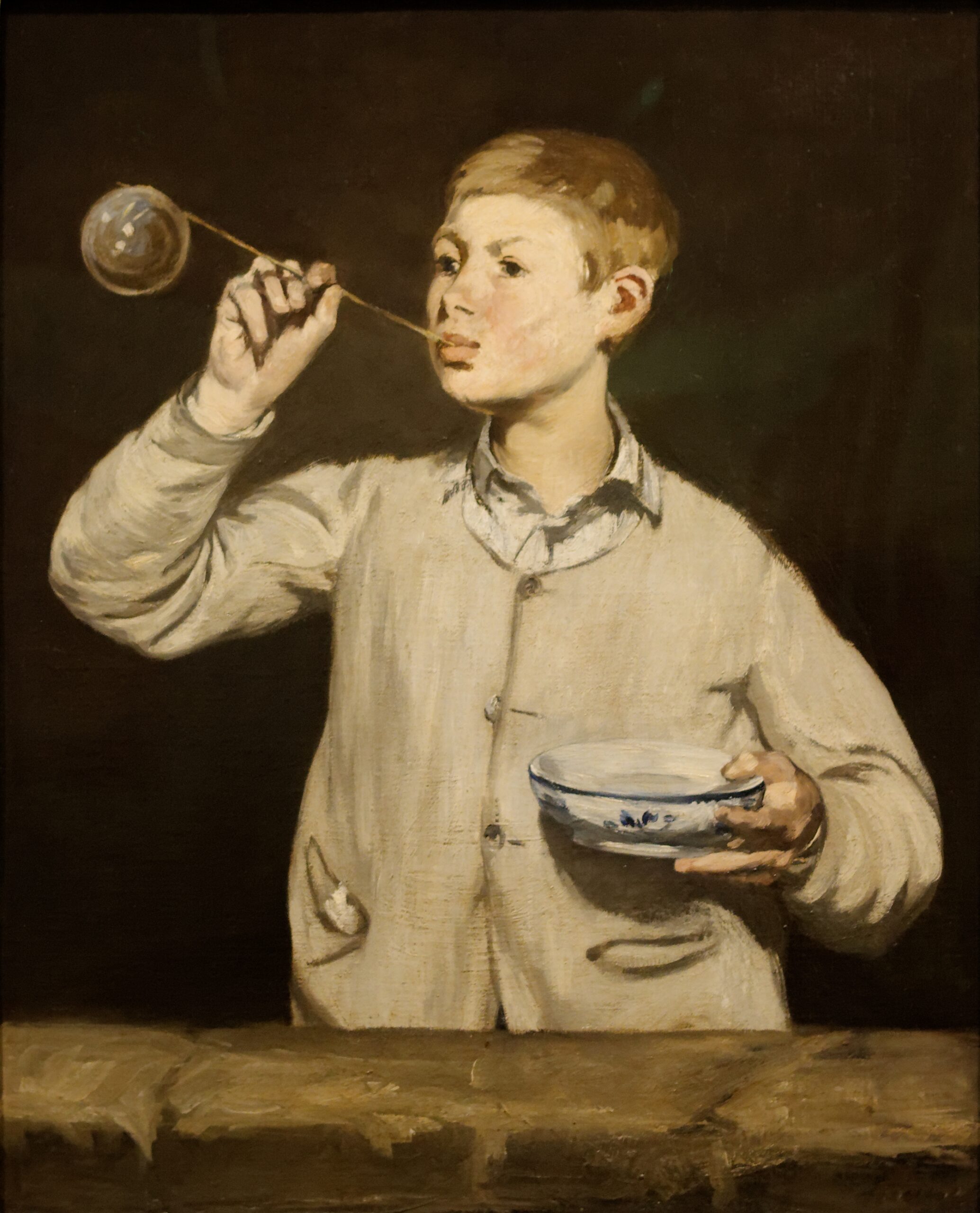
By 1867, when his submissions were rejected both by the Paris Salon and the Exposition Universelle, Manet constructed a pavilion opposite the street of the latter in Paris, where his pictures were displayed for all to see. This was the same year Boy Blowing Bubbles was created.
Édouard Manet—the eldest son of an official in the French Ministry of Justice—had early hopes of becoming a naval officer. After twice failing the training school’s entrance exam, the teenager instead went to Paris to pursue a career in the arts. There he studied with Thomas Couture and diligently copied works at the Musée du Louvre. Met Museum
Boy Blowing Bubbles was painted in 1867. It’s subject matter is 15 year old Léon Koelin-Leenhoff, the illegitimate son of Manet’s future wife, Dutch pianist Suzanne Leenhoff. The boy may have been fathered by Manet himself, but this is the subject matter for an entirely new post. I love this painting. The nearly monochrome palette and dark background are almost a love letter to the Masters which preceded Manet, such as Murillo, Frans Hals and even Rembrandt, more on the latter below. I enjoy the free and direct style of this piece. The central subject is clearly defined, the contrast between the dark background and his light clothing propel him forward in a delightful way. This painting is consistent with Manet’s Realist desire to paint modern life.
The clothing is modern, by the standards of the time, and Léon is blowing a bubble of soap, a sign of brevity of life. This seemingly strange comparison is symptomatic of the Homo Bulla Est concept (man is bubble). This concept holds that while a person (homo) may look very solid and substantial, their life is as fleeting as a bubble (bulla), insubstantial, and completely fragile (History of Bubbles). These bubbles are most commonly seen in Vanitas paintings, loosely translated from Latin as the meaninglessness of earthly life and the transient nature of vanity. A great example of this for me is the 1663 painting by Karel Dujardin, Boy Blowing Soap Bubbles, below. This is so wonderfully camp that I think I will have a fridge magnet made out of it. The child is standing on a bubble on a shell, doubly reinforcing the transience of his life. The surrealist element of the shell surfing is meant to remind us of the transience of happiness and the brevity of human life. The fabric, reflective bubbles, clouds, waves, and the depth of the perspective make this a winning painting for me. This is perhaps a silly painting but it is undeniably fun and depicted beautifully.
… the artist’s first champion, Émile Zola, had published a lengthy and glowing article about Manet. “The future is his,” Zola proclaimed. He insisted that the much-maligned Déjeuner sur l’herbe (which was included in Manet’s 1867 exhibition) would one day hang in the Louvre. Zola proved prophetic; it took almost seventy years, but the painting entered the collection of the Louvre (now Musée d’Orsay) in 1934. Met Museum
Finally, I would like to highlight one final bubble painting which I have stumbled upon during my research for this post. Cupid Blowing Soap Bubbles by Rembrandt, painted in 1634, serves as an early example of the Hommo Bulla Est concept. Cupid was the son of Mercury and, in Greek mythology, represents love in all its varieties. The bubble we have already covered. Therefore putting these together, this ostensibly cheery portrait is actually somewhat pessimistic about the longevity of love. I adore the depiction of the wings and the bubble itself. I also cannot help but notice that Cupid looks a little bit like Rembrandt himself!
I hope these three or four paintings have brought a small amount of joy into your day. Thank you for sticking with me through this soapy post!
“quod, ut dicitur, si est homo bulla, eo magis senex”
Kraftwerk is a German band formed in Düsseldorf in 1970 by Ralf Hütter and Florian Schneider, who both produced Techno Pop with Karl Bartos in 1986. Techno Pop was Kraftwerk’s 9th studio album. Originally released as Electric Cafe, Techno Pop is the original working title of this album, re-released in 2009. Techno Pop was my album of November and December 2020 but required its own separate post to highlight just how enjoyable it is. This is the album which has seen me at my most productive. My usual revision album would be Tour De France by Kraftwerk while I was in school, however, this has now been superseded and with good reason. The only difference in the 2009 re-issue is that there is an additional track, House Phone, previously released as the B-Side of “The Telephone Call” or “Der Telefon-Anruf” 12-inch single in 1987.
This was the first album Kraftwerk released in the three years since Tour De France. The possible reason for this is below. Listening to this now without the pressure of the years of waiting Most of the album was recorded using the same instrument as Tour De France, an Emu-Emulator, which is a digital sampling synthesizers using floppy disk storage, if you can believe it. This is pictured below. As you’ll be aware I am a big fan of synth of all descriptions so this was a great discovery. From the opening notes of the first track, above, you can see this wonderful instrument at work.
When Electric Cafe was reissued on CD in 2004 with the name Techno Pop it put an end to such speculations and confirmed the sorry truth: Techno Pop had been recorded and slated for release in 1983, but a crisis of confidence – as well as a serious cycling injury sustained by Ralf Hütter – had seen its release postponed. After the album had been mixed in New York none of the band was happy with it, and the decision was taken to scrap it and start again. The change of name to Electric Cafe was presumably born of embarrassment that even as fastidious a group as Kraftwerk had taken the best part of five years to produce 35 minutes of music. And not very good music at that. Or so went the critical judgement of the time as far as the last point is concerned. Drowned In Sound
The first three tracks on this album are variations on the same theme, described as a masterpiece of “monomaniacal rhythmical development” by Drowned In Sound. Transitions between tracks are sublime and barely noticeable. The final part of the second track is a superb low end synth line which moves beneath synthesised marimba and xylophone patterns quite deftly. The band continue with the intensity of the end of track 2 into Musique Non Stop. This was a sparse rhythm track which is impressive seen alone but uniquely so seen as part of the album as a whole.
The final four tracks always fly by for me. House Phone was added to the re-release for reasons I am not fully clear on. The Telephone Call is a wonderful track and is the only Kraftwerk song which features Bartos as lead vocalist. This track on the Kraftwerk live album Minimum Maximum is one of my favourites on that album. Sex Object is a bit more divisive and certainly not what one would expect given the previous Kraftwerk Catalogue.
If techno, according to Derrick May’s famous definition, was the sound of Kraftwerk and George Clinton trapped in an elevator with nothing but a sequencer to occupy them, then ‘Sex Object’ is what happened when Clinton got swapped out for Mark King. Drowned In Sound
Ending with Electric Cafe, a sort of Franco Germanic techno meld, the album always leaves me feeling satisfied. It is balanced, has some wicked and novel synth work, and is a remarkably fully realised vision. It spurns me on and has been at my side through some of my best work. I cannot recommend it highly enough.
Rest in peace Florian Schneider-Esleben (7 April 1947 – 21 April 2020), immortal of pop.
I am often skeptical when Pater suggests films to me but my spidey senses were tingling with this title. Once again they did not let me down. All credit to Pater on this one, mind. An excellent find. Ready or Not tells the odd story of Grace, an orphan who marries into the wealthy Le Domas family. On her wedding night to Alex, she is made to play a game, as is family tradition, without realising the horror that was to come.
Samara Weaving … Grace
Adam Brody … Daniel
Mark O’Brien … Alex
Henry Czerny … Tony
Andie MacDowell … Becky
Nicky Guadagni … Aunt Helene
Prepare yourself for 90 minutes of brilliantly realised thrilling horror. Ready or Not was filmed at various locations around Toronto, including Casa Loma, Sunnybrook Park and the Claireville Conservation Area, as well as the Parkwood Estate in Oshawa, Ontario. Somehow they managed to complete filming in 26 days, which does not at all show in the quality of the finished product.
The set-up is delicious in its absurdity. Grace (Weaving), an orphan brought up in foster homes, is marrying Alex (O’Brien) and into the wealthy Le Domas family, whose fortune has been made in board games. On her wedding night she has to take part in a bizarre ritual: every time someone new joins the family, they partake in a midnight game mechanically selected from a scary antique box. If not thrilled by the prospect, Grace plays along when the card selected is ‘hide and seek’. What she doesn’t realise is that she is now the prey for the rest of the family to hunt and kill by sunrise or they will all perish. Empire
Stellar acting on the part of Weaving, Czerny and MacDowell, together with Jutkiewicz’s restless camera and Tyler’s wonderful score drive the film forward without impacting the gothic soul of the film. I had all but written off Weaving after seeing The Babysitter and Killer Queen but she was on spectacular form here. Running from a cabal of related maniacs in a ruined wedding dress escaping her attackers was a constant thrill. Ready or Not even destroyed the getaway car trope in horror films. I shall leave you to find out what I mean by this while watching the film.
Within the mêlée, Gillett and Bettinelli-Olpin allow just enough time to sketch the personalities and dynamics of the crazy clan: frenzied patriarch (Czerny), a stern matriarch (MacDowell), a good-hearted son (Brody), a poisonous aunt (Nicky Guadagni), an ineffectual brother (Kristian Bruun) and a hilarious coked-up sister (Melanie Scrofano) Empire
Overall, this is an excellent high paced horror thriller with some top class acting and a plot to die for.