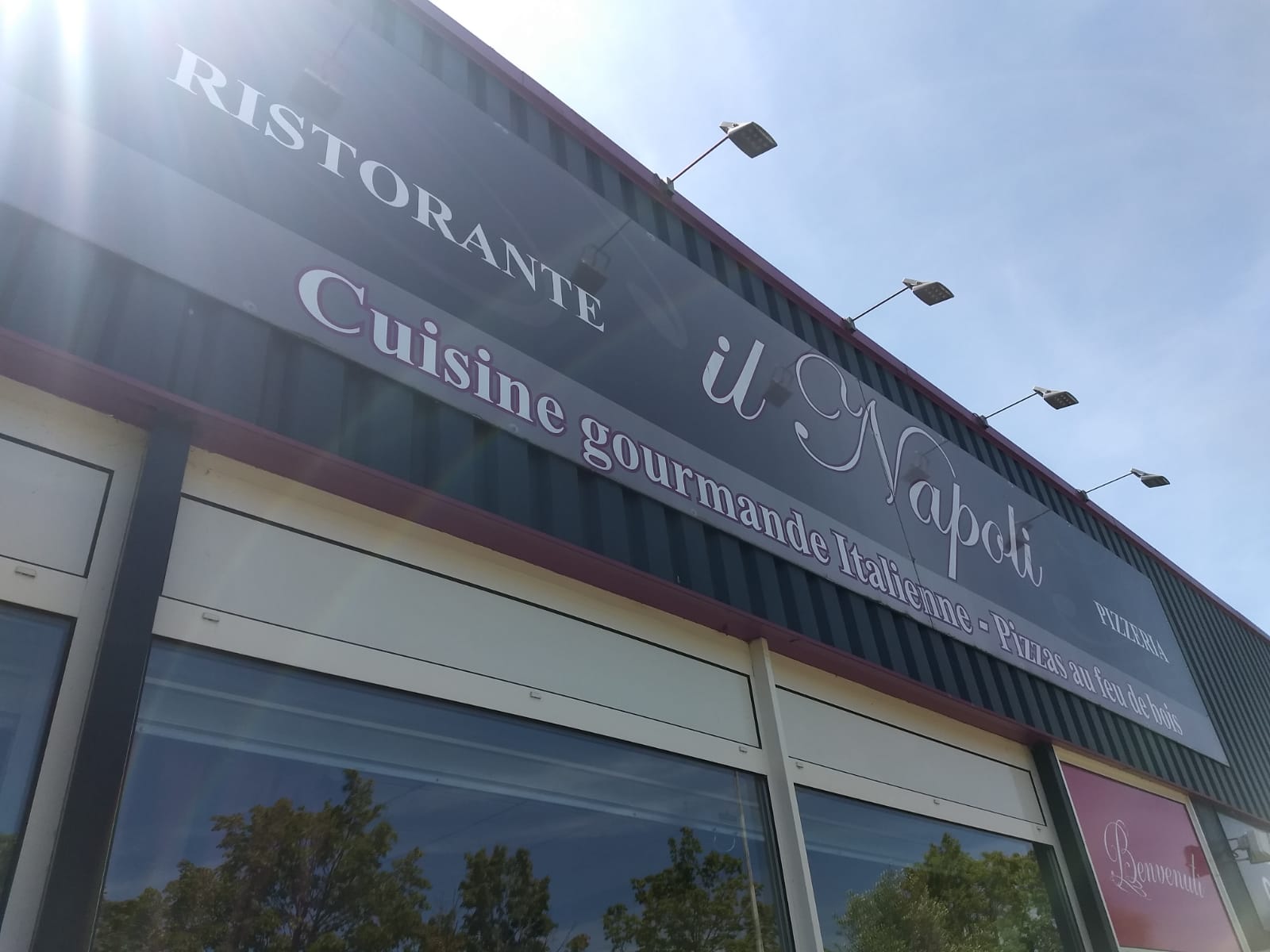
Tucked away in a suburb of Tours, Il Napoli proved to be an exceptional culinary experience. This is not someone would expect from a pre-fab building in the middle of an industrious suburb of a lesser known French town. But coming to Il Napoli with all the necessary reservations (pardon the pun) will ensure the greatest experience. You will not predict the feast you are about to ingest.
After a necessary gulp of artisanal cider, Mother ordered the Four Cheese, as is her wont. This included mozzarella, gorgonzola, farmer’s goat’s cheese and what I believe was grated pecorino. All together the semi acrid flavour of the four cheese exploded. The Four Cheese pizza is hard to do well because the four cheeses need to go well together. I found the balance here to be particularly pleasant.
I decided I had to taste the Suprema. This was topped with cream, wild mushrooms, mozzarella, Talegio cheese and raw onions. This was a little more bland than I expected, mostly on account of how sparing they were with the lardons. This is not Cedric’s home made pizza, sadly. But overall it was excellent and the crust cannot be lauded enough. More on this point later.
DEL MAR
Salade, tomates, saumon fumé, billes de mozzarella di bufala, câpres à queues, tomates confites, vinaigrette huile d’olive et balsamique.
One should mention father’s salad Del Mar which was a little light on the salad part, as you may be able to see. The toppings were legion and all quite delicious. I stayed away from the fish, as you can imagine, however I can confirm the buffala mozzarella was absolutely superb.
TARTUFATA
Crème, Gorgonzola, mozzarella fraiche, compotée d’oignons, magret de canard fumé, roquette, pignons de pins torréfiés, huile de truffes noires.
Goodness me, where to begin; mozzarella, gorgonzola, caramelised onions, pine nuts, magret of duck, roquette and black truffle oil. Magret refers to the breasts of ducks that have been corn-fed and raised to produce foie gras. The whole thing was so sublime that I shed a tear. I could not believe the intensity and novel flavour of this pizza. Put together with the outstanding thin, crispy base, this was a dish to die for.
The tiramisu was extraordinary. It was light and not terribly filling which is how such a dish should taste. The coffee was not overpowering either which came as a great relief.
The show stopping dessert for me was the pear and ice cream mille feuille seen above. The ice cream was fresh and presumably home made, the pear was seasonal and local and the pastry was divine. The pastry was light and full of flavour which only French restaurants of great repute seem to be able to achieve.
Overall, this hidden treasure was very much to our liking. I was astounded by the consistency of the excellent quality food and great, if not a tad slow, hospitality. I’d recommend this to anyone in the area ho wishes to get away from busy Tours centre and enjoy some fresh local cuisine.
1985 was a great year for music. One saw the likes of Rush’s Power Windows, Saint Kate Bush’s Hounds of Love (work of genius), Cupid & Psyche 85, Smiths’ Meat is Murder (see Barbarism Begins at Home), Propaganda’s A Secret Wish, and of course, Tears for Fears’ massive hit Songs From the Big Chair (personal favourite). But lurking in the shadows of these smash pop goliaths was a prog rock masterpiece by the name of Misplaced Childhood. I first heard this driving to and from the Saturday market in Loches, a charming French market town which boasts excellent almond croissants.
They were deemed so unfashionable in the era of The Smiths, the Mary Chain and The Cure that those who’d seen the light were only galvanized by the opprobrium. To hear Misplaced Childhood – the band’s masterpiece and biggest seller – now, out of context, liberated from playground peer pressure, is to recognise a truly great concept album. It’s one that believes 41 minutes of rock music can – like a film or book – aim for the stars and present a story full of emotion, poetry and, above all, drama. Prog Archives
The personnel on this remarkable album are as follows:
Fish – vocals; cover concept
Steve Rothery – guitars; additional bass guitar;
Mark Kelly – keyboards
Pete Trewavas – bass guitar
Ian Mosley – drums, percussion
Pseudo Silk Kimono kicks off the album in great Marillion style, lyrically dense and musically beautiful. The opening bars of synth are just majestic. Listen to the way that the keyboard punctuates the gorgeous lyrics. “Naked of understanding” is one of my favourite lines in the album. “The spirit of a misplaced childhood” is introduced at this stage in the album and is a theme which follows the album through. Listen out for the bass throughout this track.
And the misconception that prog is all about indulgent jamming and noodling? There’s zero fat here. Everything lasts exactly as long as feels right. Prog Archives
Kayleigh is of course a love song replete with longing and regret. The really impressive part of this is the seamless transition from the previous track. I almost didn’t see it happening. It was only because I was following the lyrics on the inside sleeve of the vinyl cover that I noticed at all. The balance of instruments here is key and hints at the excellent production value of the album overall.
Lavender follows, again seamlessly, and hits us with the wonderful lyric “IOU for your love”. Listen to the ingenuity of the lyrics throughout – “A spider wanders aimlessly…” – just superb. There is a beautiful languishing bridge between this song and the next.
Bitter Suite is made up of five movements five movements.
Brief Encounter
Lost Weekend
Blue Angel
Misplaced Rendezvous
Windswept Thumb
Each of these are unique and marked by a change in the musical style. This track has a strong focus on lyricism and a wide range of ingenious conceptuality made real by excellent musicianship and top class production. The prog sweep at the end of the final movement is so very Genesis.
Heart of Lothian closes side 1. Lothian is a region of the Scottish Lowlands, between the southern shore of the Firth of Forth and the Lammermuir and Moorfoot Hills, respectively. This is split into two movements (Wide Boy and Curtain Call) and is a love song in a way, to the rise and fall of the album’s central protagonist, heralding from this part of Scotland. This track is almost ballad like, but ends up a greatly felt and passionate piece of prog with, again, some superlative lyrics: “looking like an actor in a movie shot // feeling like a wino in a parking lot”
Waterhole opens side 2 in a distinctly more poppy fashion, perhaps rewarding us with something simpler after a tumultuous first side. Social commentary is as present as ever in the lyrics here: “Pattern merchants selling false impressions” and “wide boys wear love bites for their crimes” – terrific!
Lord of the Backstage has a really strong riff. Once again the transitions between the tracks are seamless. “I walk the backstage // a creature of language”.
Blind Curve is, again, split into five distinct movements.
Vocal Under a Bloodlight
Passing Strangers
Mylo
Perimeter Walk (one can almost feel the longing in this movement)
Threshold
The guitar solo and synth work are top shelf in this track. Each movement is punctuated by a change of music again. There is a real mastery of language throughout this album making the lyrics somewhat akin to poetry. Please note the excellently yelled “THE CHILDHOOD” in thick Lothian Scottish.
Childhood’s End is, to me, inspired by Rush in its beginning. The lyrics are especially heartbreaking here. Fish sings of finding direction after a woeful childhood and coming out stronger as a result, which bleeds seamlessly into the raucous final track, White Feather.
That cohesive thematic structure is mirrored by the arrangements, which flow elegantly from the artful synth-and-volume-pedal textures of opener “Pseudo Silk Kimono” to triumphant rock closer “White Feather.” Steve Rothery’s New Wave-y riffs give the album a decidedly ’80s sheen, but his Steve Hackett-esque solos keep the songs grounded in the prog idiom. Keyboardist Mark Kelly takes a similar approach, moving from breezy synth pads to intricate melodic runs. Ultimate Classic Rock
White Feather closes the show with a final seamless transition from the previous track. A real loud rock anthem-like closer which builds on the strength of the album as a whole. This is a really strong note to end on.
I’m proud to own my heart // This is my heart
These are our hearts // You can’t steal our hearts away
Overall, Misplaced Childhood is more than an album. It is both a journey and an experience. The production is flawless, the lyricism is groundbreaking and the musicality is outstanding. The sequencing cannot be praised enough – this album tells the story of a tragic journey from failure to success, musically and lyrically in a deeply moving way. Misplaced Childhood’s concept is huge and was pulled off exceptionally well. The skill of each player is on full display across the album.
Starting with nothing but dreams, Puerto Rican born Walter Mercado found tremendous fame as an astrologer and is responsible for the popularity of astrology which we see today. He brought astrology to the masses through extraordinary daily shows, viewed by millions. This docu-film charts his journey to fame, the plague of the greedy which surrounded him at his peak and his eventual recovery from his qualms. This ark is of course predictable and safe, however the presence of Walter Mercado himself makes this docu-film truly exceptional.
I was once a star, now I am a constellation.
Walter Mercado
Walter Mercado was and remains an icon. Not only because he was so flamboyant and extroverted but also because of what he represented. His life’s work was to spread as much love and light to other people’s lives as possible. This is why he ended all of his shows with the title phrase of the docu-film itself. Mucho mucho amor (much much love). Considering his message of love, one can also not help but notice how Other Walter was. He is noted in the film to have star quality and stopping power. Walter was striking not only in appearance but also in context. He was an affectionate explosive and bright loud character, starting his career in Puerto Rico of 1969. To be adored and almost worshipped in the following decades in such a regressive, as it was, hyper masculine environment is an astonishing achievement.
Costantini and Tabsch quickly dispense with the suspense. Within minutes, Mercado, now 86 and as handsome as ever, welcomes the camera into his home in San Juan, whose tangerine- and mango-painted Moorish exterior hints at the glamour within: oil portraits, costumes, awards statues, personalised Ken dolls and a doting assistant named Willie who fetches his vitamins and fixes his makeup. Says Willie, he’s not merely Mercado’s right hand, “I’m the left one, too.” Vanity Fair
Walter with Lin Manuel Miranda, writer and star of Hamilton
Throughout the docu-film we see many celebrity cameos, most notable Lin Manuel Miranda, whose admiration for Mercado was decades long. It is difficult for us Brits to understand the enormous effect Mercado had. He was on television and radio daily telling horoscopes to a captive audience of millions of people. He touched the lives of up to 120 million Latino viewers and at his peak, was broadcasted from Holland to Puerto Rico, achieving global celebrities. He met presidents and other notables. Throughout all of this he presented an image of light and a message of love.
I particularly admired Walter for his stance on religion. He takes parts from every religion and incorporates them into his shows, holding that no single religion should have the monopoly. In a way he is right. While I am a self confessed Catholic, I recognise that it is and must be an arrogance to believe there is one true God and we have found Him. All religions point to the same central tenet: be nice to one another and use your life well to the benefit of others. Walter recognised this and spread his message of love most wonderfully.
Walter at the opening of the HistoryMiami Museum
The docu-film culminates with Mercado at the opening of the HistoryMiami exhibition, celebrating 50 years since his first show.
Overall, this was one of the most moving, touching productions I have watched in a long time. Kudos to directors Costantini and Tabsch who managed to allow Walter an opportunity to tell his story in his own words shortly before his death, aged 87, in November 2019. Walter represented all that is bright and hopeful and spread a wonderful message. He was unabashedly Other but never discussed his sexuality. He defied expectations, gender roles and time itself. Walter’s body might be gone from this Earth but his spirit lives on and will always live. Please watch this wonderful heartfelt documentary and be enriched by a small glimpse into Walter’s world.
Le Bousquet was a choice find, in a cave, no less. This was indeed a welcome cool shelter from the sweltering heat outside. In fact, it was so gloriously temperate inside that there was a sort of greenhouse, pictured below, next to our table. This was one of the remarkable features of this restaurant. Another were the giant menus on planks of wood which had to be placed on chairs for everyone to be able to read their contents. This was an inconvenience but in the end likely a safer measure given we are in the midst of a pandemic. The food however, more than made up for this minor quibble.
Below you will find pictured my meal of choice. I picked a lamb and pork brochette. This meal for me runs the risk of becoming cold too quickly and the meat hardening. One should hold the metal prong and get the delicious morsels off at pace, proceeding to put them together on the plate to retain heat. This dish was absolutely delicious and filling, but not too much. The pork was the most astonishing of all, beautiful texture and an intense smokey flavour.
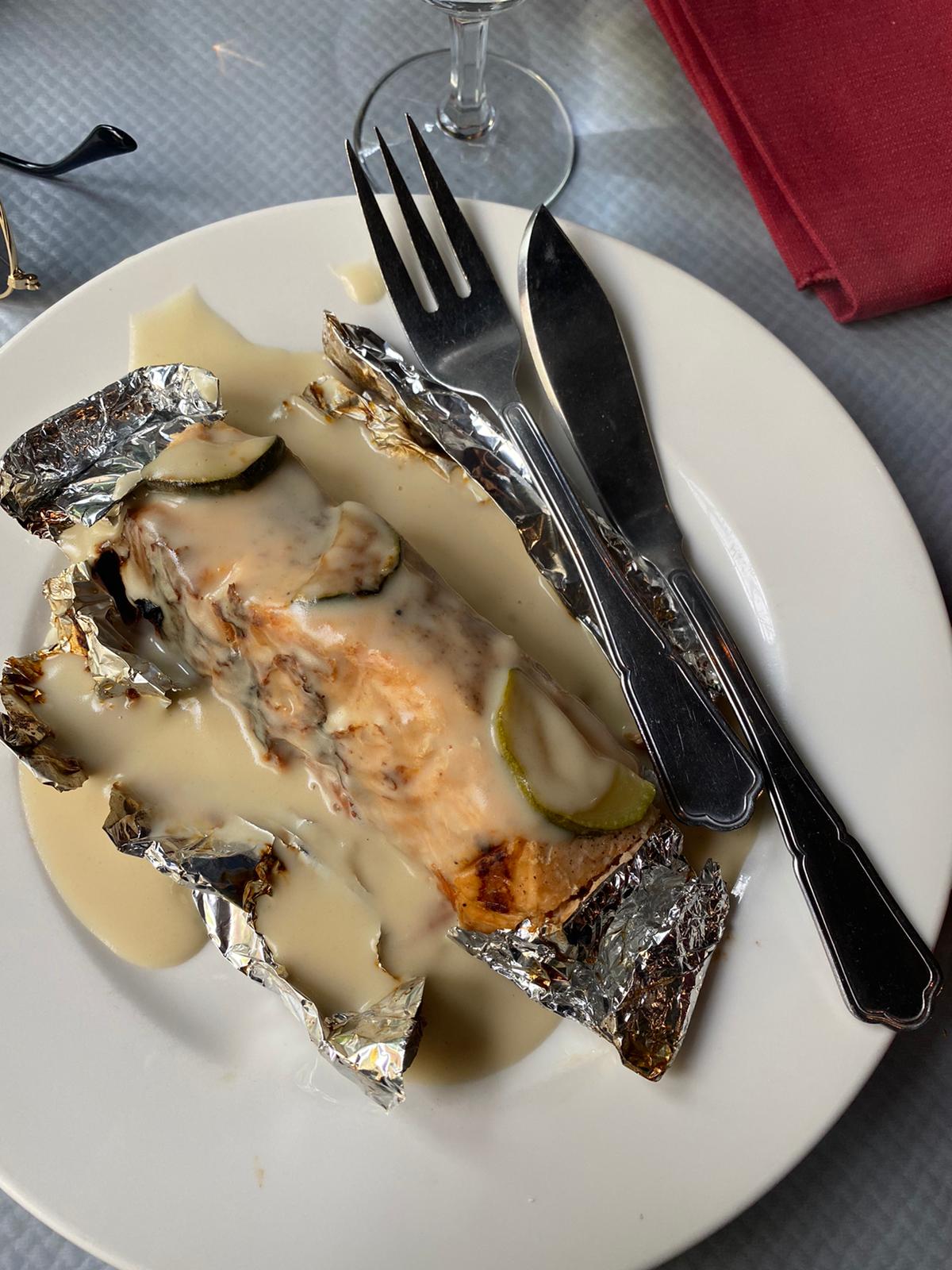
My sister opted for salmon en papillotte (a cooking technique where the salmon is wrapped in foil). Normally I cannot stand fish but this dish was really quite excellent. the fish was flavoursome and fondant.
Mother ordered andouillette to torture us. The contents of this dish do not bear thinking of, much less writing at length about so I shall spare you the agony.
Finally, father ordered the steak which was excellent. I had only a small morsel because the meat industry, beef in particular, is a huge contributor to global warming and should be regulated as a matter of urgency. While waiting for the legislative arm of government to wake up to a very imminent crisis, I choose to abstain from contributing to the beef industry. A morsel from someone else’s plate that I have not paid for is just fine, however. And I must say it was quite fine, tender and lovely. The garlic butter was the real standout here.
We had two desserts (between us not each). The first is pictured below. Home made profiteroles, filled with home made ice cream, as it should be. Everything was correct. The thickness of the pastry was exact, the flavourful ice cream and the rich fabulous chocolate sauce. Consistency, flavour and not straying from the traditional dish – this was a huge win.
Finally, the Tarte Tatin maison was also above par. The pastry tasted excellent and was by far the greatest achievement of this dish. It is difficult to fail in this dish when the base ingredient, namely apples, is freshly and locally sourced. Using seasonal vegetables as opposed to ones one can get all year round from the supermarket really took this dish up a level and made it quite extraordinary.
Overall, this restaurant was beautifully situated and beautifully decorated. In the middle of our meal, a band started playing songs. This in itself was a delight. Of course it was the typical woefully sentimental, soppy and predictable trite garbage tunes one expects in these circumstances but it was pleasant enough. A cave restaurant was an excellent idea on such a hot day and the food was of a devastatingly high quality. We all left satisfied and impressed.
It is New England in the 1890’s. Two lighthouse maintenance officers, Ephraim Winslow (Pattinson) and Thomas Wake (Dafoe) arrive on a remote island for a month long secondment which turns quickly into a nightmarish haunted and very wet situation. Their tenuous grip on reality slips away slowly in what I can only describe as one of the most brilliant and gripping horrors I have seen in a decade.
It is explosively scary and captivatingly beautiful in cinematographer Jarin Blaschke’s fierce monochrome, like a daguerreotype of fear. And the performances from Willem Dafoe and Robert Pattinson have a sledgehammer punch – Pattinson, in particular, just gets better and better. Guardian
Director Robbert Eggers (The Witch) has created something beautiful and maniacal here, deliberately intending to nauseate the audience. This film was shot in a nearly square 1:19:1 aspect ratio, and monochrome, which immediately throws one off. To add to this, most of the scenes are insular and claustrophobic. Their intensity increases incrementally which only adds to the excellence. Their roles are established quickly; Wake plays the stern weathered superior whose duty is to care for the prater Promethean light atop the lighthouse, whose enclosure Winslow is not allowed to enter. Winslow in the other hand is a ‘wickie’, a lower ranking officer who does all the menial tasks, including purifying the water and fending off rude seagulls.
The Lighthouse is itself a tall tale, the kind sailors might have once told over a frothy tankard of ale with a faraway look in their eyes. It is a folk tale deeply rooted in that tradition, soaked to the salty skin with superstition and sinister iconography. And yet… The Lighthouse is an altogether taller tale than most. There are plenty of moments where you’ll have no bloody idea what you’re watching. Other times it feels like an endurance test — like you’ve been stranded on an island in a storm with little chance of rescue. But surrender yourself to its strangeness and you might also find some enchantment in its light. Empire
The development of each character is masterfully portrayed, keeping one on the edge of an ever present precipice. The cinematography is bordering on art, with shots presented bluntly, without needing to resort to descriptive narrative or even words at times. My personal highlight of this movie was the scene where both Wake is talking down to a drunk Winslow, some time after a ship was supposed to come and pick them up for their next assignment. Of course, Winslow decided to beat a seagull to death, and seagulls contain the souls of dead sailors who revolted and created a storm so violent that no ship could reach them. The intensity of the scene and the way the camera looks up at Wake as he is berating Winslow gives us a really stunning perspective on both protagonists but also of the mastery of Dafoe’s acting capacity.
Dafoe’s mercurial movements, his rippling face and spooky smiles, dovetail beautifully, articulating Wake’s moods and adding to the destabilisation. He barks orders, sings a shanty, indulges in sentimentality and turns his yowling mouth into an abyss. NY Times
Overall this film scores a perfect ten for me. This is as much an inner as an outer horror. The direction, acting, cinematography, production and concept were all astonishing and tied together beautifully. The Lighthouse portrays the limits to which the isolated mind can be pushed, and the effects on those who go beyond those limits, making it a perfect film for our isolated times.
How long have we been in lockdown? Five weeks? Two days? Help me to recollect.