Can you believe I read the Guardian on occasion? I can’t. While perusing these hallowed pages, I happened upon a wonderful article about an old exhibition of Sorolla works at the National Gallery. I was instantly smacked in the face by Sewing the Sail, which I will discuss at length. I then did some more digging and was blown away by this master of light. Below are three paintings which stuck out to me as particularly inspired.
Sorolla (1863-1923) was a Spanish painter excelling in portraits, landscapes and works of social and historical themes. He is most known for extremely adept depictions of people engaged in various activities under the Spanish sun or near water, both of which feature in this review.
Sorolla was a child prodigy. Orphaned at two, he was raised by an aunt who recognised his gifts, bought him pencils and paints and got him work as a lighting assistant to a local photographer at a very early age. A breezy portrait of his beloved wife, Clotilde, from 1906, shows her focusing a brand new camera at the beach, and many of Sorolla’s paintings are lit and composed like snapshots. Guardian
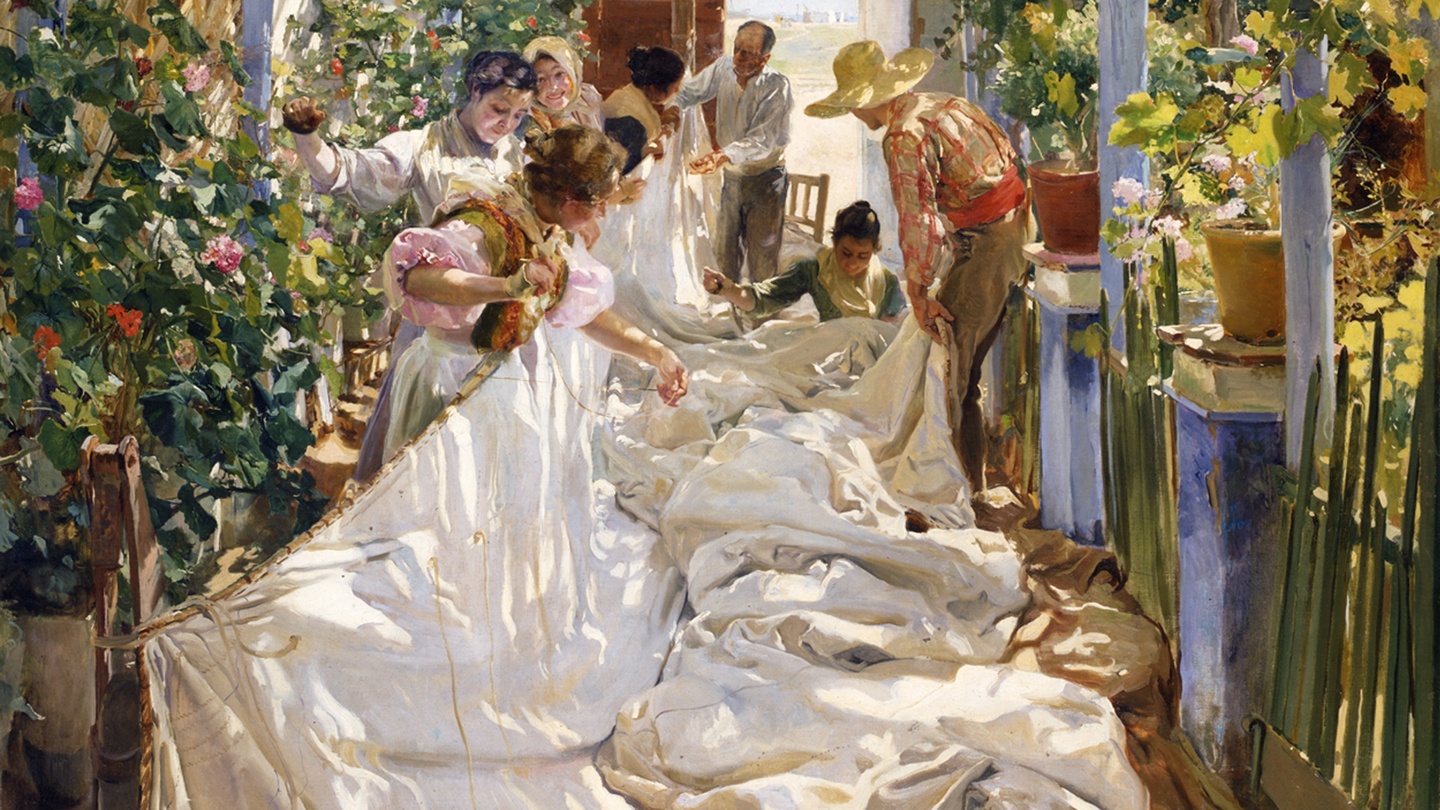
Sewing the Sail, 1896
This to me is the epitome of light depiction. I’ve been to Spain many times, in many disguises, and have seen (and felt) the startling effect of the Spanish sun. This almost folkloric depiction of Valencians coming together to sew a sail for a waiting ship captures the light in a way which baffles me. Think about it, Sorolla could very well have removed the plant pots on the gorgeous blue plinths, but he kept them there so the light was split up by the leaves and petals across the sail. Let’s not ignore the fact that paintings are not pictures, everything in a painting represents a decision by the artist, not happenstance. Sorolla chose to make this more difficult and the result of his heroic effort are astounding.
Further to this, there are more flowers on the opposite side of the sail, making for further splitting of the light within the leaves, rather than on the sail, giving the effect of a really wonderful bouquet of leaves, light and colour.
Moving onto the sail itself. The crumpling effect rendered here is exquisite. Have a look at your bedsheets next time you change them and imagine the skill it takes to capture all the light and shadow on them, now put a plant in front of the window. You’ll see what Sorolla was up against. Observe the seam of the sail on the left side, roughly rendered but no less clear.
And let’s discuss the people in this painting, with their varied expressions. The third woman on the left seems to be amusing her neighbour with a story. The first woman on the left is concentrating deeply on the work at hand. The man at the back of the painting seems to be inspecting the work of an unsuspecting fourth woman, who seems to be begrudgingly taking on his criticism.
Overall this is an astonishing piece which correctly grants Sorolla the title of Master of Luminescence which I have ascribed him.
Running Along the Beach 1908
Another aspect Sorolla was known for were depictions of water and the heavenly Spanish Summer. If you’ll excuse the child with bare ankles, this is really an excellent piece. I jest of course, while children are in all circumstances off-putting, this one is rendered quite exceptionally. One is given the impression he has just this instant come from the water and begun to chase the two young ladies in front of him. the depiction of the light and water on the skin is really extraordinary.
Observe the beauty of the water in this painting. The motion is shown so wonderfully. And also the varieties in motion, there are many different levels of wave crests here. These are all shown to be in motion at the same time which is truly an achievement to behold.
Observe the gorgeous way he has depicted water being absorbed into the sand. We see this in three or four stages. At the bottom right we see relatively dry sand. Moving closer to the sea there is a layer of freshly wet sand followed by a layer of water just receding, in which the reflection of the running children is reflected roughly to give the impression of motion. Finally we have the water itself receding back, ready for the next wave to crash. the crests of the waves are also exquisite.
Nude Woman 1902 (take on Velazquez, Rokeby Venus?)
Now this isn’t just any old nude woman, this is a portrait of Sorolla’s wife, Clotilde García del Castillo, painted in 1902, when she will have been around 37 years old. I’ll refrain from any lecherous comments on the aesthetics of his wife’s buttocks, focusing instead on the way that she has been lovingly and elegantly depicted here. The curvature of her spine and the sheen on her skin, the way she is admiring her ring, almost in adoration of the man who gave it to her (insert disparaging comment about the male fantasy here), are all represented beautifully.
The way that the light catches the silk/satin sheets is also extraordinary. Observe the plush duvet and the way the folds are almost running from Clotilde’s body. Also note the translucent patterned throw at the end of the bed, a wonderful detail to contrast with the solid silk.
In the title I make the comparison with the Rokeby Venus (also known as The Toilet of Venus, Venus at her Mirror, Venus and Cupid, or La Venus del espejo) because there is a school of thought which believes Sorolla’s Nude Woman is an ode to the Rokeby Venus by Spain’s most noted painter Velázquez. I will let you draw your own comparisons but I have included a very helpful video from the National Gallery explaining at length the sensational painting below.
This is the only surviving female nude painted by Velázquez. The subject was rare in seventeenth-century Spain, where overtly sensual images were met with disapproval by the Catholic Church. In spite of this the king, and wealthy Spanish art collectors in his circle, did own mythological paintings depicting nudes by artists such as Rubens and Titian. National Gallery
I won’t go into this marvellous work as I could devote an entire post to it. Please find below a great dissection of this painting by Francesca Whitlum-Cooper, Associate Curator of Paintings 1600-1800 at the National Gallery.
There you are, two nudes for the price of one. I must say when I started doing reviews in late 2017, I never thought I would be giving my two cents on 17th Century nude paintings. Life does take us in bizarre directions.
I hope you have enjoyed reading my thoughts on these masterpieces as much as I have enjoyed writing them. I get so much out of art reviews. I maintain that every alternative perspective understood helps us to become more well rounded individuals.
Omar Naim’s screenwriting and directorial debut gives us an inventive concept: the Zoe Chip, implanted in rich people’s babies’ brains and developing with them, records every aspect of their lives in glorious technicolour and Dolby Digital sound. Cutters’ (glorified morticians of sorts) jobs are to take the whole footage of a person’s life and create a promotion reel. Taking advantage of people’s grief to make money is a reprehensible pass time. This moribund and unsettling profession sees Alan Hakman (Robin Williams) as its stalwart champion.
In this chilly sci-fi fantasy, Mr. Williams’s character, Alan Hakman, is the go-to guy for people who demand the ultimate obituary. Alan works as a “cutter,” anthologizing the greatest hits from people’s memories into mini-movies that are marketed as Rememories. His digests of golden oldies splice together the happier, upbeat moments he selects from so-called Zoe Chips, nearly invisible devices implanted in people’s brains at birth that record a lifetime’s experiences. NY Times
Editing anyone’s life story, living or dead, to give a better impression is a disturbing idea. Especially so when relating to profiting from such an activity. But Williams brings his trademark effortless brilliance to the role. He plays it as one would expect any successful mortician to be played, morosely, humbly and consistently. The only times when we see him waver from this placated state is when he is talking to the daughter of a Mr Bannister, a recently deceased lawyer whose family commissioned a final cut for a ReMemory (pseudo-funeral). Bannister was also an embezzler and child molester. Here Williams is nice and friendly, rather than impenetrable and stoic. Of course, one criticism I would have of this picture is that it hints at deeper plot possibilities and then shies away from them. Hakman has seen all of Bannister’s life (somehow pinpointing these two huge moral turning points within seconds of each other). He could have done something to right this wrong but instead used the conversation to elicit information about a childhood friend of his whom he saw when watching her father’s Zoe footage.
Meanwhile, a growing movement of tattooed anti-Zoe activists, in which a former cutter and colleague of Alan’s (Jim Caviezel) has become a leader, wants to steal Bannister’s implant and expose his corporate crimes. Roger Erebert
This brings me neatly to another criticism I have of the film. There are several messy sub plots which distract from the plot and take away any momentum the plot has built up. The bizarre memory from Hakman’s youth where he and a friend walked across a shaky plank and his friend fell off, scarring Hakman for life, was an unnecessary distraction. The idea that from this, Hakman dedicated his life to correcting the wrongs of people’s pasts, somehow absorbing and absolving their sins, while corroding his own soul in a pseudo martyrial fashion is far fetched.
Robin Williams in “The Final Cut”.
There are several other sub plots which add precious little to the film, like the brief romp Hakman has with Delila (Mira Sorvino), an ex girlfriend of a client whose re memory introduced us to Hakman’s profession. There is also a group of protestors led by an anti-Zoe implant cabal who have strange tattoos which are not at all explained.
If you can ignore the numerous unnecessary sub plots and focus instead on the ingenious concept and Williams’ brilliant performance, this will be an enjoyable film for all.
A restaurant? What fresh hell is this? My thoughts exactly, dear readers, as I crossed the threshold of a bizarrely normal eatery. The tables were further apart than in the Before Time of course and the staff were wearing masks, as were the customers while travelling between their tables and the loo or to settle the bill, but otherwise the state of things were of an appreciable normality.
The first order of business was to obtain a half litre of cidre doux, or soft cidre, which is customarily consumed with crêpes in France. Thus graced by this sensational sweet treat, we awaited with eagerness our holy crêpes.
There is hardship in everything except eating pancakes. Charles Spurgeon
Pater’s Salade Baltique consisted of smoked salmon, marinated prawns, mustard sauce, honey and dill. Now as many of you know the sight sound and smell of fish repulses me more than cold showers or people named Josephine, so I did not attempt it. But Pater tells me that the quality was superior, especially that of such base ingredients as the salad leaves themselves. It is impressive what a little sunshine will do for one’s crops. Find below a delicious a beautifully lit close up shot.
This salad has restored my faith in tomatoes. Pater
My dish was rather less auspicious as I sought something a tad less rich for my first visit to a restaurant in a quarter year. I was worried that such an intake of rich food after months of eating healthily and exercising might explode my liver. Hence I opted for the Galette Fermière. Interestingly, if a crêpe is savoury, it is called a galette. Don’t ask me why, I don’t make the rules.
I am not sure whether the time elapsed since my last restaurant visit has made me impressionable but my galette was really quite exceptional. The texture of the pastry itself was wonderfully savoury and exactly crunchy. The filling, too, was divine. I am a fan of the melange of sweet and savoury. Hence the apple, honey, egg, Emmental cheese and goats cheese which filled this galette were quite excellent. I ignored the radishes as I detest photograph enhancing touches designed to appeal to mindless and/or young people who feel the need to share every aspect of their lives with individuals or groups instead of living and enjoying it for themselves. Life, and crêpes, are to be enjoyed for one’s benefit and enhancement rather than to give an impression of its quality to others.
“Darling, I keep my crêpes in check, so to speak, and I’m always filled and have my pastry done comme il faut” Arkadina, Act II, The Seagull by Chekhov
Mother’s galette was by far and away the best one on the menu. This was obvious from the outset. I managed to negotiate two small bites and was astonished at the effect. The Savoyarde consisted of raclette cheese, potatoes, bacon lardons and creme fraiche.
I will not shy away from saying that this galette was a masterpiece. The interplay between textures and flavours was just breathtaking. The fluffy nature of the potatoes as contrasted with the chewy lardons and fondant cheeses nearly brought a tear to my eye. The flavour of each ingredient was so pronounced as to be appreciable individually as well as holistically. This galette was a lesson in the making of a perfect dish. Five stars from me.
Overall, this was an excellent way to restart my culinary journey. I am elated to have had this opportunity and deeply impressed by La Crepicoise. I cannot recommend it enough to those of you in the area or thinking of visiting.
Choosing Rattus as album of the month this month was bold. Producing a review for this masterwork is rather very difficult. You would not believe it from first listening but this album was released in 1977, making it 43 years old at the time of writing. While the likes of ABBA, Fleetwood Mac and Barbara Streisand dominated the charts, the Stranglers thought they would unleash a torrent of dark punk energy on the world. And by gum, it worked.
With Hugh Cornwell on vocals and guitar; Dave Greenfield (RIP) on keyboard and vocals; Jet Black on Drums and Jean Jaques Burnel on Bass Guitar, this album features the classic old school Stranglers line up. Before I go into the music, I wanted to mention Dave Greenfield. He passed away, sadly, in early May 2020. This post is as much a tribute to The Stranglers as it is to the genius that was Dave Greenfield. I won’t claim to be an expert, and neither does The Guardian (who misattribute his death to COVID, when this was only a small factor in his cause of death, in typical mainstream media style), but they have written an excellent Obituary, which I encourage you to read.
Its distinctive combination of lyrical anger and organ-driven sleaze was both deeply confrontational and musically accomplished. This was an album that found considerable success by crossing barriers: those older music fans who found the minimalism of The Damned or the Ramones a little too off-putting could deal with the snaking arabesques of Hugh Cornwell’s guitar solos, Jean Jacques Burnel’s growling Fender Precision bass or Dave Greenfield’s frankly psychedelic organ arpeggios. Oh, and some great tunes. BBC Music
As well you know, I live and breathe music. I grew up with The Stranglers, despite being a teenager in the early 2010s. My Great Grandfather moved home from Haxby to Harrogate in North Yorkshire when I was about 14. Downsizing does require some sacrifices, as you can imagine. I got the old Sharp CMS 150 Hi-Fi which didn’t make the cut. It looked like the photograph below, with equally big speakers. This was my introduction to vinyl, as well as tapes CDs and FM radio (mostly BBC Radio 3 in those days, before I tired of the nasal pomposity and unattainable scope of knowledge they propagate). The first LP I heard was Men At Work, Business As Usual. Of course I wasn’t aware that there was a difference between 33RPM and 45RPM. I played this first LP on the latter setting and thought Ivan Doroschuk had taken rather a heavy dose of helium.
Eventually I riffled through Father’s vinyl collection and landed on Rattus Norvegicus. My understanding of the concept of music expanded irretrievably from then on.
You must understand that when your introduction to punk and rock starts with the album that features Down in the Sewer, nothing can ever be the same.
On the Rattus picture sleeve, French bassist Jean Jaques Burnel affected a lean, asexual allure that hinted at Roxy and Bowie: next to him, unfashionably bearded keyboard player Dave Greenfield could have been touring with heavy/prog rockers Uriah Heep. Behind them, drummer Jet Black (unfashionably old for punk at 35) and guitarist and vocalist Hugh Cornwell loomed like two faces who wouldn’t have been out of place working a London crime firm. On this form, The Stranglers skilfully implied danger rather than bellowed it. We Are Cult
Now to the music: the opening number, Sometimes, immediately puts the Stranglers in sharp contrast to their punk contemporaries by demonstrating that they can actually play their instruments. Immediately all three main instruments shine in their own light. The keyboard in particular is very impressive here. The lyricism is pure punk, spitting out anger leading up to a stunning solo from Cornwell. Please take note of the production value here and throughout this album. These are flawlessly produced tracks with seamless transitions between motifs and riffs, with a beautifully balanced sound where no instrument walks over another.
While IV [Rattus] may be ill-tempered and downright ugly in its misogyny at times, its anything but dull. Where most Punk bands were ranting against society, the Stranglers focused on inner conflict. IV is a frustrated, angry tug of war of sex, conscience and low self-esteem. It’s downright perverse in its sarcasm and nihilism. In short, it’s not a very pleasant place to be but like anything with a dark allure, you can’t resist going down that alley once it presents itself. Soundlab
Goodbye Toulouse used to be one of my favourite Stranglers tracks. It tells the story of Nostradamus’ prediction of the downfall of the city. I’m so drawn to a weird keyboard wizardry that Greenfield unleashes on us. It reminds me of Waltz in Black and the more choice experimental tracks on Side 2 of The Raven, which I love. One of Top Ten tracks ever is Lilies and Remains by Bauhaus – which is reminiscent of this Otherness which the Stranglers are so known for. Goodbye Toulouse itself features a relentless bass-line and, again, flawless production and balance.
London Lady (Why did you lay me? // Your head is crowded with the names you’ve hounded) is pure punk rock late 70s misogyny. If you’re revolted by this, good for you. Keep it up. I would encourage music listeners to separate the ignorance of times gone by from the merits of the musicality of a piece or track. Watch out for the cascading guitar in this track, which is just awesome.
‘London Lady’ follows and is a nasty bit of derision aimed at a female rock journalist […] Malicious and vengeful as it is, it’s all spat out with so much self-loathing, you’re inclined to think Cornwell may have richly deserved the slight that’s gotten under his skin. In other words, he makes no pretence of being any better than the bile he’s hurling. Soundlab
Princess of the Streets tells the story of a Regina George-like pack leader who is out to cause trouble. This features extraordinary bass and keyboard with solos flawlessly woven in.
Hanging Around remains one of my top tracks by the Stranglers. The characterisation in the lyrics is superlative (Big girl in the red dress // She’s just trying to impress us. Standing in the Coleherne // With the leather all around me). This is a reflective punk piece which takes pot shots at religion and the London club scene life. The solos are incredible.
Peaches (oh boy) doesn’t really need to be spoken about I think. It’s an excellent track and speaks to the typical beach gawking pervert and the perceived enormity of female bottoms. There is innuendo and plenty of lechery. This is overplayed in my opinion. Every band needs their most popular track but it is seldom their best musically. One should not trust the music taste of the general public.
Grip was my previous top Stranglers track (before Down in the Sewer and Walk On By changed my life). This track is a sharp contrast to the poppy stylings of the previous tracks. In my notes for this review, I have underlined ‘keyboard’ with a choice expletive. Greenfield is truly in his element here.
Ugly is once again a terribly misogynistic track which epitomises this dark punk rock energy. It is filled with vitriol and anger at the hideous subject but also at themselves for feeling this way. The synth and lyrics really stand out here (I would like to see a passionate // film between // the two ugliest // people in the world // when I say ugly, I don’t mean rough looking // I mean hideous)
Now, Down in the Sewer, where to begin? In my estimation this is inspired by the Doors’ Light My Fire. Indeed a lot of Greenfield’s keyboard stylings can be seen to stem from the wonderful musical stylings of Ray Manzarek. This track is an 8 minute masterpiece and is undoubtedly the crowning jewel of this album, if not the entire Stranglers repertoire. The lyricism, the central riff which holds the piece together, the cycling through solos – everything in this piece is aimed at letting the audience know who the Stranglers are and how good they are.
IT JUST TAKES OFF!!! Nicholas Jenkins (neé Saint)
They’ve got sharp teeth *clack clack clack* // Deep breath // And lots of diseases
I wish there were some way to describe the excellence of this track. It’s so suffused in brilliance that I find it difficult to talk about. The keyboard, synth, drums and guitar are all flawless and follow one another seamlessly (into the sewer?) into an insane crescendoing euphoric ending. The end bass is magisterial and reminiscent of the earlier bass during the first solo cycle. One reviewer noted the end of this track is like 1000 Rattus Norvegicus running all over your speakers. The track comes full circle and ends leaving you feeling breathless, needing a few minutes to readjust.
Rattus Norvegicus is the kind of album that will leave you feeling awed at the power of music and the sheer talent of those performing it. It is a jewel in the crown of punk and a deciding factor in late 70s English musical brilliance. I am constantly amazed by this album. It is over 40 years old but has not lost one note of its excellence. Why has this album survived? I believe in part due to the novel genius it displays. That spark of individual inspiration is so rare in music. Often one can dissect a new band using what came before. With the Stranglers, it is more difficult to see this. One can find their roots with ease but they branched out so far from them that they have become seminal artists themselves.
Jean-Etienne Liotard was one of the most accomplished portrait artists of his time. Born in Geneva, Switzerland in 1702 he went on to have a very successful career, completing most of it in stays in Rome, Istanbul, Paris, Vienna, London and other cities. At the height of his career he was commissioned to represent members of royal families in his respective residences. The masterpiece came to my attention through a recent Guardian article, exploring how the painting was donated to the National Gallery through the UK’s AIL Acceptance in Lieu scheme. This painting was given in exchange for a waiving of a whopping £10 M inheritance tax bill. The government must be thrilled. Let’s explore it further.
Jean-Etienne Liotard was an artist in great demand across Enlightenment Europe and beyond. An eccentric and distinctive portraitist, his work conjures up the magnificence and cultural curiosity of the age in vividly lifelike detail. Royal Academy
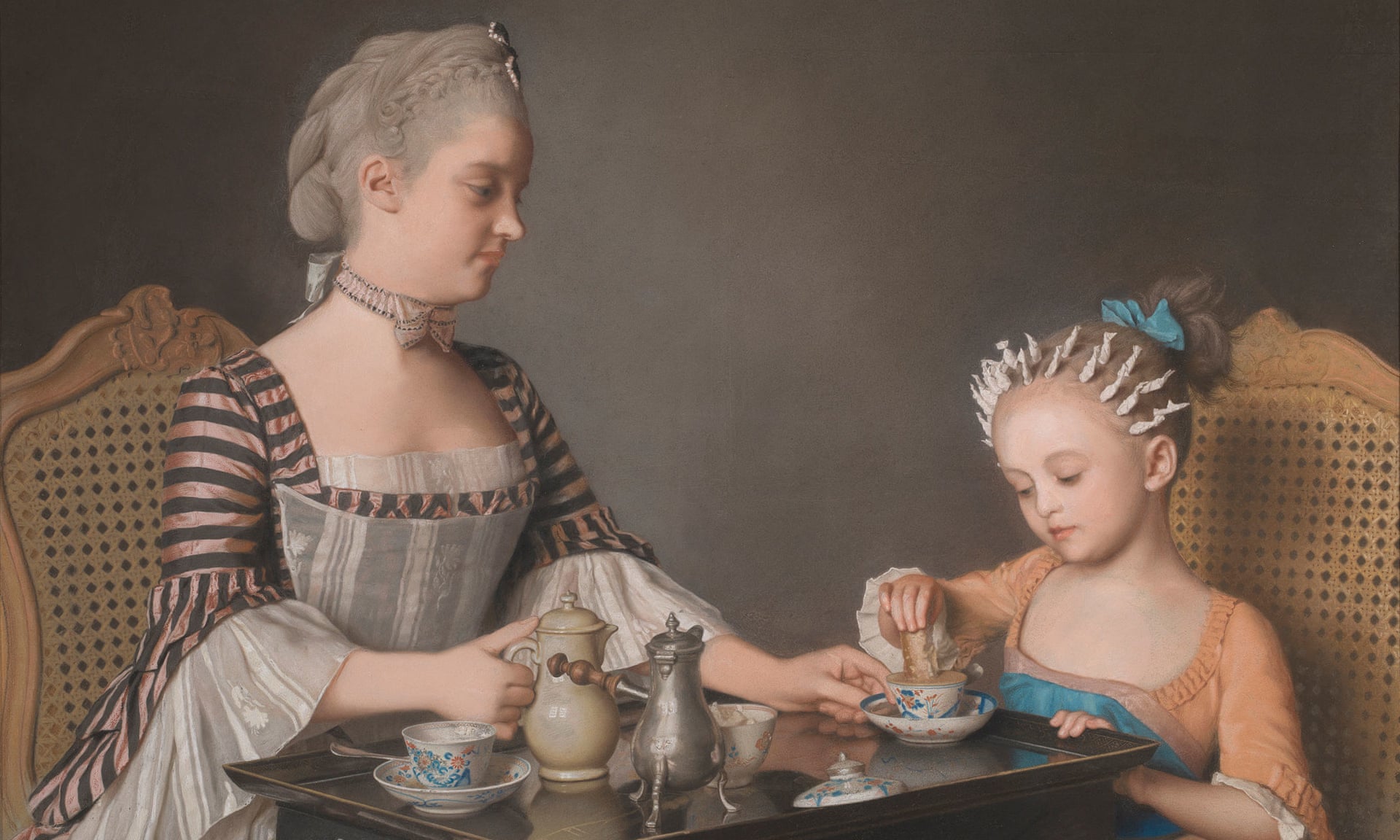
This masterpiece represents a tender moment captured between a mother and her daughter having breakfast. the level of attention to detail is astonishing here. Look at the reflection of the tableware from the perfectly lacquered breakfast table. The reflection of the light on the metal pot and the porcelain jug, subtly different from each other, is impressive indeed. Liotard has produced this effect by wetting the pastels and creating lumps to give it form. And look at the reflection of the window pane in the milk jug!
Perhaps the greatest detail is the sheet music in the open drawer in the bottom left hand corner of the painting. Liotard has actually signed his name and the place the painting was made “Liotard, in Lyon, 1754”. Self referential? Yes, but in the most marvellous way.
Observe the tender look the mother is giving her daughter while steadying the saucer, observe the little curls of paper in the daughter’s hair and the concentration with which she is dunking. These paper curls were used to set her hair for the day, further confirming this scene is taking place at breakfast. If you look closely you’ll see that the mother’s finger tips and nails are reflected in the table, which is an extraordinary detail. Also, the cup of coffee into which her daughter is dunking is about to overflow, hence the need for her mother’s steadying hands.
The satin-esque material of the mother’s dress is resplendently portrayed, especially as contrasted with the simpler ‘smaller’ version of the same dress her daughter is sporting. Notice the similarity in the cut of both dresses and the ruffles in the sleeves.
The gallery said the level of care with which the still life aspects of the work had been executed was extraordinary. They include unusual layers of thick wet pastel to create the illusion of reflection on the metal coffee pot and Chinese porcelain. The Guardian
Overall I am awed by this work. The fact that a pastel work from 1754 has managed to last nearly 300 years and still be in this remarkable condition. The definition of each constituent part of this painting and the sheer detail Liotard has managed to expose to us is extraordinary. See below for more details on this painting, as told by the National Gallery’s curator for portraits 1600-1800, Francesca Whitlum-Cooper.