Father, if you are reading this, you win again. I was introduced to Peter Gabriel Plays Live during my most recent trip up North. When I browsed the record stores at Tynemouth Market the morning after, and happened upon this record, I must admit I believed in fate. This, from the former frontman of Genesis, is a masterwork in entertainment. Playing with Tony Levin (bass, stick, backing vocals), Jerry Marotta (drums, vocals), David Rhodes (guitar, vocals), and Larry Fast (keyboards), Gabriel manages to reproduced beautiful and unique versions of the studio originals, spread across his six previous albums.
Most of his biggest hits and key album tracks are represented in tight, inspired performances — the notes concede that some of what is here was sweetened after the fact in the studio, but the immediacy of the stage performances wasn’t lost in the process, and that emotional edge and intimacy give songs such as “Solsbury Hill,” “I Don’t Remember,” and “Shock the Monkey” a sharper, deeper resonance than their studio renditions, fine as those are. AllMusic
This album is made up of pieces recorded during Gabriel’s 1982 tour. They present mature considered reproductions of his key studio successes. My highlights must begin with Family and the Fishing Net. This ominous offering is apocalyptic in its outlook, speaks of the absurdities on the minutiae of weddings and is inspired by early poetry of Dylan Thomas. It is followed by the extraordinarily creepy and urgent Intruder, where Gabriel sings of breaking into a woman’s house and never being caught. Watch out for the stunning end to this track.
Gabriel’s unearthly wail and the artful force of bassist Tony Levin and drummer Jerry Marotta transform both the chilling reverie “Family Snapshot” and the anthemic rocker “D.I.Y.” “Biko,” Gabriel’s salute to South African civil-rights martyr Steven Biko, comes vibrantly alive, its tragic martial pace inflamed by Fast’s bold synthesized bagpipes and guitarist David Rhodes’ angry fuzz chords. Rolling Stones
The first track on side 3, and the first track I was shown by Papa, San Jacinto is easily my favourite. This track speaks of the artificial world of Palm Springs as contrasted with the comparatively genuine life approach of indigenous inhabitants on the other side of the San Jacinto Mountain Range. This is followed swiftly by Solisbury Hill, arguably the most famous track on the album, which needs no description except that is is bloody brilliant.
Plays Live offers the perfect vantage point to admire everything, with the caveat that his third album is best experienced in its original studio form…On Plays Live, Gabriel re-affirms his place as a live performer with few peers and manages to give his catalog a fine spit-and-polish in the bargain. Prorography
Biko is my final highlight. Gabriel sings of anti-apartheid civil rights activist Stephen Biko, who was assassinated in 1977. This is a superb choice to end an album of this magnitude on. It is just forceful and potent enough to shock, but the melody is sufficiently restrained that one can truly focus on the words spoken.
Overall, while this album lacks some sequencing (such is the plight of compilation albums), Gabriel has presented a wonderful offering to the altar of Music. Plays Live covers all bases, it is fun, catchy, evocative, well researched and striking. I recommend it to you for momentous evenings, or even evenings when some trifling squib ghastly person dares to impugn your reputation. It’s certainly made me feel better.
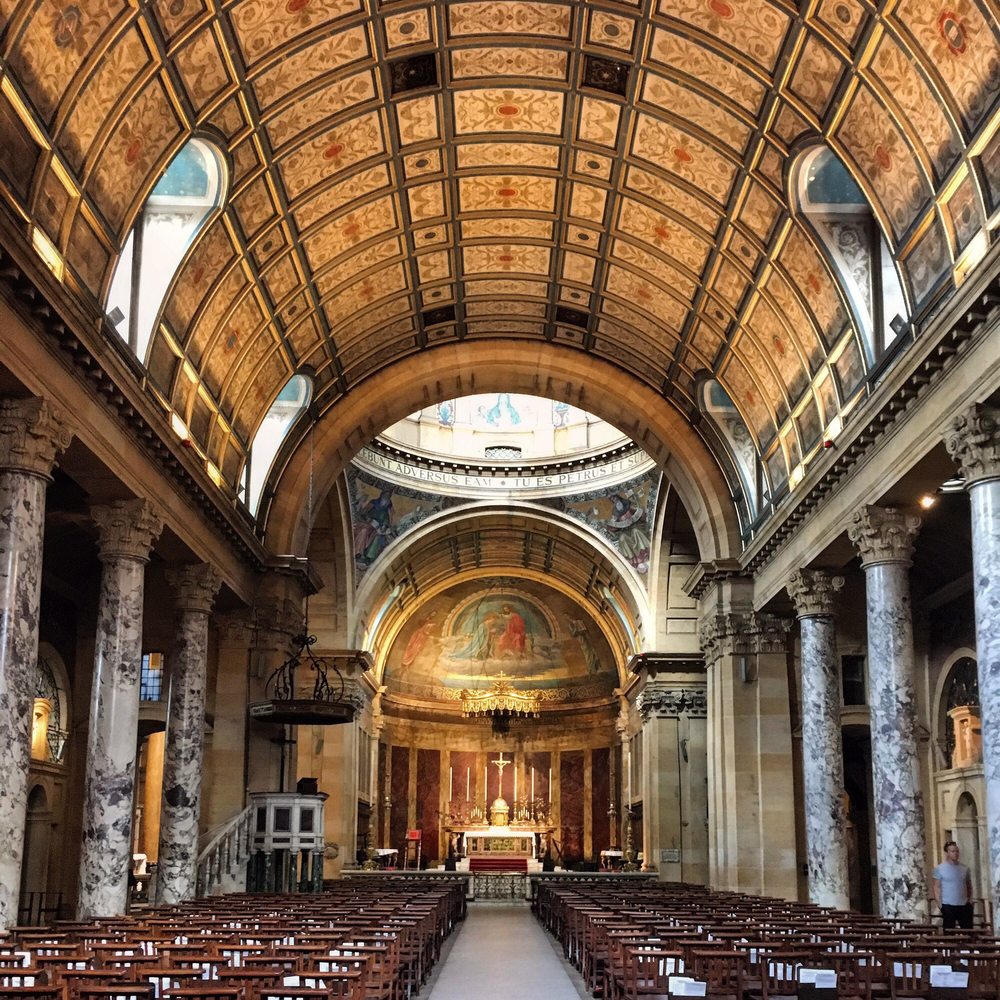
Would you believe me if I told you there is a Romanesque church, dome and all, in the middle of Birmingham? No? You’d be right. But there is one in Five Ways/Edgbaston. The Birmingham Oratory was built between 1907-1910 in honour of Cardinal, now Saint, John Henry Newman, the founder of the English Oratory in 1849. The Birmingham Oratory is a Catholic religious community of priests and brothers of the Congregation of the Oratory of St. Philip Neri, and was their first house in England.
Saint Philip had the gift of healing, returning many sick people to health. He lived in close contact with the supernatural and experienced frequent ecstasies. Those who witnessed him in ecstasy gave testimony that his face shone with a heavenly light. He always had a delicate health. On one occasion, the Blessed Virgin Mary appeared to him and cured him of an illness of the gallbladder. Pierced Hearts
Saint John Henry Newman visited to Rome to explore the possibility of establishing an order of Oratorians. He returned to England, with Pope Pius IX’s formal approval, to establish an English Oratory. I’m not sure how the Hagley Road must have looked like in 1907, I imagine a lot more pious than it does now. It is extraordinary to me to think that within sight of my seat in the office there is a gorgeous Romanesque Oratory, which I can visit on my lunchtime for Mass if I so choose (I haven’t yet) and few people know it is there.
It has just occurred to me that I should have a Catholic section to my blog.
I digress. The Birmingham Oratory is a wonderful tranquil place, a stone’s throw from the centre of Birmingham. It is rife with history and is a constant reminder of the marvellous work Saint John Henry Newman did in furthering the Kingdom of God. This ‘furthering’, whichever religion we profess, or don’t, is surely a noble aim indeed. Achieving it in one’s lifetime must be an extraordinary thing.
Let’s be honest here – this is not the most glamorous cafe, best placed or best kept cafe in Birmingham. However, and this cannot be said for many establishments, it is down to Earth. While other restaurants plaster the walls garish colours and throw avocados at you as if you were trying to pole-vault the Welsh border, Reservoir Cafe remains originally humble. In the dejection of this forgotten corner of Edgbaston, Reservoir Cafe stands as a bastion of common sense and straightforward food.
My colleagues and I had the chance to go for our yearly bi-annual Wellbeing Committee Walking Group luncheon. We ordered in advance and everything arrived at the table in excellent time. We all took tea and an ample helping of milk. So ample in fact that the rest of the place had to do without before we realised we had pinched the entire place’s milk jug!
I digress. The above photograph depicts the gorgeous club sandwich I ordered. This was filled with chicken, fresh vegetables and a lovely sauce. Forgive me for not going into detail – this was a month ago and my memory is foggy at the best of times. I remember it being really filling.
The colleague to my right had a chicken, tomato and bacon sandwich which I am told was quite divine, above is its photograph, taken in the macro style.
Let me distance myself from the food for a moment and talk about the style of the building. This must have been an hotel at some point in the past. The architecture would have been gorgeous. The windows are high and let in much sunlight (if any is available in this country). There is delightful wrought ironwork on the spiral staircase leading downstairs. The wood panelling backing the restaurant was also well preserved and helped give a quasi- ornate feel to the cafe.
Overall, this cafe makes good food at a good price in a good location. You know exactly what you’re getting and you know it won’t cost you. Seven of us ate and drank for a combined total of £30, which I found was extraordinary. This is the Edgbaston cafe to go to if you’re in the mood for something delightful and dependable.
Despite stubborn popular opinion, Hull has a lot to recommend it. There are an array of theatres, marvellous cultural sites as well as it being the home of formerly alive poet Philip Larkin. But at the heart of Hull is also the Ferens Art Gallery. This is home to some impressive paintings and some nauseating modern art. Below are my highlights from this gallery.
Philipe de Champaigne – The Annunciation ca. 1644
This picture was painted for the private chapel of Queen Anne of Austria (1601–1666), the widowed wife of Louis XIII. The chapel, a small oval room in the Palais Royal, Paris, was decorated by the most prominent French painters of the day. Met Museum
The Annunciation refers to the announcement by the angel Gabriel to the Virgin Mary that she would conceive a son by the power of the Holy Spirit to be called Jesus (Luke 1:26–38). This is a particularly fine representation of this momentous and emotive event in the Christian Faith. Observe the Virgin Mary’s humility here. Observe the beauteous righteousness of the angel Gabriel. The fabric really took my eye as well. The way that the light is reflected from the heavens opening, how it falls more evenly on Gabriel is wonderful. I also love the cherubs fighting to get a look at the event. This is a really impressive painting.
Crijn Hendricksz. Volmarijn (c.1604–1645) – The Supper at Emmaus ca 1632
I was surprised to find another Catholic piece in my highlights. Perhaps I am becoming more holy. This 1632 piece by Crijn Hendricksz may be seen as an attempt to hold a candle to the famous painting of the same name by Caravaggio produced in 1601. I’ll focus on this one for now, if that is all right. The painting depicts the moment when the resurrected but incognito Jesus, reveals himself to two of his disciples (presumed to be Luke and Cleopas) in the town of Emmaus, only to soon vanish from their sight (Gospel of Luke 24: 30–31).
As you may have seen from my Highlights of the Mauritshuis post, I am a sucker for candles represented in paintings. I love the way that Hendricksz has depicted the light on Jesus’ face in particular. I also appreciate the pseudo iconographical breaking of the bread here. Observe the elegance of their fingers and how the light is reflected in their nails. Observe the stigmata on Christ’s hand. Observe the delicacy of the wrinkled brow. I’m really impressed by this.
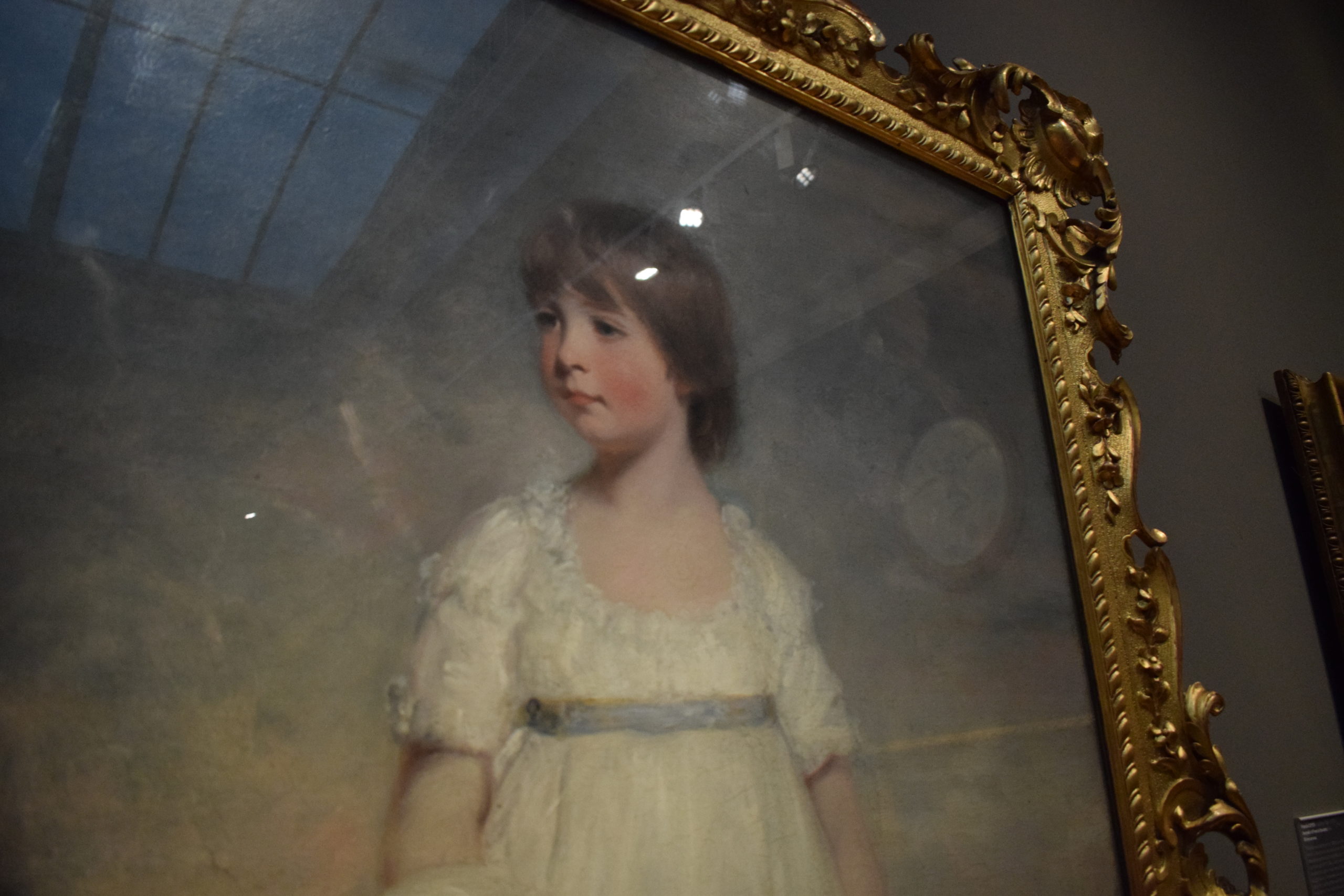
John Hoppner (1758–1810) – Anna Isabella Milbanke (1792–1860) (later Lady Byron)
Moving away from Christ, Hoppner’s delicate portrait of Anna Isabelle Milbanke also struck me. Anne Isabella Noel Byron was the 11th Baroness Wentworth and known as Baroness Byron. She was born Milbanke and loved between 17 May 1792 – 16 May 1860. Milbanke was highly educated and religious, perhaps known in part for her marriage to Lord Byron, a famous English poet. She described him to her mother as “a very bad, very good man”.
But you don’t want to hear about their marriage in Seaham, near Durham, or the fact that I have eaten at Downey’s Fish & Chips and so too should you. No you want to hear about the vicissitudes of this painting. And who can blame you? While the rendering of this portrait is not as sharp as the latter two, I should say it is of great merit. The first aspect of note for me is the tule of the dress. The crashing of the waves in the background and small boat in the distance are delightful. However, the true highlight of this piece is facial finesse depicted. The expression is solemn, almost glum (perhaps Lady Byron is cold in the sea air). I think this portrait is quite marvellous.
Spencer Tunick – Sea of Hull 2017
From Catholicism to nudity, I am happy to say my final highlight is the Sea of Hull. This was a piece commissioned for an installation at the Ferens Gallery to celebrate Hull’s relationship to the sea. Interestingly, the photo shoot itself took three hours and the volunteers depicted were ushered around Hull by aptly names ‘nude wranglers’. One has to immediately admire the commitment of these blue people. Hull is rather far North and is a sea town, which means howling coastal gales. The fact that Spencer Tunick convinced 3200 people to go out, sans-kecks, is deeply impressive.
Moving onto the composition of this photograph, one can see the different hues of blue are used cleverly to give the impression of motion. These four shades were taken from the Ferens Gallery itself. Looking at the photograph, I was amazed at its sheer scale. Thousands of people painted themselves one colour and gathered together as one sea. The inference of unity, resolve and strength shown here is clear. To me, this is a unique piece, bravely conceived and flawlessly excecuted.
Stéphane Janssen, one of the volunteers, said of the piece: “I always say that it’s the least sexual thing that I’ve ever seen in my life. We are naked, but it is not important. We are equal. Big people, small people, all colours, all walks of life. Guardian“.
Please do visit the Ferens if you’re in the area. I assure you it is rewarding, even if it is in Hull.
Nanette is at its core a discourse on comedy. That is not to say it is an academic manual, but more a careful dissection of the art form. Beginning as a traditional comedy show, Hannah Gadsby tells tale of her youth as a queer person in Tasmania, a country where homosexuality was illegal until 1997. Even then, the decriminalising only passed the Tasmania Legislative Council by one vote. Gadsby jokes that this is far too recent. She is right. As the show wears on, we are privy to Gadsby’s signature dry self depreciation which made her a star in Australia. Tales of her moving to more progressive Australia, the trials of being Lesbian but not ‘brightly feathered’ (as Jim Morrison put it) and some of the more disquieting consequences of being queer.
It was on a visit to her sister in Adelaide in 2006 when Gadsby entered Raw Comedy in 2006, progressing through the heats to win the national prize. As the winner, she was sent to the So You Think You’re Funny competition at the Edinburgh Festival Fringe, where she won second prize. From that point on, she performed numerous stand-up shows at festivals around Australia, such as the Adelaide Fringe, Melbourne International Comedy Festival and Sydney Comedy Festival. Wikipedia
But what really makes Nanette stand out is the social commentary it espouses. Usually in stand-up comedy, this is hinted at in succinct anecdotes or throw away remarks (à la Quentin Crisp). Hannah Gadsby dedicated the latter portion of her Netflix special directly addressing several pervasive and uncomfortable issues within the queer community, Fine Art and comedy as a whole. This is at once harrowing, deeply saddening and undeniable.
Netflix’s advertisement for this programme states “behind every joke, there is a story”. Nobody encapsulates this more frankly than Hannah Gadsby. Watching Nanette was nothing short of a revelatory emotional rollercoaster. I challenge you not to be moved.