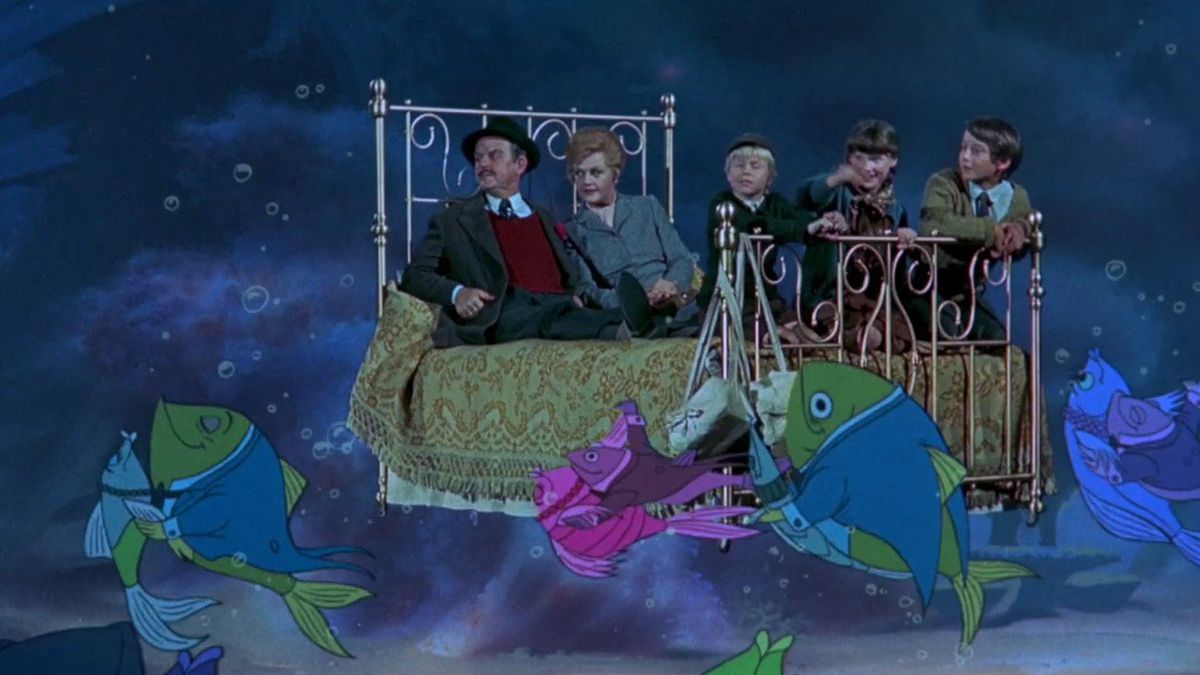
Unsurprisingly this film was made by the same team as made Mary Poppins 7 years prior. Disney, to their great credit, have managed to create a film with enduring magic. What surprised me when watching again was how much of it I remembered from my childhood and the aspects which struck me then still striking me now. Why did I happen upon this film? Well, I showed Nick the avocado I was growing, in a pot of water initially, and I made the remark that it was bobbing along. Nick, who had regrettably not yet seen the film, did not get the reference. I showed him the infamous video. The rest is history.
Angela Lansbury, one of those actors who arrived fully middle-aged, takes over from Julie Andrews as the kooky, genial pseudo-mother figure — here a proto-witch on a magical correspondence course rather than a flying nanny — and does a fair job with the necessary blend of the ethereal and stoical English pragmatism. Empire
Ain’t it lovely how we get along, swimmingly? Some choice rhyming aside, this did inspire many hours of laughter between Nick and I, a testament to the consistent quality of the film.
My favourite scene must be the Naboombu football game under the sea, with the most bizarre rules known to man or cartoon. I remember being amazed by this as a child, and perhaps it sourced by distaste for the sport. 1971 animation here folks, that’s the really astonishing part. 50 years have passed and the animation is still as fresh as day 1 and can perhaps compete with some more modern cartooning.
For the Naboombu soccer sequence, the sodium vapor process was used, which was developed by Petro Vlahos in the 1960s. Animator and director Ward Kimball served as the animation director over the sequence. Directing animator Milt Kahl had designed the characters, but he was angered over the inconsistencies in the character animation. This prompted Kimball to send a memo dated on September 17, 1970 to adhere to animation cohesiveness to the animation staff. Because of the heavy special effects, the entire film had to be storyboarded in advance, shot for shot, in which Lansbury noted her acting was “very by the numbers”. Wikipedia
Overall, while I could not get away from the knowledge that this was a children’s film, although perhaps the stock uninteresting children in Ms Lansbury’s care were only put there as ciphers for children watching, this film was squarely aimed at a wider audience. The plot is relatively dense, the comedy is consistent and the animation is fantastic. An enduring, magical special piece of cinema.
The third edition of the Cedric Suggests 5 Album Favourites is here, and not a moment too soon. Below find 5 of my favourite covers from albums I have been enjoying throughout the month.
Love – Forever Changes 1967
You’ll be aware that I reviewed Forever Changes to be album of the month in March. This was premature of course, it should be album of the year. But that small regret aside, the cover is superbly cool, featuring all members of this diverse band together, in trippy multicolour, in the shape of a heart. Now tell me that’s not excellent. I imagine those enjoying the full psychological and visual effects of the Summer of Love will have spent many an hour transfixed by this cover.
Betty Davis – They Say I’m Different 1974
Betty Davis is a funk monster of indescribable talent. This record is in the running for album of the year, it is steeped in filth and wonder, but we are not here to speak about the music. The cover is excellent, bearing in mind this is 1974, and Ms Davis is featuring a terrific futuristic funk look which borders on drag. Her long glass pseudo chopsticks are also marvellous. And of course who does not love a furry boot? The cover projects the image of a formidable woman who marries her weird with grace and unrelenting originality. One need only listen to the album to be confirmed in this view. Did I mention she was married to Miles Davis?
As legend has it, Miles grew jealous of Betty’s friendship with Hendrix (which Miles allegedly suspected may have been more than that), but Betty’s place in the middle of this intersection of geniuses apparently resulted in more than just divorce filings. By popular account, it was Betty who turned Miles on to Sly and Jimi, which in turn may have been the catalyst for Miles’ most radical musical evolution: the still awe-inspiring Bitches Brew, released in 1970, a year after his separation from Betty. Pitchfork
Camel – Mirage 1974
Nimrodel… I’ll say no more. Playing this for my father ended up with him introducing me to Marillion, for which I am eternally grateful. This cover for me is really excellent and worthy of framing. Aside from being considered one of the greatest prog albums of all time, the cover is so much fun. It is based on the logo for Camel Cigarettes, much loved at the time by GIs and consumed by gangsters in Hollywood movies.
The Original Cleanhead – Eddie ‘Cleanhead’ Vincent 1969
Blues mastermind Eddie Vincent was likely saddened by his very clean head, but he did not fail to capitalise on it. Men often think baldness makes them less desirable but Eddie rallies against this idea, in his Cleanhead Blues describing exactly why he is bald:
If it wasn’t for you women I’d have my curly locks today
If it wasn’t for you women I’d have my curly locks today
But I’ve been hugged kissed and petted
Till all my hair was rubbed away
So there you have it! The album is spectacular of course but the cover is also worth your attention. We have an awful lot to thank Flying Dutchman for (Super Black Blues for example), so I am not mad at this commercialisation of cover art. The text is subtle and understated and the whole thing is on Eddie’s very bald head. I just find the whole affair wonderful.
Grace Jones – Nightclubbing 1981
Another Jean Paul Goude masterpiece of photography. This is one of my favourite Grace covers. The obsidian skin, matched only by the beautifully dark Armani tailored suit and precision haircut. The only bright spark in this cover is the cigarette Grace is smoking (perhaps echoed in Goude’s later Grace cover of Hurricane). The red eyes and lips, the piercing gaze and the lazer cut hairstyle all make up for an extraordinary, Other and striking cover.
I know what you are thinking: it is not the end of the month! You are quite correct. But May is Nick’s birthday month and he has been bestowed the honour of having Album of the Month in May, as he has done for the last two years. But, that said, I could not refrain from sharing this monumental masterwork with you. It is up there with the best Kate Bush albums (The Kick Inside and Hounds of Love being cornerstones of pop). I shall review each track individualy because they deserve to be heard. Walk Straight Down the Middle is a bonus track available on the CD release. It includes some sterling bass work from Japan bassist Mick Karn and bush making peacock sounds, which I was not aware would cheer me up as much as they did.
It might seem like an uncanny echo of her debut single—another literary character overcome by desire, fantasizing about rolling around in fields—but Bush wasn’t the same singer who’d loaded the gothic romance of “Wuthering Heights” with the life-and-death fervor of teenage lust. “Someone said in your teens, you get the physical puberty, and between 28 and 32, mental puberty,” she said in 1989. “It does make you feel differently.” Pitchfork
The album opens with the title track and some excellent church bells. These are followed by some, shall we say sensual vocals, and some jig reminiscent of the Jig of Life on her previous album.
Love and Anger follows in the theme of the album, this character overwhelmed by complex feelings and a slight deference to her male counterpart, perhaps. But musically Kate is completely in control – the energy of this track is hard to match, it is novel, striking and relentless. Her vocals remain terrifyingly agile and deeply moving. The addition of a wailing guitar on an already busy track only amplifies the greatness of the track.
Take away the love and the anger
And a little piece of hope holding us together
Looking for a moment that’ll never happen
Living in the gap between past and future
Take away the stone and the timber
And a little piece of rope won’t hold it together
The Fog is our executive relief, with vocals similar to that on her previous album. Listen to the guitar which comes in at 0.35 seconds. This ethereal blanket of music carries you through the track in the most… sensual way. The lyrics also have some echo to side 2 of Hounds of Love:
This love was big enough for the both of us
This love of yours
Was big enough to be frightened of
It’s deep and dark like the water was
The day I learned to swim
Reaching Out For the Hand tells of the joy of motherhood and a newborn baby’s tentative reaching our for its mothers hand. This track is home to some of the most exciting and uplifting passages in the whole album. Kate’s rhythmic howling leads to a staggering “reaching out for the hand…” and the violins! One is loathe not to melt from the love and energy in this track at this point alone.
Heads We’re Dancing continues on the energetic march to perdition. Would you believe it tells the story of a night out with Hitler. Bush told Q magazine in November 1989: “Years ago this friend of mine went to a dinner and spent the whole evening chatting to this fascinating guy, incredibly charming, witty, well-read, but never found out his name. The next day he asked someone else who’d been there who it was. ‘Oh, didn’t you know? That’s Oppenheimer, the man who invented the atomic bomb.’ My friend was horrified because he thought he should have given the guy hell, attacked him, he didn’t know what…” Bush then ran with the idea of the worst night out possible with a horrible man that one does not recognise. Listen out for the bass work from Mick Karn (from UK band Japan – a stern favourite of mine)
Deeper Understanding tells the story of Bush falling in love with her computer as alternative lovers turn cold around around her. The Fairlight CMI here is utilised to maximum potential to great an enormous sound, with suitable amounts of Bushean walling in the background. This is perhaps where The War on Drugs obtained their album title A Deeper Understanding from, but that is up for debate. The production is absolutely devastating throughout, with Karn’s bass puncturing the track throughout.
But she’d never sounded more grounded than she did on these 10 songs, most of which are about regular people in regular messes, not disturbed governesses, paranoid Russian wives or terrified fetuses. It was, she said, her most honest, personal album, and its stories play out like intimate vignettes rather than fantastical fairy tales. Unlike the otherworldly synth-pop-prog she pioneered on 1985’s Hounds of Love, she used her beloved Fairlight CMI to produce lusher, mellow textures, complemented by the warm, earthy thrum of Irish folk instruments and the pretty violins and violas of England’s classical bad boy, Nigel Kennedy. Pitchfork
Between a Man and a Woman sees the unexpected addition of flutes. Once again it follows the pattern of the album, creating vignettes of people / fictional character’s lives and displaying who they are, who they want to be and who they end up being. In this sense it is less of a thematic and conceptual juggernaut like its predecessor. The concept of this track is perfectly executed in the track, following the tumult of relationships which are under strain. The music follows the cycle of trauma and even tells the fictional interloper who enters and tries to give advice to the warring couple to back off.
Never Be Mine features vocals from the Trio Bulgarka which Bush fell in love with after hearing a tape of theirs. See them together below.
Okay, let’s talk about Rocket’s Tail. The high point of this album speaks about Kate’s dreams of being in the sky with the stars and fashioning herself a rocket to be able to do so. The rocket takes off and is accompanied by a moment of such musical force that my soul left my body the first time I heard it. The Trio Bulkara can be heard in the background supporting the rocket on its way up and back down some minutes later. Indeed a part of it still does on each subsequent listen. This is Kate at her musical apex, an astonishing work of pure unbridled genius which cannot be lauded enough.
This Woman’s work tells of the imbalance of womanhood in child rearing and the additional effort which women put in to motherhood. In a way it is a beautiful love letter to motherhood and the regrets which parents have. This sensational longing remonstrance is unsurprisingly among Bush’s most listened to tracks. If we listen to the lyrics it is really a very moving ode to women which rather deeply affected this reviewer. It is fitting of course that the original album tracks on this phenomenon should end here. What an excellent and devastating way to finish off an emotional rollercoaster. Kate is still embattled by the warring sentiments of love, lust, loneliness, passion, pain, and pleasure but moulds this anguish into a devastating work of superlative and enduring flawless beauty.
[A Woman’s Work] captures a moment of crisis: a man about to be walloped with the sledgehammer of parental responsibilities, frozen by terror as he waits for his pregnant wife outside the delivery room, his brain a messy spiral of regrets and guilty thoughts. Yet Bush softens the song’s building panic attack with soft musical touches so it rushes and swirls like a dream, even as reality becomes a waking nightmare. Pitchfork
Another magnificent triumph from the one and only Orson Welles. Based on the novel by Booth Tarkington, The Magnificent Ambersons tells the tale of a whip smart scion from an aristocratic family who tries to ruin his mother’s happiness. One of course questions whether there was an American aristocracy, perhaps an important family would be a more accurate description. In any case, this is a really terrific film, an unfinished masterpiece. Welles’ work is missing some 43 minutes after RKO decided to publish an alternative cut. I read recently that TCM have joined the search for the lost minutes of this masterpiece, which is very exciting indeed.
Tarkington’s Pulitzer Prize-winning book struck many chords with Welles, himself the Midwestern son of a wealthy inventor (like Joseph Cotten’s character, Eugene Morgan). In fact, he suspected that Tarkington, a friend of Welles’ family, based the spoilt brat and “princely terror” Georgie Amberson Minafer on him — he, too, was called Georgie as a child. Empire
Joseph Cotten … Eugene Morgan
Dolores Costello … Isabel Amberson Minafer
Anne Baxter … Lucy Morgan
Tim Holt … George Minafer
Agnes Moorehead … Fanny Minafer
Ray Collins … Jack Amberson
Erskine Sanford … Roger Bronson
Richard Bennett … Major Amberson
Orson Welles … Narrator (voice)
For a film which is unfinished, the message in The Magnificent Ambersons is conveys loudly, clearly, and dare I say, completely. Joseph Cotton (later starring in Welles’ Citizen Kane) is the perfect antidote to the insufferable George Minafer – who is spoiled rotten and drives the whole town around the bend. His repulsive nature conveys perfectly the critique of the dying old money class as pitted against Eugene Morgan’s much more palatable character bringing in the new money of the motor industry. In a way the film pits old against new. Georgie represents the sternly held but ultimately unfounded set of restrictions, body and mind, which the bourgeoisie impose on itself. This is represented in the physical sense by Georgie repeatedly getting in the way of his mother having a relationship with Eugene, partly I suppose derived from his own desire to marry Eugene’s daughter Lucy but also out of repulsion for Eugene’s innovation and vigour. Of course Georgie goes about any purported positive goal in the worst possible ways and might end up receiving the correct comeuppance by the end of the film…
But it’s a flawed masterpiece, as brilliant a study of social change as Visconti’s The Leopard. We see a rich, Midwestern family in decline from the 1870s into the 20th century as a new commercial, bourgeois society emerges.Welles doesn’t appear but provides an eloquent, seductive voiceover, and the movie is admirably served by several Mercury Company performers from Kane (Agnes Moorehead, Joseph Cotten, Ray Collins) and new recruits (Tim Holt, Anne Baxter). The experimental narrative combines extended takes with sharp montages of social commentary, and veteran Stanley Cortez’s photography is as remarkable as Gregg Toland’s on Kane. Guardian
Let me start by stating that I am obsessed with this album and this band. I have referred to this band as Japan’s answer to Kraftwerk on early listens but really the two were contemporaneous. Why was Kraftwerk so successful when YMO are comparatively unheard of? Perhaps because the former embraced a style and theme and the latter leaned into a fun, futuristic funk and an ‘inherent sexiness’. They combined their clear Eastern style and influence with more Western style song structures which is perhaps why it appealed to me so much. The combination of this with the fun almost high fashion visuals did stagger me.
If you’re a more seasoned gamer you may have come across a sterling example in ‘Rydeen’. Yellow Magic Orchestra’s soaring electro-pop epic, taken from their 1979 album Solid State Survivor, was not only a major influence on the development of early video game music (or “chip tune”) but also appeared directly in titles such as Trooper Truck (1983) and Super Locomotive (1982). More so, the song’s incredible marriage of propulsive rhythm and sugar rush melody laid out the blueprint for what was to become an era defining sound not only in Japan but in western countries such as the UK – where cheap Japanese electronics were being retuned to the post-punk atmosphere. Classic Album Sundays
After the drums of the first track, Technopolis, one immediately feels as though they are in for a thrilling ride. This is the apex of Japanese synth pop. Catchy ‘melody’, rapid fire changes and an overall sense of urgency tying the track together. YMO manage to produce an almost otherworldly sound here.
Absolute Ego Dance follows, and provides a quieter but still very punchy track. Listen to the bass line throughout, which I feel underpins the bizarre frond-like dispersal of sound throughout the film. The high pitched synth takes over about one third through. Try to listen and separate what you are hearing. This is multi-layered and complex, while maintaining high energy and infectious rhythm.
Front and back cover
Rydeen, as you will have red above, was featured in several video games, including Sega’s Super Locomotive. The beginning of the track on the album does sound like a train. This is my favourite track on the album. In fact I would go as far as to say this is one of the best, most infectious and appealing synth pop tunes of all time. It was indeed the band’s most successful single. The bridge about halfway through the track lends itself to a terrifically energetic and highly complex final section of the song. So many layers!
Castalia is comparatively mysterious and dark, but still showcases a mastery of synth. The track provides us with a good bridge between the height of energy in the opening tracks and those in closing. When trying to focus on work and needing drive, I tend to skip this track, however I have deigned to listen to it while composing this review.
Behind the Mask is another highlight of the album, the soaring bassline which emerges one minute in and the trippy ethereal backing transport one to another plane, almost. For all its esoteric feel, the track is still incredibly strong and multi-layered.
The band’s decision to deliver their lyrics in English (with help from translator Chris Mosdell) spoke to their ambition to be known as a globalised band, accessible to as wide a range of people as possible. Having grown up in a post-war Japan that was both coming to terms with its isolated past and anticipating its precarious future, its not hard to understand how American imports of jazz, rock, funk, and folk records might have represented a break from the troubles of their parents’ generation. Ibidum
Day Tripper is an audacious cover of a Beatles track which is sure to at once delight and horrify the band’s western audience. High energy, colourful, creative and ultimately alive. This song is emblematic of the ambitions of the album.
Insomnia is the third of three especial highlights on the album for me. The cascading echoing synth is a testament to the capacity of this genre of music. The imaginative strength it must have taken to compose something of this scale baffles me. We know Ryuichi Sakamoto, one of the founding members of YMO, has gone on to compose a variety of soundtracks, notably for the Oscar winning film the Revenant.
In summary, Solid State Survivor is a remarkable, alive, durable album. It brims with adventure and is striking in its agelessness. A true technicolour thrill. YMO had a brief but shining span and have had an enormous impact on this reviewer.
Directed by Orson Welles and starring a magnificent Anthony Perkins, The Trial is a superlative interpretation of Der Prozess by Franz Kafka. The film was released in 1962. Welles wrote the screenplay as well as directing the film, which shows in its unique style, perspective and voice. The Trial tells the story of Joseph K, accused of something – bit we do not know what – and is subjected to a trial – but the court processes are not clear. It is a masterful interpretation of the novel and captures all its haunting nightmarish disquiet. In terms of further context, Sight and Sound voted Citizen Kane as the greatest film of all time in their 1962 annual review, likely giving Welles a well needed boost of confidence in the making of this film.
The blackest of Welles’ comedies, an apocalyptic version of Kafka that renders the grisly farce of K’s labyrinthine entrapment in the mechanisms of guilt and responsibility as the most fragmented of expressionist films noirs. Perkins’ twitchy ‘defendant’ shifts haplessly through the discrete dark spaces of Welles’ ad hoc locations (Zagreb and Paris, including the deserted Gare d’Orsay), taking no comfort from Welles’ fable-spinning Advocate, before contriving the most damning of all responses to the chaos around him. The remarkable prologue was commissioned from pioneer pinscreen animators Alexandre Alexeieff and Claire Parker. Timeout
There are so many outstanding moments in this film it is difficult to find one or even three standouts. It is shot in a similar way to Citizen Kane, with a focus on wider shots and perspective, as can be seen by the cover photo I have chosen, showing the first scene in the film where Joseph K is at what I suppose would be the preliminary Hearing in his trial saga. A lot of the scenes were shot in the Gare d’Orsay in Paris, after it shut down as a working train station but before it became the Museum D’Orsay, which now houses some magnificent Van Goghs, among other tremendous works, which I remember being very moved by visiting as a child. I wonder how my perception would alter now.
Another quite haunting scene for me was when Joseph meets Titorelli the painter, who informs him all about the nefarious Court’s practices. This scene is preluded by Joseph K meeting the girls outside the artist’s studio who follow him. You can see them at either side of the hallway following Joseph K as he leaves Titorelli’s studio in the above photograph. This for me captures the almost choking claustrophobia of the book and film. The fundamental hopelessness of Jospeh’s cause is highlighted in this scene especially. Titorelli tells Joseph of the rules of the Court, while being badgered by dozens of young girls outside, who are also agents of the Court, and escapes them through a corridor which leads directly to the Court. I found it utterly extraordinary.
I shan’t go further to avoid spoilers but this is a truly special film, as indeed most of Orson Welles’ films are (Magnificent Ambersons is a must watch, even with pat of it still missing to this day). Beautifully shot, Anthony Perkins is radiant as Joseph, Welles is superlative as the useless lawyer and the whole thing is a beautiful translation of the airlessness of the novel.