by Cedric | Oct 15, 2020 | General, Miscellaneous
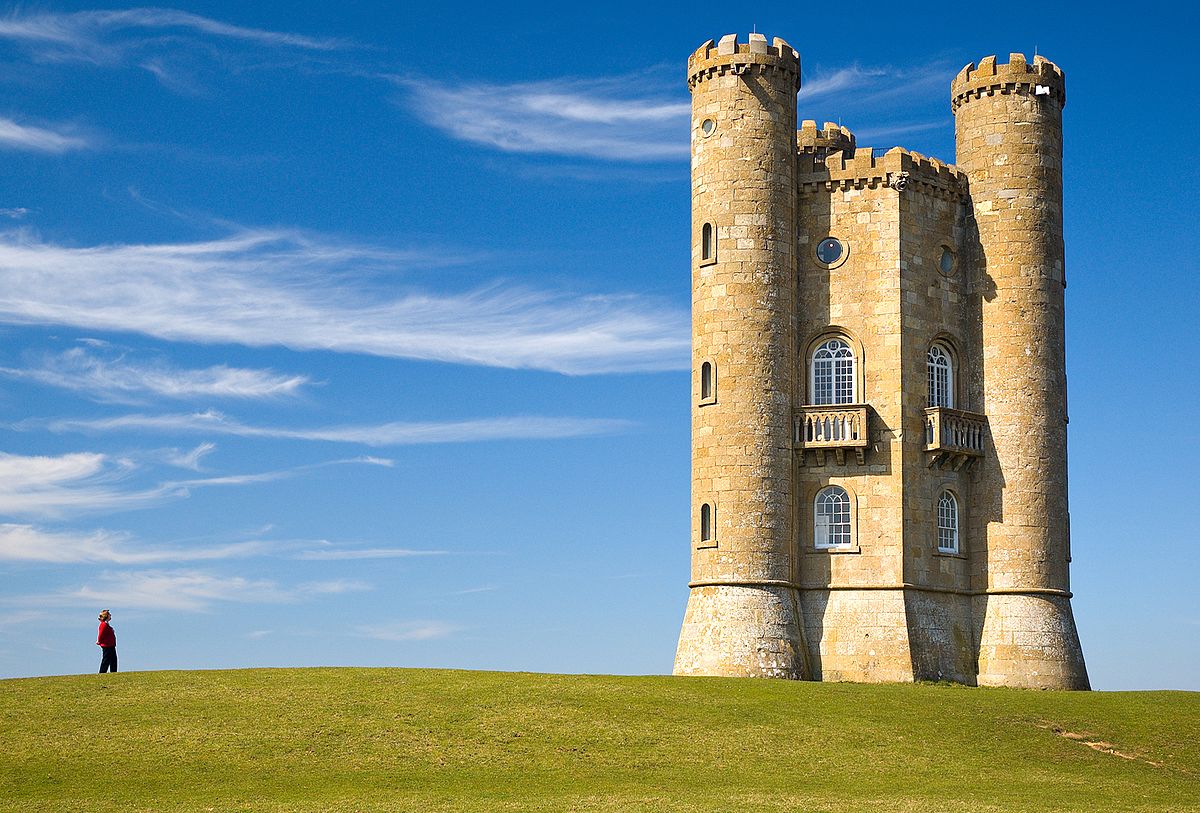
Broadway Tower is a beautiful folly which sits atop Beacon Hill, the second highest hill in the Costwolds, after Cleeve Hill. This tower was the brainchild of Lancelot ‘Capability’ Brown and built by James Wyatt for Lady Godiva between 1798-1799. Lady Godiva wondered whether she could see a beacon from her house in Worcester, some 22 miles away. She must have been chuffed that she could in fact see the beacon clearly. Phil and I visited this wonderful monument following another Walking Englishman Walk. Walking outside was at the time one of the view government sanctioned ways to meet up to people without falling foul of the law.
In the late 1950s, Broadway Tower monitored nuclear fallout in England; an underground Royal Observer Corps bunker was built 50 yards (46 m) from the Tower. Manned continuously from 1961 and designated as a master post, the bunker was one of the last such Cold War bunkers constructed and, although officially stood down in 1991, the bunker is now one of the few remaining fully equipped facilities in England. Wikipedia
The view from Broadway Tower was quite stunning. We went on one of the last days of summer and could see as far as sixteen counties at once, not sixteen countries as I pronounced when there.
Interestingly, around 1870, Sir Thomas Phillipps, aniquary and book collector, used the tower as his printing press. You’ll be glad to know he collected the largest collection of manuscripts in the 19th Century. He spent almost all of the substantial estate he inherited from his father on vellum, a sort of calf skin paper. the Magna Carta, for example, is written on vellum. Please see below another snap shot of the glorious view from Broadway Tower.
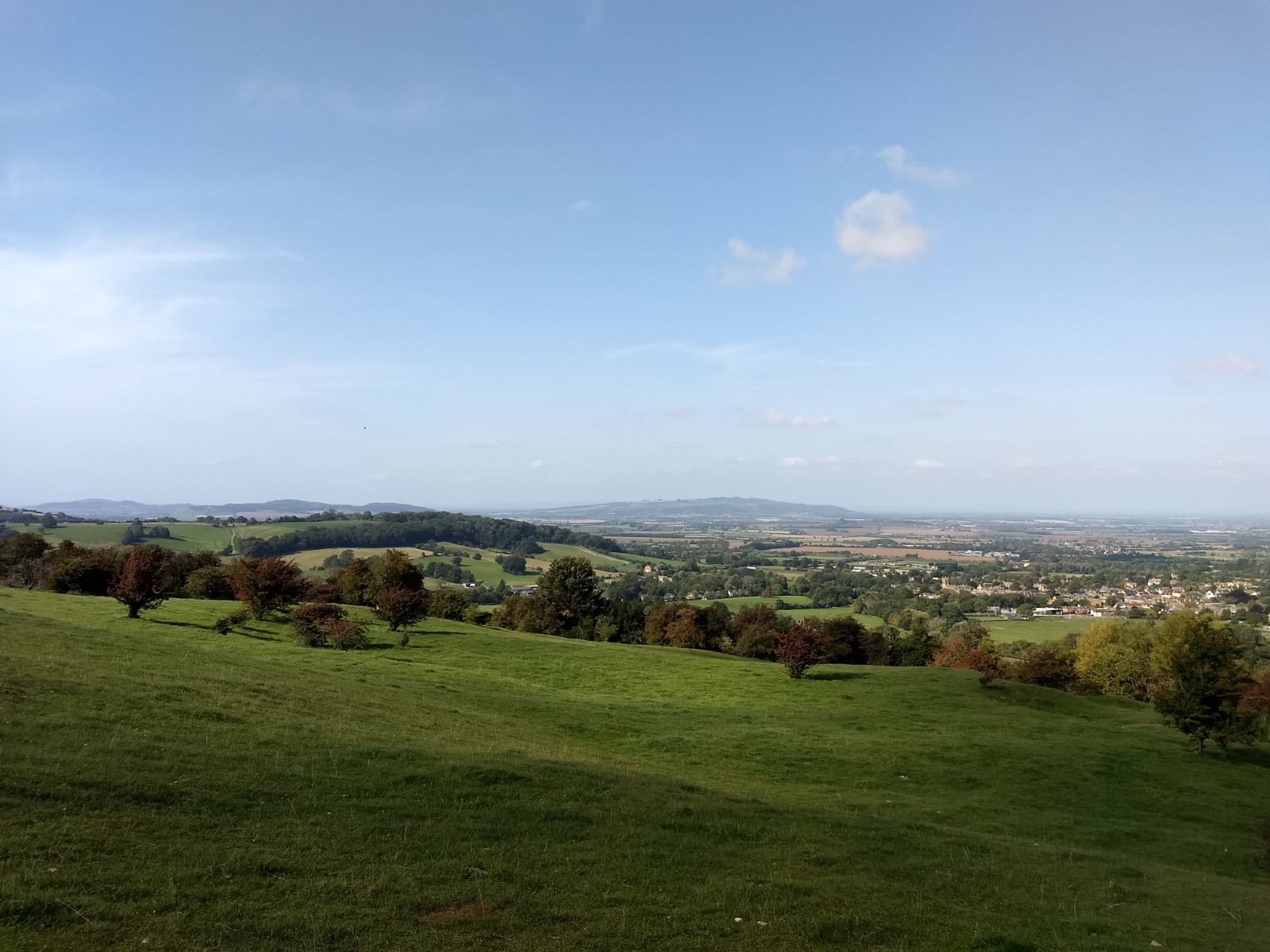
In summation, I hope you have enjoyed this brief history of a wonderful monument with a magnificent view. I have had to pinch the cover photo from the official website because we arrived just after 11am which meant that the hordes of tourists had descended and I would not be able to post any of the photographs we took for fear of data protection breaches. But to appease the photo hungry among you, please find attached one final picture of this excellent view atop this monument. I hope you will visit. There is a museum in this tower now but sadly due to the nature of our walk we were unable to visit it.


by Cedric | Oct 11, 2020 | Art, General
You will have seen a few surrealist posts on the blog recently, it was only right I should write one about one of the great contributors to this artistic movement. René Magritte (1898-1967) was a Belgian born artist whose work was primarily in the genre of surrealism. Many will know the famous Son of Man, the portrait of the man with the bowler hat and an apple in front of his face. This post will focus on less famed works of his which I find personally thought provoking.

The Lovers, 1928
When I first re-discovered Magritte, I looked at the totality of his career and picked a few pieces that stuck out. The Lovers was one such piece. The theme of frustrated desires is common in Magrite’s work and even more common in our current COVID situation. Don’t worry, the viral references stop there. This piece has rather struck me and I’ll tell you because why. Above the frustrated desire reading, one can interpret this as an exploration of the idea that we can seldom reveal the true extent of who we are, even to those most close to us.
The fabric is done beautifully, the shading is impressive and the background is sufficiently simple that we can focus our attention on the lovers themselves. People’s skulls are, apparently, not as shapely and spherical as depicted. It is more of a rounded triangle with a bulbous bottom from the profile. In addition, the rest of the painting is crudely rendered. The tie and collars look as wilted as the kimchi we have just made. The lady lover’s arm looks like unfired clay and their outfits are almost an afterthought. But in spite of this I am quite taken by it.
Enshrouded faces were a common motif in Magritte’s art. The artist was 14 when his mother committed suicide by drowning. He witnessed her body being fished from the water, her wet nightgown wrapped around her face. Some have speculated that this trauma inspired a series of works in which Magritte obscured his subjects’ faces. Magritte disagreed with such interpretations, denying any relation between his paintings and his mother’s death. “My painting is visible images which conceal nothing,” he wrote, “they evoke mystery and, indeed, when one sees one of my pictures, one asks oneself this simple question, ‘What does it mean?’ It does not mean anything, because mystery means nothing either, it is unknowable.” MOMA

Time Transfixed
Time Transfixed is another oil on canvas painting. This was originally a commission by Edward James, art collector, to be displayed in the ballroom of his London home. Magritte has transformed the coal burning stove into a churning LMS Black 5 4-6-0 Locomotive headed straight for the viewer. Its original title, La durée poignardé, actually translates as Time Stabbed rather than Time Transfixed. Magritte wanted this painting installed at the bottom of James’ staircase so it would ‘stab’ the feet of his guests on their way up to the ballroom.
The combination of a train and a fireplace puts the two in sharp contrast and allow us to consider both individually. Magritte wanted to ‘evoke the mystery’ of both aspects of the painting. I should say he succeeded in this respect. On an aesthetic level, the train is quite beautifully rendered too.
The artist later explained this picture: “I decided to paint the image of a locomotive… . In order for its mystery to be evoked, another immediately familiar image without mystery—the image of a dining room fireplace—was joined.” The surprising juxtaposition and scale of unrelated elements, heightened by Magritte’s precise realism, gives the picture its perplexity and allure. Artic

The next piece we will consider, below, is Perspective: Madame Recamier. This is the one which took me most by surprise. Hitherto Magritte has consistently succeeded in making me think about certain things in completely different ways but this one made a lasting impression. Madame Juliette Recamier was a Parisian socialite whose salon was frequented by many important, and doubtless a few self-important, French people. There is a famed painting of her by Jean Louis David, below, which Magritte seems to parody here.
Perspective: Madame Recamier
If you compare the above to the original below, you will see that there is a noticeable difference. To me both are phenomenal in their own right. The original is a beautiful and flattering depiction of a young socialite at the height of her social powers. Each element is delicately portrait and adequately spaced to give its central figure an even more elevated status.
One can surmise the addition Magritte has chosen. I am impressed by the way the his piece has sharpened elements of Jean Louis David’s work and made everything clearer. I am interested to know why he chose to leave Mme Recamier’s dress visible. But most of all the addition of the coffin says something fairly startling. It is in effect saying that when we admire commissioned portraits of figures, we are essentially looking at cadavers. This thought will follow me now as I look at new pieces of art in the future.

Madame Recamier original, Jaques-Louis David
Overall I know Magritte will become a favourite artist for me. His perspective is as enlightening as it is jarring. I do not think I will look at art the same way. I hope these pieces have evoked some joy in you. I look forward to reviewing the next Magritte paintings which strike me.

by Cedric | Oct 7, 2020 | Food and Drink, General
I hesitated for a moment when drafting this post, I considered putting the Tannin Level in the art category of Cedric Suggests. The Tannin Level was always a place I would aspire to dine when living in Harrogate. By virtue of my, then, extreme youth, I did not have the funds to do so. Thankfully the times have changed and in my favour. This was the first stop we made on our way up to the Yorkshire Dales and was well worth the two hour drive.

The Tannin Level is a below ground restaurant on Raglan street in the heart of Harrogate which boasts some of the finest and most reasonably priced foods in town. We began with the Tasting Board which consisted of mini fish & chips, Smoked haddock & leek fishcake, honey roast chorizo, crispy halloumi, chicken liver parfait, dressed leaves and grilled bread. It is difficult for me to pin down a favourite component of this lavish tasting board as everything was exceptional. Perhaps the most fantastic was the chicken liver parfait, which, as the name suggests, was perfect. It reminded me of the home made parfait I would have at Christmas in France. The waiter did reveal to me that this was likely because the parfait, as with everything else on the menu, was made fresh on the premises each day.
The chorizo was delightfully oily and yet somehow soft. The halloumi was seasoned in a way I had not encountered before. More on the batter on the fish and chips below…

What amazed me about the fish and chips was the way the batter stuck to the fish itself so tightly. This is achieved by adding baking soda and some sparkling water to the batter mix. This helps with wasted batter and gives a far more accurate picture of what lies beneath. Additionally, my worry with fish and chips is often how much batter there is on the damned thing. I will usually be full once a fraction of this batter is consumed so was most grateful to the Tannin Level for eliminating this problem. The haddock itself was divine as we had come to expect. The mushy peas were also a star of the show, they were pureed to perfection and had a tantalising flavour which I am at a loss to describe to you.

Nick and I ordered the Trio of Pork which consisted of crispy Yorkshire belly pork, 6 hour braised pork cheek, French black pudding pasty, buttered mash, honey glazed Chantenay carrots, baked apple puree and red wine jus. This was nothing short of masterful. The black pudding was encased in home made pastry and was so fine in texture I could not believe what I was eating. It was beyond anything I expected. I’ve never been one for crunchy meat. The remaining pork on my plate did not last very long. It was so soft and flavoursome. It fell apart on the fork but still held together enough to be chewy. The apple sauce was probably some of the best I have ever tried. There were only a few splodges here and there but it was enough to make a marked impression on me. Overall a sensational dish.

We were so thoroughly impressed with our meal at the Tannin Level. I am now cross with myself for not going more often when I lived in town. If you are in Harrogate and have a spare £20, go for lunch at the Tannin Level, you won’t regret it one bit!
by Cedric | Oct 3, 2020 | Art, General
Henriëtte Ronner-Knip (1821-1909) was born in Amsterdam to Josephus Augustus Knip and Pauline Rifer de Courcelles, both artists. She was the first woman admitted as an “active member” to Arti et Amicitiae, a prestigious art society in Rokin in the Netherlands. From 1870 she painted her most famed works, focussing on cats and dogs in bourgeois settings. We shall focus on a few of them below.
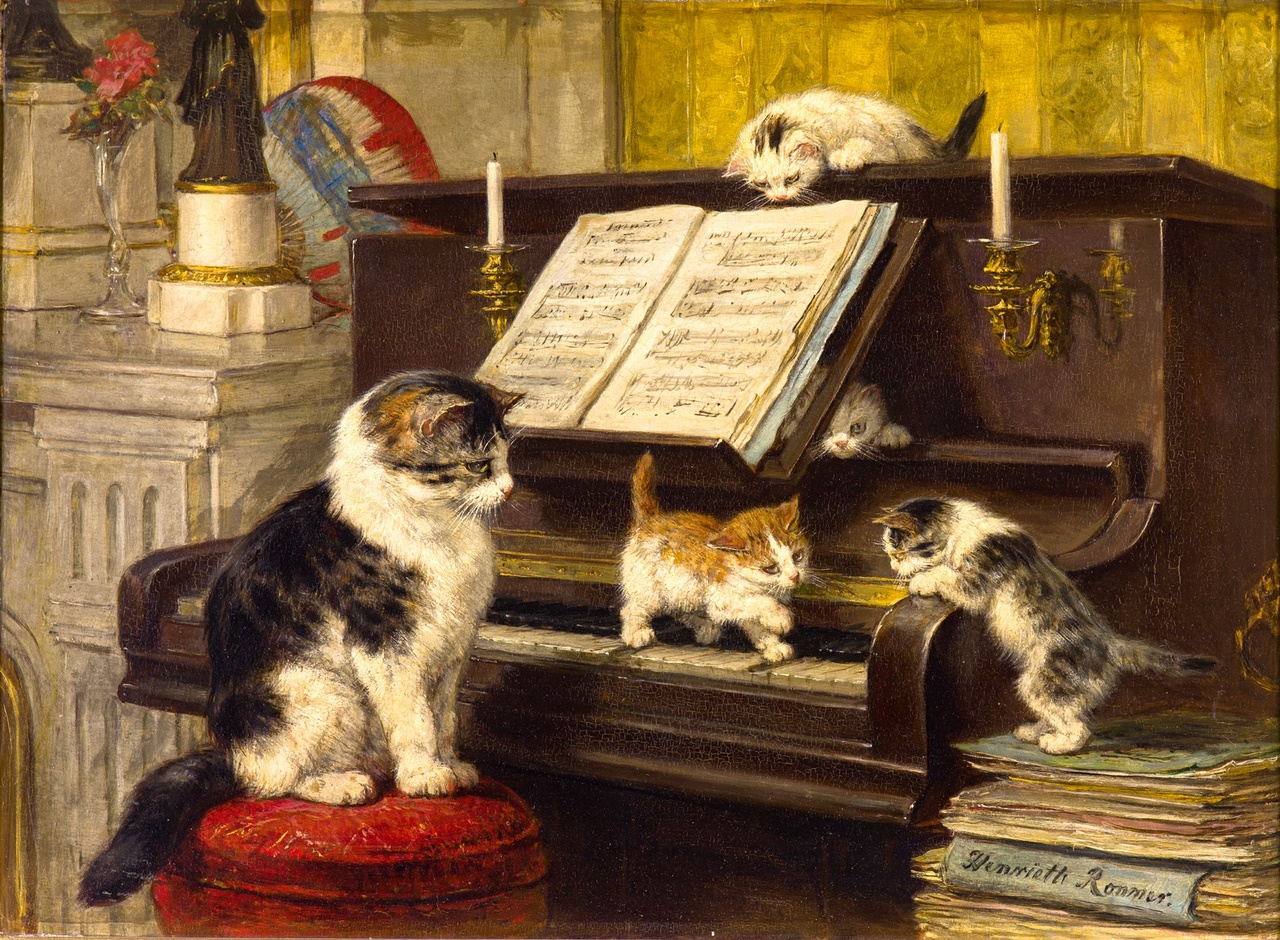
The Piano Lesson 1897
This was my first introduction to Ronner. I am a cat person myself hence I shall be biased in favour. This above painting is truly adorable and exquisitely well done. The scene would be beautiful even without the cats. The piano is rendered beautifully, the dull, weathered dark wood being a particular highlight. The marble statuette in the top left has a lovely reflection on the rich table top. The candle holders are lovely and ornate. In addition to all of this… cats! My favourite is the one hiding behind the sheet music. I am also deeply enamoured of the weary mother cat watching on, exhausted.
Kittens at Play

This is perhaps less refined than the one above but is still delightful. The surroundings are not as clear cut, one is not exactly sure which room the cats are in, tormenting their poor mother. What we do know is that one has managed to pearce a sheet of paper, another is having a nice conversation with Mother and one is falling into a box and looks quite distressed. My favourite kitten in this painting is that one clinging for dear life onto the curtain. The detailing of the cats’ coats is beautiful. Mother cat is most likely a Turtle Shell cat and looks quite divine.
Mostly sentimental portrayals, her paintings rarely offer any metaphorical meanings and are focused only on the cats themselves. She studied her cat subjects avidly and with sincerity. She even went so far as to construct a specially built glass-fronted studio in which her cats could freely scamper about, sleep, and get into the types of trouble that only cats can get themselves into. Daily Art Magazine
Cat At Play

For our final piece we will study a lone cat being mischievous with. This Moggie is clearly in its master’s games room or office, as evidenced by the smouldering cigar in the right foreground. The cat is occupying itself by playing dominos, or at least moving the pieces around as it sees fit. Its reflection in the finely lacquered table is very well executed, as is the shadow of the pencil perched precariously on the table edge. I also like the artist’s name on the marble plinth in the corner.
These paintings are just lovely and adorable. There is not much to think about beyond this, which is a bonus for this reviewer. I thought it might be useful to contrast these with the below.
Cecilia Beaux – Sita and Sarita (1921)

This was a portrait of Sarah Allibone Leavitt, Beaux’s cousin, with a black cat perched on her shoulder. This and the earlier paintings are linked by the idea that they don’t mean anything profound, they are just excellent paintings of cats. Beaux’s painting was accused of being witch like in its mystery. Beaux’s sister later remarked: “Please make no mystery about it—it was only an idea to put the black kitten on her cousin’s shoulder. Nothing deeper.”. I love how the cat appears to merge with Sarah’s hair. I also admire the luxurious way the white fabric has been rendered. All in all an excellent delightful painting.
I hope you have enjoyed a much needed vacation from excessive thought in reading this post. Sometimes we need to stop thinking so deeply about things and just appreciate them for what they are.

by Cedric | Sep 22, 2020 | Art, General
This wonderful offering by Thomas Eakins (1844-1916), a Philadelphian artist, depicts the events of a famed rowing race on the Schuylkill River in May 1872. Eakins was an important American painter, photographer, sculptor, and fine arts educator. H graduated from the Pennsylvania Academy of Fine Art in 1866. He is said to have carried American Realism to its height. The Gross Clinic (1875) is considered one of the most importance pieces of American art. But today, we shall focus on The Biglin Brothers, featured below.
Thomas Eakins was at the forefront of Realist painters who shifted the focus of American art from landscape to the figural subjects favoured by the European academies in the 19th century. Working in oil, watercolour, sculpture and photography, Eakins is renowned for his pictures of outdoor activities and portraits of intense, brooding figures—many of whom were his friends and acquaintances—pictured in darkened interiors. Influenced by the motion studies of Eadweard Muybridge [(1830-1904)], Eakins was fascinated by the male physique, often unabashedly photographing his models in full nudity while boxing or wrestling. Artsy
For me this is a triumph in composition. The way motion is depicted is just superb. Observe the way the rowers’ arms are locked and the clarity with which their hands gripping the oars is depicted. This is even correct down to the thumb detail on the first rower’s right hand. Following on from the earlier point of Eakins being inspired by Eadweard Muybridge’s motion studies; look at the four different sets of rowers shown in this picture, all at different stages of motion. We can draw a direct parallel here with Muybridge’s motion studies, one of which is included below. I have chosen the camel in motion because the others are mostly nude and this post will be going up before watershed.
Another aspect of this which I think is executed very well is the reflection in the water. It cannot be overstated that it is very difficult to depict water. The detailed split reflection in the foreground of the painting helps us to focus on the rowers in the foreground. In addition, the luminosity of this piece is excellent. Eakins has portrayed the two rowers with light coming from their right and created a sort of spot light for them, while also allowing shadows of the other rowers to be cast in the water in less detail.
Finally, I love the addition of the blue flag matching their hats and the steamboat in the right hand corner of the painting. Seen together as a whole, the elements of this painting meld to make a delightful picture of a day at the races in Philadelphia.

Eadweard Muybridge – A Camel in Motion
I shall endeavour to investigate Eakins’ work with added zeal and may well take on the task of reviewing his masterpiece. But for now, I hope you have enjoyed this small tribute to a magnificent painting.

by Cedric | Sep 18, 2020 | Art, General
Camille Pissarro (1830-1903) was a key figure in the impressionist and post impressionist movement. His works were key in the progression of both. He counted amount his great friends and colleagues Claude Monet and Edgar Degas. He preferred to work in the outside, capturing gorgeous moments like the one below. An interesting fact about Pissarro is that he married his mother’s maid and had eight children with her.
The painter Camille Pissarro was the most artistically innovative and socially concerned, most revered, and eldest of the famed and courageous group of French painters known as the Impressionists and Post-Impressionists, and the only Jew among them. Mentor, friend, enthusiast, perhaps their leader, he was a major figure in this French art world. At his memorial in 1904 Octave Mirbeau proclaimed, “Camille Pissarro was one of the greatest painters of this century, and of all centuries.” WideWalls
Late Afternoon in our Meadow is an excellent example of Pointillism. Pointillism is a technique of neo-impressionist painting using tiny dots of various pure colours, which become blended in the viewer’s eye. Seurat developed this art form most and we will discuss one of his pieces in a short while. I saw one of Pissarro’s Pointillist pieces in Birmingham Museum and Art Gallery. The Pont Boieldieu, Rouen, Sunset was a sensational piece and I look forward to when the gallery opens again. The great thing about Pointillism is that the further away you are from the painting, the clearer it becomes. The closer you get the more vivid the colours become. It’s a win win.
I was drawn to Late Afternoon in our Meadow because of the rich purple in the centre. I was then taken by the way Pissarro has succeeded in bringing to life so may elements in this meadow, from the woman in white to the young trees in the foreground, extending to the single cypress tree in the background. I think it is a lovely painting and a lovely example of pointillism.

The Channel of Gravelines, Petit Fort Philippe, George Seurat 1890
This for me is the high mark of Pointillism. Seurat has depicted a beautiful scene at the Petit Fort Phillipe. The boats are just gorgeous, the variety of boats depicted is lovely. The shadows depicted by the walls are masterly. The scope of the painting and the depth is also impressive. I like the way the whole painting is framed by slightly darker pigment dots around the borders is great. There is a sense of refinement and beautiful luminosity in this painting. I especially like the reflection of the lighthouse in the water.
His systematic application of dots in colours carefully chosen according to laws of chromatic harmony results in unparalleled luminosity. Seurat painted a narrow border of darker dots around the edge of the canvas, heightening the brilliance of the light. Indianapolis Museum of Art Collections Handbook.

Palais Ducale, Monet (The Doge’s Palace) 1908
Moving from Pointillism, I wanted to highlight a Monet piece, following in the Impressionist theme, the Palais Ducale. This piece came to my attention following a piece in Art Newspaper. I was spellbound by it. The way that the palace is reflected on the water. The crude visible brushstrokes depicting so much motion and so many intricate details on the palace itself without the need for absolute precision is masterly to me. One even gets a glimpse of the well to do people wandering the corridor beneath the arches middle of the painting. This is so wonderful to me I felt I should share it with you.
I hope you have enjoyed these three Impressionist masters as much as I have. Until next we meet…
