Note: I have made references throughout this blog to timings for certain highlighted moments (e.g 0:06 of track 1) – this is in relation to a recording of the work I will link to below (follow along should you so desire)
Beethoven’s Eroica (heroic) Symphony – already the title tells us something, this is a work about heroism. Instrumental music had not really ever been about things in this way before this point. True, there had for a long time been programme music, but never before had a work become so embroiled in the world of ideas, politics and philosophy as this one became from its inception. The “Eroica” of course was not the original title. This was a symphony to be dedicated to a specific hero: Napoleon. It was to be Beethoven’s “Bonaparte Symphony”. Well that was until the former crowned himself emperor, and in response the composer angrily crossed out the dedication on the score. There were other heroes too in the composer’s mind when writing. Consider, for example, that the theme from the final movement is taken from his earlier music for the Ballet: ‘the Creatures of Prometheus’, and that this theme is in fact related to the opening heroic theme of the symphony. Could this then be a Promethean symphony, dedicated to the titan Prometheus who brought fire to mankind? The question to whom this symphony is really dedicated remains to a large extent unanswered, but is a question that I should wish to return to at the end. For now, though, I will focus on the heroic accomplishments of the music.
Image from the manuscript of the Eroica, with Bonaparte angrily crossed out
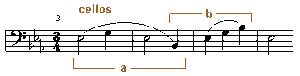
The symphony begins with two great thundering chords of E-Flat major (0:06 of track 1), so familiar yet each time sounding so thrillingly new. An introductory staccato statement of chords such as this was not an uncommon device at that time, a kind of call to attention for the listener. In Haydn’s first quartet of his Opus 76 set, for example, he begins with three sharp chords, a kind of wake-up call to his aristocratic patrons that now was the time to stop chatting and start listening. But in this case, it feels different. It sounds more like a call to action. Then there begins a theme in the cellos (0:09 of track 1). It is a theme of utmost simplicity built to large extent from intervals of a third. It is in essence rather like a bugle call, but do not be deceived, this is the heroic theme upon which Beethoven will build an immense structure. The key is significant. From the first chords onward up till this point, we have been firmly in the symphony’s home key of E-Flat major. E-flat major was seen at the time as a noble key, a key associated with the enlightenment and works like Mozart’s Singspiel ‘Die Zauberfloete’. The choice was almost certainly deliberate.
Illustration of the opening heroic theme, taken from a website offering an analysis of the work
We are not, however, allowed to dwell in this safe home territory for too long, the music moves down through D-natural to rest at C-sharp (0:13 of track 1). A false note, not within the E-flat major scale. In this short passage, then, already we see a microcosm of the whole movement, a movement which will evolve to become a titanic struggle. Although, we are reassuringly brought back to our home key by the strings and woodwind, the message is already clear: this symphony’s beauty will be built from conflict. It is not long before we encounter our second conflict, this time one rhythmical in nature (from around 0:30 to 0:42 of track 1). So far, the movement has kept unambiguously to its 3/4-time signature. This means there has been a natural accent on the first beat (123, 123, 123), but Beethoven now adds accents or sforzandi on alternating beats so that the meter becomes ambiguous (123, 123, 123, 123, and then, 123, 123). The listener will feel the violence in the music from these forceful sforzandi accents that intrude on the flow of the 3/4 meter.
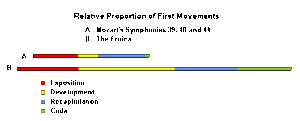
From the start onward, then, the movement is full of struggle. It is also grand in size and scope. Beethoven expands the sonata-allegro form that Haydn and Mozart had utilised to suit his titanic designs, in particular, he enlarges the development section and coda greatly. The development section of the Eroica is extraordinary, it includes a passage of immense intensity in which dissonant chord is followed by even more dissonant chord (7:23 – 7:56 of track 1), and afterwards the composer shockingly introduces a new theme in E-minor (8:06 of track 1). The coda is developmental to a greater extent than ever before heard in a symphony, but also crucially to the drama of the whole work, it refrains from bringing the tension to a final close. That will have to wait until the very last movement (13:05 to the end of track 1).
First movement proportions in comparison to works by Mozart (taken from the same website), Mozart’s last three symphonies = A, Eroica = B
The Second movement is a funeral march, something never before included in a symphony (though there is a funeral march in Beethoven’s piano sonata No. 12 published in 1801). By using a funeral march Beethoven was making a reference to the public ceremonial music of the French Revolution, and thereby associating the work with the radical politics of his day. Significantly, this movement can be used to refute any simplistic interpretation of the work as a programmatic piece about Napoleon, since the French general was still very much alive and on the scene at the time. The limited space I have here compels me to focus on one particular moment of this movement and that is the fugue around the mid-point of the movement (from 5:51 of track 2). This is a moment of such sublime, impassioned beauty that it simply demands to be highlighted. With the third movement the audience is to some extent offered a respite from the intensity of the music, though the musicians are certainly not let off from the challenges of the score. I am thinking particularly of the trio section (the middle part of this movement), in which the first horn must play music towards the high end of its register while the two lower horns must execute a difficult passage towards their lower end (2:35 – 3:57 of track 3).
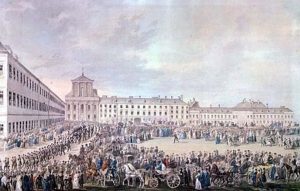
Painting of the procession at Beethoven’s own funeral in Vienna (1827)
As I briefly mentioned above, the main melody from the last movement is found in the composer’s earlier Ballet music for ‘the Creatures of Prometheus’. This meant that Beethoven probably envisaged this final movement first, though the work of musicologists has shown he composed it last. We do not begin, however, with the tune, but instead after an initial burst from the strings (0:00 of track 4), the orchestra outlines the bass line of this theme (0:12 of track 4). This is a theme and variations movement, in which the melody of the theme is heard for the first time only in the third variation (1:51 of track 4). The theme metamorphoses before our eyes through a variety of guises, at times light-hearted, at times serious and grand, and Beethoven demonstrates profoundly his contrapuntal mastery at several points. Towards the end, we have what is for me a truly glorious moment in which the horns take up an augmented version of the melody (7:47 of track 4). A fog of doubt prepares us brilliantly for the final orchestral eruption leading to a triumphant finish for the movement and the symphony.
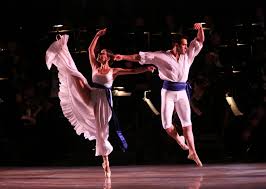
An image from a staging of the Ballet “The Creatures of Prometheus”
But a triumph for whom? We are, again, confronted with the same question all these years later, who is the hero to which this heroic symphony is ultimately dedicated. Is it Napoleon, dubbed the World-Spirit on horseback by Hegel, who ultimately disappointed so many liberals in Europe including Beethoven? Or is it Prometheus, the mythical Titan and benefactor to mankind, who appeared to be the archetypal hero for the enlightenment. I myself am more attracted by other interpretations. Wagner suggested it was the artist and Beethoven in particular who was the hero. This man who lost that sense most dear to him: his hearing, but who nonetheless struggled through it all anyway, despite the immense pains of illness, the personal strife, the unending setbacks. Without a doubt Beethoven seems to be a very suitable choice. But I would go a step further and caste us all in the role of hero. In the end, every life involves struggle, all life includes sacrifice, those that can take it upon themselves to face the challenges of the world and who choose to live and to live life to its fullest extent can consider themselves heroes.
Here is the recording upon which the timings are based, you are more than welcome to choose your own performance but please note the timings could be very different if you do:
“What does matter is that Led Zeppelin represents the rock ‘n’ roll you’re meant to believe in as a teenager. We’re naive to ignore the musical perfection and hungry enough to enjoy the feels. Consequence of Sound” Reading through reviews of LZII, I found this above quotation struck me most. You see, as a teen, I inherited my first record player. This was a monstrous four tiered Sony beast of a machine with a tape player, CD player, radio and turntable all in one. In truth this was the beginning of my life in music. When my Great Grandfather moved homes, I got the record collection. In this collection was LZII. I cannot count the amount of times I have heard this album since my teenage years but it is certainly up there as one of my favourites. LZ aficionados will readily tell you this isn’t LZ’s best work, and they might be correct academically, but this is my favourite of theirs, and my blog. Above all, rediscovering its brilliance has struck me harder than any other album this month.
Led Zeppelin II, which came out in October ’69, just nine months after its almighty, self-titled predecessor, must have benefited from the fast turnaround. The recording process was completed at different studios during the band’s near-constant touring in 1969, and maybe the reason it was so successful was the London group, while on the road, didn’t even have time to think about the hype they were building. With LZII, Led Zeppelin became Led Zeppelin, proving their essence at the same time. To speak cosmically about the matter: What happened was what was supposed to happen. Consequence of Sound
LZ consists of vocalist Robert Plant, guitarist Jimmy Page, bassist/keyboardist John Paul Jones, and drummer John Bonham. Each get their own moments to shine throughout the nine tracks on this album with solos seemingly coming from nowhere to entice and enthral the listener throughout. Produced by Jimmy Page, this is the first true flexing of LZ’s muscles and shows us what the band is truly capable of.
Like I listened to the break (Jimmy wrenching some simply indescribable sounds out of his axe while your stereo goes ape-shit) on some heavy Vietnamese weed and very nearly had my mind blown. Rolling Stone
While I did not have the luxury of “heavy Vietnamese weed”, or indeed any of the other narcotics John Mendelsohn then goes on to describe he was on while listening to this track, I was similarly amazed. Page’s solo, introduced by Bonham’s teasing drums and Page’s shrieking in line with swelling guitars, is difficult to comprehend and ties together a seamless rock anthem which is now instantly recognise-able as one of LZ’s crowning jewels.
The Lemon Song, while featuring some questionable lyrics (“Squeeze my lemon, till the juice runs down my leg”), this may be my favourite on the album. One can recognise the lemon’s phallic symbolism here as being rooted in the blues which preceded LZ. Indeed Willie Dixon did sue LZ for Bring It on Home, LZII’s closing track. This was a blatant cover of a Sonny Boy Williamson blues song of the same name, written by Willie Dixon. But back to the Lemon Song, watch out for the glorious Page/ Bonham solo in the middle which once again, comes out of nowhere and builds to a magnificent crescendo. Listen also for Jones’ impossibly great bass sustaining this track gloriously. For cross reference, listen to the following tracks:
Killing Floor – Howling Wolf
Traveling Riverside Blues – Robert Johnson
Living Loving Maid is another. “Alimony, alimony, paying your bills”. This track is perhaps a bit repetitive but certainly sets the mood for what is to come and is danceable to a T. It is also described as ‘eternally hummable’.
For every young person who discovers “Whole Lotta Love” and “Heartbreaker” and “Living Loving Maid (She’s Just a Woman)”, there’s an older person who gets sick of them from overplay and doesn’t need to ever hear them again. Pitchfork
Ramble on is another highlight. The riff that keeps riffing. Watch out for the Lord of the Rings reference bid song. My final highlight is the instrumental Moby Dick, which showcases Bonham’s genius drumming in the same way as the closing track on Cream’s Fresh Cream, Toad, showcased Ginger Baker’s drumming prestige.
Overall, this is a remarkable album which holds very fond memories for me and I hope it will be able to deliver these to you also, in these trying times.
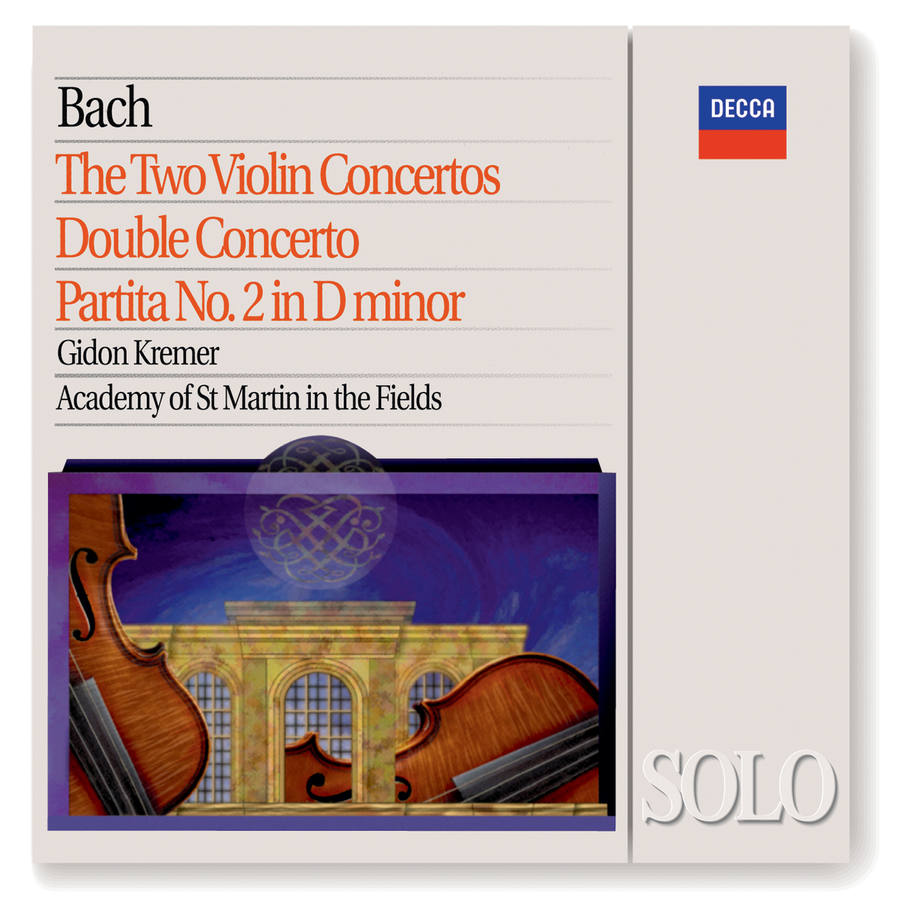
I hope you will forgive me for the almost mythical length in the title of this post. Equally I hope you will forgive this AOTM not being pop. At the end of the month, I reflect on which album has moved me the most. In February, it is this one. There is no doubt in my mind that what Gideon Kremer and the Academy of St Martin in the Fields (herein the Academy) have achieved is nothing short of miraculous. This review will be split into three sections because I believe each piece deserves to be considered in its own light.
The Two Violin Concertos
BWV 1041
Out of Bach’s vast body of work, only two Violin Concertos survive (BWV 1041-1042). Both are included here and played so beautifully by Gideon Kremer and the Academy of St Martin in the Fields. The first movement is all excitement and ebullience. Bach’s precision is at its most foreboding in the second movement of the first concerto, for me.
This second is the first evidence in this album that where we hear the violin’s voice. To me it speaks of sorrow, anger and impatience, with the central motif returning almost hauntingly towards the end of the movement. The final movement returns to a faster pace. The harpsichord is demanding of one’s attention from the outset. It is important we do not underestimate its power in all three pieces here.
The finale is described as ‘rolling and jolly’. Bach uses a technique for the violin soloist known as bariolage, “a special effect in violin playing obtained by playing in rapid alternation upon open and stopped strings” Meriam Webster. Pay attention near the end of the final movement, it is quite astonishing and almost overwhelming.
Most of these concerti date from Bach’s so-called Cöthen period from 1718-1723, a happy, productive time for Bach. His new employer, Prince Leopold of Anhalt-Cöthen seemed to be fond of the latest fad, the Italian-style Concerto, as typified by Vivaldi. The older German version had four movements, but Bach quickly adopted the Italian three-movement fast-slow-fast structure, the form that propelled it into the Classical period. Good Music Guide
BWV 1042
The second Violin Concerto opens with a simple melody which lures one into a false sense of security, following by a joyful burst of beautifully harmonised violins and harpsichord. This beautifully repeated melody is repeated and added to throughout the first movement building up to a really remarkable crescendo towards the end. Again, watch out for the importance of the harpsichord and the haunting use of double bass. Kremer plays with such magnificent vigour, bringing bursts of life into Bach’s composition.
The second movement is as compelling as it is haunting. The bassline is simple and repetitive but it underpins and lends support to the soloist and harpsichord. This is a crystal clear example of Bach’s ability to give voice to his instruments and create emotion through this voice. Listen to the second movement and ask yourself, what is Bach telling me? What was he thinking when he composed this? What was he trying to convey? I hear sorrow, passion and hope. Not to mention how impossibly beautiful this movement is. I find myself ready to shed tears at multiple points when listening to Bach’s compositions.
The final movement is once again a return to faster pacing. the second violin is imposing here, adding gusto the first violin, which leads the ensemble marvellously. This movement is an uplifting finale to a moving concerto.
The opening Allegro of the E major concerto is Bach at his most sunny and carefree. Podger and company exude joy, although they are occasionally a touch frantic: uplifting though their performance is, they never quite relax into the mellow composure this music needs. More effective is the soulful Adagio, contrasting dark intensity with sublime moments of golden light emerging from brooding clouds, and an ebullient finale. BBC Music
The Double Violin Concerto BWV 1043
This for me is the apex of classical music. The Double Violin Concerto is unquestionably the best piece on this album and perhaps of all time. If there were a classification system for masterpieces, this would surely sit near the top. Split into three movements; Vivace, Largo and Allegro, Bach masterfully conveys the violins’ unique voices speaking to each other and to us. A world of emotion is unveiled and conveyed so beautifully that I am reduced to tears every time I hear it.
Vivace
This first movement is enthralling form the beginning. Mathematically perfect, this movement combines the two violins and harpsichord to present an unstoppable onslaught of cohesion and remarkable beauty.
Opening with a Bachian fugue, each violin answering the other, rapidly alternating the melodic line, carrying different tunes yet so closely intertwined as to be inseparable, their combined voices miraculously greater than the sum of their parts. Good Music Guide
Largo
The Largo movement is sublime beyond description. this is uniquely illustrative of the fact Bach invented harmonisation for instruments. Never before had this level of communication occurred between instruments. Listening as I write, it is almost as though the two violins are speaking to one another in the style of a vocal Aria. Listen to the way it builds and falls with such keenly felt emotion. It is impossible for one not to be moved by this. The Largo is the pivotal movement in this concerto, providing . This movement is evocative, tender and deeply human.
Allegro
As though to shake us back to life after being emotionally pulverised by the Largo, Bach fills the third movement with a powerful recurring motif and solid recurring bassline. The insistence of each instrument to be heard is distinctively felt here. It washes over you in all its magnificence, all its mathematical perfection and all its impossibly complexity. The Allegro is almost a great architectural work, crowning the top of an already sound and extensive structure founded by the previous two movements. Kremer plays at his finest here and does not disappoint. I am agog that a piece of this level and concentration of beauty even exists. We are truly blessed to have access to this piece of music and, in addition, this extremely fine recording.
Partita No.2
Partitas are suites for solo instruments or chamber ensembles. They are unaccompanied. Here, Bach splits the Partita No.2 for Solo Violin into five parts, the Allemande, Corrente, Sarabande, Giga and Ciaccone.
Kremer faces the music nakedly and directly, without recourse to cohorts, gimmicks, clever arrangements, or anything other than the notes on the page. All Music
Kremer is left to play on his own here and delivers some of the most felt and emotional playing I have heard. These Partitas are complex to play and a challenge for any soloist. My personal favourite is the Giga. I believe the repetitive motif allows us to focus on the Partita as a whole and elicit from it a deep sense of humanity. The melody is remarkable, the recurring motif is intricate and the emotion is conveyed clearly and powerfully. It is no surprise that these partitas have become the go to for any violinist’s repertoire.
Kremer’s tone and expression are chimerical, unpredictable, and sometimes rawly emphasized, and it is sometimes hard to tell if he has deliberately marked out all his dynamics and bowings — as if parsing all those running sixteenth notes into motives and cells — or if he has merely left such decisions to the moment’s inspiration and spontaneously poured himself out in wave after wave of short, hiccuping phrases and exaggerated gestures. Ibidum.
Overall, this album completely staggered me. Beforehand I had known of classical music as an aide to revision and not truly appreciated its merit. It is thanks largely to St Nick and Louise that I have shed my ignorance. I was drawn to Brahms before truly hearing Bach and the genius he conveyed. I think Bach is now firmly my favourite. Nothing will compare to the Concerto for Double Violin. All of human sentiment is contained within and it is impossibly beautiful. The Largo is utterly sublime and I think will remain my favourite movement of classical music for some years to come. St Nick is right to say listening to Bach is a humbling experience and re-contextualises the world of classical music. He was the first to bring instrumental harmonisation to European classical music, previously only considered for vocal music. He was the first to give instruments a voice and make it heard. It is right that Bach is called the founder of modern classical music. I am in awe of Bach’s genius. There was no way that this album wouldn’t be AOTM.
I can think of no better way to end a decade than to laud the woman, the myth, the legend that is Grace Jones. It is not hyperbolic to state Grace Jones has had the second greatest influence on my life, after mother/father dearest(s) of course. Slave to the Rhythm was the first record I ever bought. I bought it for £4 from the British Heart Foundation in Harrogate because the cover was torn (The G and R in the corner are missing). This is still the pride of my record collection.
Few human beings have so fully embodied the notion of a “singular artist” more so than Grace Jones. In the annals of pop music and fashion, there has simply never been anyone else on earth quite like her—strong, severe, and otherworldly in every way, Jones has blazed a trail through popular culture over the past four decades that remains unrivaled in terms of boldfaced originality. Pitchfork
I find it quite difficult to write about Grace Jones. She means so much to me and to so many others. Meeting her in Piccadilly in 2014 was one of the highlights of that year, topped only by seeing her play live at Parklife Festival in Manchester. The potency of her presence is not to be understated.
Working closely with the Jamaican duo Sly and Robbie as her rhythm section, her brilliantly eclectic sound at the time fused elements of rock, funk, post-punk, pop, reggae and more. In more recent years this hybrid has been credited for influencing alternative acts like Massive Attack, Gorillaz, Todd Terje, Hot Chip and LCD Soundsystem. Tidal
How does one even begin to speak about Slave to the Rhythm? This was a concept album produced by the legendary Trevor Horn (founder of ZZT records). It is an autobiographical work which tells some of Grace Jones’ story in song but interrupted with fellow ZZT founder & journalist Paul Morely interviewing Grace. This album is etherial and enormous in scope.
An audio biography of Grace Jones, produced by Trevor Horn, it’s a sonic treat along the lines of Yes’s 90125 or Frankie Goes to Hollywood’s first album (both produced by Horn). The music ranges from slick R&B runaway grooves to striking audio montages, interrupted occasionally by conversation about Jones’s life. Serious ear candy. All Music
Ian McShane opens the album in a haunting rendition of John Paul Goude’s Jungle Fever. This sets the scene for a melodic journey through Grace’s wonderful vision. Grace worked with some of the best musicians there are (Sly & Robbie of course were Black Uhuru) to produce an album of such beauty that words to describe it are failing me. This had to be album of the year. It’s scope is enormous and I seldom utter a word when listening.
Stylistically, Slave to the Rhythm incorporates funk, R&B and go-go beats that encompass the classic ’80s sound that Trevor Horn is known for, while losing the reggae and new wave elements found on Jones’ previous trilogy of albums. Originally intended for British group Frankie Goes to Hollywood following their debut hit “Relax,” the album’s titular centerpiece ”Slave to the Rhythm” was written by Bruce Woolley, Simon Darlow, Stephen Lipson and Trevor Horn. In something of a unique approach, the album’s tracks are, in essence, radically different interpretations of the same original song. Tidal
Grace Jones changed my life. I remember the moment it happened too. We had just moved to our second house in England and my father made me a compilation CD called ‘Movin’ On Up’. Inevitably, the famous track by M People was on there. But the track which really caught me off guard was ‘I’m Not Perfect, But I’m Perfect For You’. Nothing was ever the same. Please enjoy Slave to the Rhythm, which is album of the year, but also the album of my lifetime.
Friends, loyal readers, people who dislike me reading this trying to find a chink in my armour (and failing), this is my favourite post of the year. In this post, I have the honour of paying homage to albums which I’ve truly enjoyed throughout the year, but for whatever reason have not made it to Album of the Month. This is also the longest post of the year, consisting of twelve mini-reviews. I hope you’ll do me the kindness to bear with as we embark on a retrospective musical journey through 2019…
A Storm In Heaven – The Verve (1995)
There is so much to say about this album. It is hair raising from the opening note. Filled with magnificent psychedelic delights, this album is almost overpowering in parts. The Verve’s prowess in taking on on a cosmic voyage through sound is unrivalled. This 1995 album is a gift to new generation rockers. Overall, this is an ethereal psychedelic journey of an album.
Standout Tracks
Already There (“I thought I watched my best years leave / then I watched them come back”) – reminiscent of Us and Them by Pink Floyd.
Sun and the Sea
A Storm in Heaven is the dark, mysterious stranger of The Verve’s discography. As drugs and creative differences eroded the band’s professional and personal relationships, they upsettingly exiled themselves from their debut’s inimitable personality. Drowned In Sound
2. A Deeper Understanding – The War on Drugs (2017)
I liked this album so much I had to buy it on vinyl. Another example of prime psychedelia rock, A Deeper Understanding does what it says on the tin. At points this album becomes deeply introspective and in a way allows us to reflect on our own vices. But in addition to being accessible, this does provide a high quality and large sound. The scope of this album and the beauty of its sequencing are not to be underestimated.
Standout Tracks
Pain (“I resist what I cannot change”)
Holding On
Clean Living
Granduciel’s work finds its meaning in the totality of its sound, in how writing and arranging and perfecting every detail in the studio is part of building music that carries you with it. His way of understanding the world is to use that sound machine to excavate and explore his interior life and hopefully shape it into something listeners might understand, even when he’s not entirely sure where he’s going. Pitchfork
3. Are You Experienced? The Jimmy Hendrix Experience (1967)
There are few albums which everyone can agree on as being superlative. This is one of them. As a debut album, the breadth Hendrix achieved here is astonishing. Are You Experienced covers rock, blues, soul and folk, culminating in a seminal rock n roll album. Rolling Stones considers it the 15th Best Album of All Time. “Rock’s most innovative and expressive guitar record” about sums it up. I wrote in my notes that this was a gift to Rock.
The sound forged on the album synthesized elements of 1967 psychedelic rock with traditional rock, blues, and soul. This was all topped off by the proficient and original guitar work by Hendrix, who used cutting edge techniques and technology to create sounds never before heard. Hendrix also composed solid songs, rooted in heavy blues and roots rock. This, along with the frantic but solid rhythm by Redding and Mitchell, gave Hendrix the perfect canvas on which to paint his guitar masterpieces. Classic Rock Review
4. One of These Nights – Eagles (1975)
One of These Nights didn’t make AOTM at the last minute because Country Joe & The Fish took me by surprise. I think it is remarkably accomplished and quite unique by comparison to the rest of their arsenal. This album seems to be journey through the lyricists’ pain. Lyin’ Eyes speaks of an adulterous woman, Visions talks of ambition and After The Thrill… well you can guess the subject matter. Overall I found the album beautifully sequenced, evocative and touching.
Their music reflects the Hollywood ethos of glamorous, narcissistic ennui, exhibiting the contradiction between the city’s atmosphere of “laid-back” machismo and its desperate rootlessness of spirit. Even the Eagles’ more plaintive songs have a surface sweetness that belies the jaded pessimism of so many of their lyrics. This sweetness, combined with superb arrangements, brilliant playing and the seamless vocal harmonies of Glenn Frey, Don Henley and Randy Meisner, accounts for the band’s popularity, for it evokes everything gratifying that people would like to fantasize about L.A. Rolling Stones
5. Adolescent Sex – Japan (1978)
In my top albums of all time, this ranks very highly indeed. Adolescent Sex is an album of supreme technical brilliancy with the relentless hooks and almost overwhelming rhythms. Every track is absolutely perfect and remarkably different from the last. The solos are outstanding. David Sylvian’s voice is magnificent, the whole thing is great, except one thing. the reason this is not Album of the Month is because it is too good. It should be Album of the Year. The reason it cannot be Album of the Year is because of the track Don’t Rain on my Parade which I believe is a complete butchery of the wonderful original by Barbara Streisand in the movie Funny Girl. Alas it must be relegated to Almost Album of the Month. AOTY must be perfect, you understand.
Standout Tracks
Transmission
Wish You Were Black
Lovers on Main Street
Television
Sparse, austere and melancholy are the last words you’d use to describe their debut and its successor, which took a randy sledgehammer to subtlety. They are abrasive, strutting, gobby, in-your-grill slashes of glam-punk-sleaze-funk, and pretty much everything the personnel, then aged around twenty, grew to aesthetically oppose. The Quietus
6. Air – Air (1971)
This is one of the treasures of my collection. I wish I had this on vinyl. While I will admit Googie Coppola (lead singer) does go a bit far at points in this album, her vocal range and the capacity of her voice are astonishing. She is able to captivate the listener and cut through the marvellous, complex rhythms underpinning each track. This is the height of funk and is a fantastic, excellently produced and splendidly varied album.
Standout Tracks
Mr Man
Realise
Man’s Got Style
Not to be confused with French duo Air, this group featured the amazing talent of Googie Coppola on vocals and an impressive cast of musicians who collaborated with Flora Purim and Ray Barretto. Whether it’s the funky groove of Mr. Man or the lighter touches of Jail Cell, the expressive voice of Googie blends itself in a unique way with great songwriting and a strong musical knowledge at work here. The beauty of a song like Sister Bessie is simply unbelievable and brings to mind some of Roberta Flack’s most memorable moments. Music is my Sanctuary
7. Blue – Joni Mitchell (1971)
Now this. I’ve been a fan of Hejira for a long while. Joni Mitchell’s ability to go on journeys and write about significant people or experiences she has, then translate them into a striking piece of music is remarkable. I found this acoustic album beautifully arranged. Joni Mitchell’s vocal range is so joyous to experience. This is a strong album on all fronts, superb arrangement, lyrically brilliant and melodies to die for. A truly special album which has become quite close to my heart.
Standout Tracks
California (not so subtle criticism of France, which I always applaud)
River (Listen to the Jingle Bells riff and see where she takes it)
A Case of You (heartbreaking love song)
The accompaniment — James Taylor and Joni strumming a nervous, Latin-flavored guitar part over a bass heartbeat that throbs throughout the song — perfectly expresses Joni’s excitement and anticipation. So does the melody, a dipping, soaring affair which she sings in her sweetest soprano. Rolling Stone
8. The Kick Inside – Kate Bush (1978)
Let’s open with the fact that Kate Bush was 19 when she released this. Some of the songs contained therein were started when she was 15. When I was 15 I was doing all sorts of ghastly things, like reading Garth Nix and thinking it was first rate literature. Moving on from my startling confession, This album continues a theme which has been unwittingly running through this post: namely that I seem to gravitate towards strong purposeful women in music. Kate Bush’s debut is an unquestionable masterpiece. The vocal range, the harmonies, lyrical mastery, the sheer strength of this wonderful woman make for a stunning album. This album is so much greater than I can express here. The Pitchfork review, quoted below, is most excellent. This could have been album of the year. Perhaps this should have been.
Standout Tracks
Every single one
Yes, the song “The Kick Inside” is about childbearing, but the young woman is pregnant by her brother and on the cusp of suicide to spare their family from shame. Subverting the folk song “Lucy Wan” (the brother kills his sister in the original), it shows the depths of Bush’s studies and her everlasting curiosity for how far desire can drive a person. She was signed at 16 but her debut took four years to make, during which she engaged multiple teachers in a process of spiritual and physical transformation. She pays tribute to their lessons alongside rhapsodies on unexplained phenomena, delirious expressions of lust, and declarations of earthbound defiance. Rather than feminine function or freak accident, these are the cornerstones of creativity, she suggested: mentorship and openness, but also the self-assurance to withstand those forces. Her purpose was as strong as any of them. Pitchfork
What made Bush’s writing truly radical was the angles she could take on female desire without ever resorting to submissiveness. “Wuthering Heights” is menacing melodrama and ectoplasmic empowerment; “The Saxophone Song”—one of two recordings made when she was 15—finds her fantasizing about sitting in a Berlin bar, enjoying a saxophonist’s playing and the effect it has on her. But she is hardly there to praise him: “Of all the stars I’ve seen that shine so brightly/I’ve never known or felt in myself so rightly,” she sings of her reverie, with deep seriousness. We hear his playing, and it isn’t conventionally romantic but stuttering, coarse, telling us something about the unconventional spirits that stir her. Pitchfork
9. Wild is the Wind – Nina Simone (1966)
Haunting is the first word I wrote down for this album. Nina Simone embodies pain, more than this, she makes you feel it. Every note of her music is dripping with soul and genuine feeling. It is a marvellous achievement that this is translated directly for the listener. This album, made of ‘leftover songs’, is perhaps disjointed in terms of sequencing but no less hard hitting. Four Women hit me right between the eyes. The way Nina shows her disapprobation for the treatment of women of colour in 16 lines is breathtaking. Nina’s take of James Shelton’s 1950 classic, Lilac Wine, never fails to make me sob uncontrollably. This is also true of Wild is the Wind (Dimitri Tiomkin and Ned Washington 1957), which features prominently in my Top Ten Tracks.
I believe Nina Simone is a stalwart of music and a gift to us all. We could all learn something by listening to this album.
Standout Tracks
Four Women
Lilac Wine
Wild is the Wind (This is in my top ten tracks ever)
“Although she largely interpreted other people’s songs, some of the strongest lyrical content in her catalogue comes from her own compositions, particularly “Four Women,” a spare, trenchant character study that manages to capture all the impossible contradictions of black American womanhood in just 16 lines.” Pitchfork
How best to describe her singing? Haunting is the first word to come to mind, although on 1966’s Wild Is the Wind—which was composed of songs left over from previous recording sessions for the Phillips label—she demonstrates conclusively that she’s anything but a one-trick pony. Just listen to the raucous opening track “I Love Your Lovin’ Ways,” a mighty R&B track on which Simone cuts loose on the vocals while also playing some bona fide gutbucket piano. And then listen to the remarkable “Four Women,” a stripped down jazz tune that celebrates the many varieties of proud black womanhood. Bassist Lisle Atkinson and drummer Bobby Hamilton provide minimal accompaniment on the track, while Simone pours a world of unmitigated anger into such lines as “My skin is brown/My manner is tough/I’ll kill the first mother I see/My life has been rough” and “I’m awfully bitter these days/Because my parents were slaves.” And she goes from defiant—she practically shrieks the final lines of “Four Women”—to flat-out brassy on the horn-driven “Break Down and Let It Out,” with its over the top arrangement by Horace Ott. Vinyl District
10. Lovesexy – Prince (1988)
Where to begin? This is one of the few Prince albums I possess on vinyl. A work of pure and undeniable genius. “An album so crammed with ideas it might have seen him through the 1990s had he been more parsimonious and spread them out.The Quietus” Lovesexy is a powerhouse of pop. A relentless album which does not stop to take breath, nor should it. It is massive and infectious and astonishing. Reading reviews of this album from people who know far more about this artist than me is humbling and awe inspiring. Again, this was far too superior to be Album of the Month.
Standout Tracks
Alphabet Street
Anna Stesia
Positivity
I Wish U Heaven
But nothing else had quite the instant effect upon me of Prince’s Lovesexy, which in 1988 made me feel as if a giant box of fireworks had been deposited in my brainpan and a lit match flung thereupon. The Quietus
Context, then. It had only been a year since Sign O’ The Times, which was already regarded as a masterpiece among masterpieces. Look at the run Prince was on – 1999, Purple Rain, Around The World In A Day, Parade. You had to go back to Stevie Wonder or Bob Dylan to find a solo artist in that form, and if you care to pursue the parallel, Sign O’ The Times was Prince’s Blonde On Blonde, his Songs In The Key Of Life. The moment of what could have been epic overreach but wasn’t, when the listening world was amazed to find it was all within his grasp – that his talent and vision really did match his ambition. Ibidum
Because Prince had made stronger albums than Lovesexy. He’d made tighter ones, and more ingenious ones. But what he had never done and would never do was make one that erupted upon the listener in such synapse-popping ecstacy. It’s an exploding kaleidoscope of a record. Ibidum
11. Skylarking – XTC (1986)
As with the last few, this could have been Album of the Year. Skylarking is an album of superlative scope, great depth and musical brilliancy. It should come as no surprise to you that it was produced by my hero Todd Rundgren, who featured so heavily last year. This resulted is a masterclass of sequencing. Listen and you’ll find no more than four instruments playing at once. There is, mercifully, much room to breathe throughout this work.
Dear God was not supposed to be on the original album. Thankfully it was remastered to include this track in the middle of side two, though it is the final track on the CD version, bizarrely. I only mention this because the track is in my Top Ten Tracks ever. Overall, however, this is just a stunning album.
Standout Tracks
Summer’s Cauldron
Grass
Dear God
Sacrificial Bonfire (pseudo orchestral)
With career-defining consequences. Skylarking – XTC’s ninth, reissued here with corrected polarity plus instrumental mixes and extensive demos – became their much-loved 80s fulcrum, enchanting fans with its misty-eyed portrayals of British pastoral, from the picnicky opening pairing of Summer’s Cauldron and Grass to the Trumpton-ish The Meeting Place and the gorgeously drizzly psych-pop of Ballet For A Rainy Day and 1000 Umbrellas. Here are the roots of Tears For Fears’ Seeds Of Love era, the Lilac Time’s career and Kirsty MacColl’s wonderful Kite. Louder Sound
12. Bryter Layter – Nick Drake (1970)
A poignant moment for me this year was undertaking a 30 mile cycle journey throughout Warwickshire (on a bike I’ve since been told has terminal cancer), ending in the picturesque town of Tanworth in Arden. This is where Nick Drake died tragically in 1974. Whenever in the vicinity of this musically and religiously hallowed ground, I make a point of visiting Nick Drake’s grave. The trains are so infrequent in that part of England that we had some time. I used this to listen to Bryter Layter in full while seated on a bench overlooking the rolling Warwickshire hills near St Mary Magdalene church. I count this as among one of the most moving experiences of my life.
The sad truth about Nick Drake’s music is that it was not appreciated while he was alive. This was due in part to his refusal to go on tour or to engage much publicity for his albums. In a time of blockbuster musical talent (ABBA, The Three Degrees, John Denver, David Essex, Barry White etc), it is difficult to be heard above the noise, pardon the pun. But Drake’s music would get the recognition it warranted in later years and he now has a considerable cult following. In fact, every year, The Nick Drake Gathering features in Tanworth.
The album itself is a considerable achievement. Music people will understand from the opening track that this is the kind of album one puts their phone away for. Northern Sky, a song about the positive effect loved ones can have on one’s life, is a favourite of mine. Poor Boy is evidently influenced by Bossa Nova (likely Stan Getz for the time period) and provides the closest track to pop on the album. Drake’s haunting impassioned whispering voice is at its apex in One of These Things First. Hazey Jane I encapsulates perhaps Drake’s greatest introspective criticism “Do you feel like a remnant of the past // do you feel like things are moving a little too fast?”. Yes, Nick, yes I do.
Overall this is a masterwork of majestic beauty. Its scope and the clarity with which it showcases the writer’s sorrow are second to none. It is no surprise Nick Drake is considered a seminal British musician who influenced legion artists after him. I am indebted to St Nick for bringing Nick Drake into my life. I also have him to thank for my enduring cholera, but that is a story for another post.
Standout Tracks
Hazey Jane I
Poor Boy
Northern Sky
One of These Things First
With even more of the Fairport Convention crew helping him out — including bassist Dave Pegg and drummer Dave Mattacks along with, again, a bit of help from Richard Thompson — as well as John Cale and a variety of others, Drake tackled another excellent selection of songs on his second album. Demonstrating the abilities shown on Five Leaves Left didn’t consist of a fluke, Bryter Layter featured another set of exquisitely arranged and performed tunes, with producer Joe Boyd and orchestrator Robert Kirby reprising their roles from the earlier release. AllMusic
Drake’s melodies are seldom less than enchanting. Built around acoustic folk-jazz guitar figures and muffled percussion, they become emotionally charged when shaded by arranger Robert Kirby’s poignant, eddying strings. Rolling Stone
Well we made it through another AAOTM. I hope you’ve enjoyed the preceding 3000+ words. This year has been quite the musical journey. I so look forward to what awaits me in the coming decade.
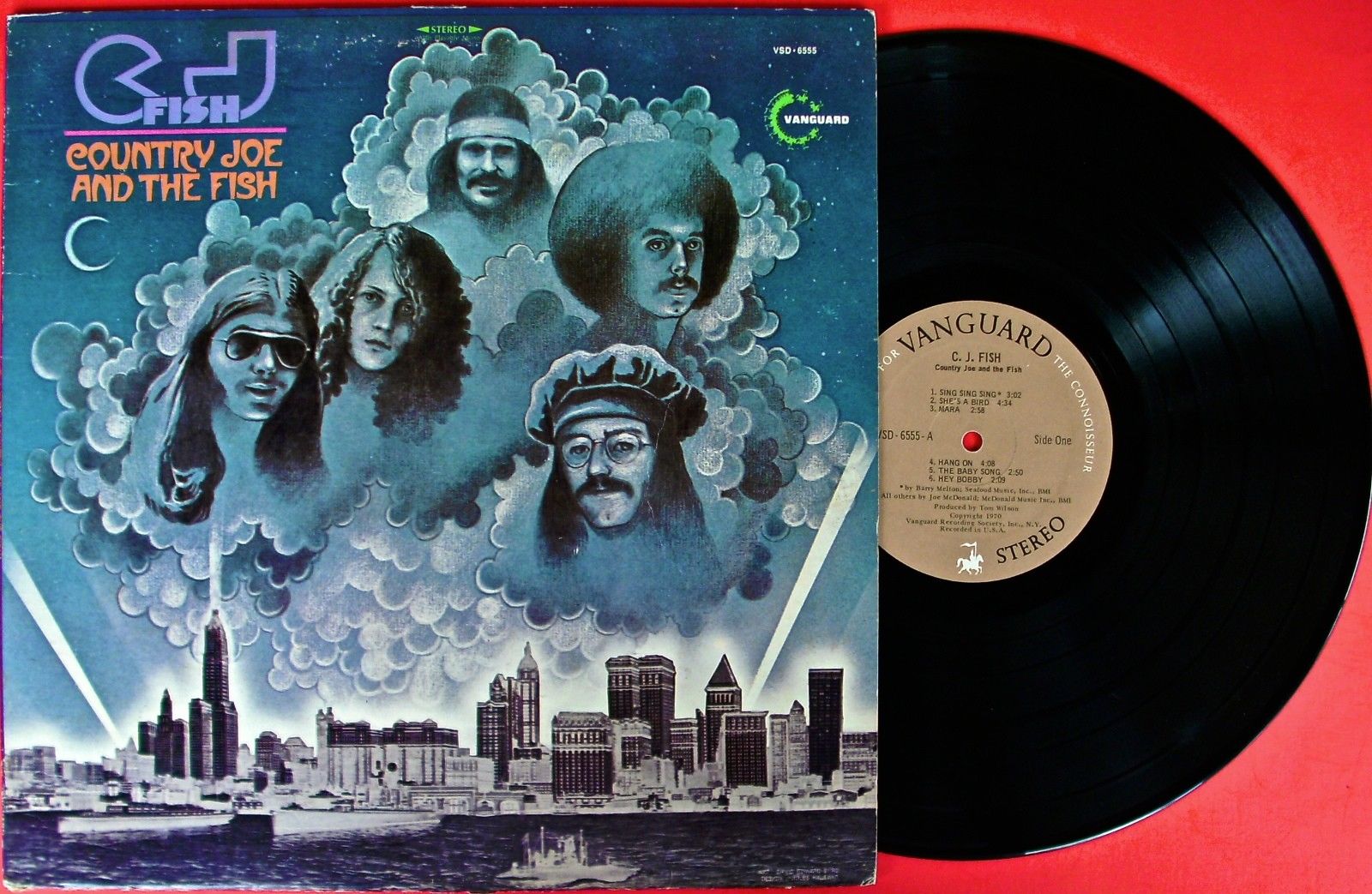
AOTM has been especially difficult for me this month. As you know I listen to at least one new album a day. This practice has grown to include one classical album also. Originally, this coveted title was set to go to The Eagles’ masterwork One of These Nights. Then it was set to go to Clearlight’s debut, Clearlight. The latter was on account of Doug Lubahn, the group’s bassist having sadly passed away this month. Lubahn was the bassist on three of the Doors’ studio albums, hence is quite close to my heart.
But following Clearlight down the Doors rabbit hole, my father recommended Country Joe & The Fish. Naturally I exhibited taut revulsion at being told to do anything. One is prone to believe their music taste is superior to others’, are they not? I relented and listened to Love Machine, which set a very agreeable tone. Then I went and listened to the whole thing. Now I am not swift to admit that I am wrong, but boy was I wrong.
The “CJ Fish” album was the sixth to be issued by Vanguard Records in 1970, and was the last to feature new material from the group as the only subsequent album was the historical retrospective “Life And Times of Country Joe & The Fish”, issued the following year, by which time the band had broken up and Joe McDonald had embarked on a solo career. ACE Records
The first track which took me was Mara. This is a masterful combination of Doorsian rhythm with a fresh and original melody and lyric. I have yet to happen upon anyone who masters the lyrical form better the The Doors’ Jim Morrison. In fact I have several books of his poetry in my library. But these were not bad.
The overall timbre is interesting, being both joyful and sobering at the same time. Some bright spots in the material are “Hey Bobby,” “She’s a Bird,” and “Hang On,” which are delightfully Country Joe. AllMusic
The Baby Song was another standout. Of course in the current climate crisis, the lyrics “Come with me, we shall make a baby” is not the greatest advise. But this impending doom is the subject for a later blog post. Notice how the solo near the end of this track resembles a baby’s tantrum.
[The songs] are uniformly professional, varying from the gentle piano-led jazzy ‘Mara’ and ‘She’s A Bird’ with its dreamy guitar soundscape midway through to ‘Rockin’ Round The World’ which is much more upbeat and funky, as you would expect. ACE Records
Silver and Gold is my third highlight. Psychedelic rock at it’s finest. absolutely mind blowing.
The Love Machine is the runaway hit of this album of course. This is also the closest to the Doors sound of the whole album. This smooth pop psychedelia masterpiece is impossible not to groove to. It builds and builds, adding layers as it goes culminating in a measure of blissfully bewildering music. I am so deeply impressed.
The album lands on a melancholic note with Return of Sweet Lorraine and Hand of Man. The former is a magnificent example of how to vent one’s ire correctly. The latter is a corny country track which exudes bizarre pseudo populist positivity.
Overall, this album can be condensed into a Nick Drake & The Doors hybrid. The composition of each song is balanced and beautiful, with enough room for me to be able to wrap my minds around it. This bluesy, psychedelic pop meld is a testament to the masterful production of Tom Wilson, who had by this time produced Bob Dylan and Simon & Garfunkel. This album epitomises 1967 Los Angeles. This is where the Doors originated, of course. Some harsher critics say this is not their best work but I think C.J. Fish is pristine. I dare you to prove me wrong.


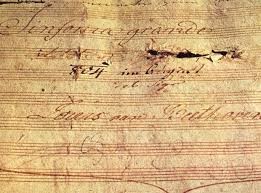 Image from the manuscript of the Eroica, with Bonaparte angrily crossed out