Note: I have made references throughout this blog to timings for certain highlighted moments (e.g 0:03 of track 1) – this is in relation to a recording of the work I will provide a link to below (follow along should you so desire).
On the 30th December 1884 , in the world-famous Leipzig Gewandhaus, the premier of Anton Bruckner’s 7th symphony was received with rapturous applause. At the age of 60 Bruckner had now experienced his first taste of success with an audience. But why had it taken so long for this modest but industrious Upper Austrian to find favour with the public? One reason was simply that Bruckner had started surprisingly late in life to compose large-scale works, he had not approached the genre of the symphony until near the end of his fourth decade on this earth. The other perhaps more important facet was that he had found himself, quite by accident, at the fore of central Europe’s raging musical conflict between the supporters of Johannes Brahms and the supporters of Richard Wagner. At first glance, the tremendously modest Bruckner, who had little to no literary interests would seem an unlikely member of the Wagnerian camp, but nonetheless, that was the group he had found himself pigeonholed into. In fairness, Bruckner had gained a deep appreciation for Wagner’s music since the early 1860s and was known to have practically worshipped the older composer. What made Bruckner more offensive to the other side, though, was that he had had the temerity to compose abstract symphonies, and what’s more to compose them in Vienna, where Brahms, and perhaps more importantly the critic Eduard Hanlick resided and reigned supreme. Brahms had derided Bruckner’s symphonies as musical ‘Boa constrictors’, but Hanslick was the more abusive, orchestrating venomous attacks in the Viennese press. It goes without saying that the conservative orchestras and audiences of Vienna were by no means receptive to Bruckner’s symphonies which were both long and in their mind lacking proper rigour.
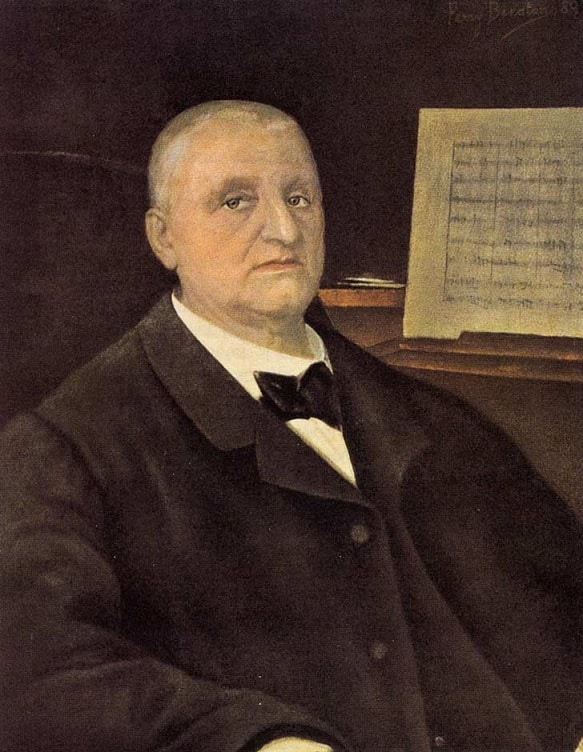
Painting of Anton Bruckner
The audience that heard Bruckner’s 7th symphony for the first time in Leipzig, however, was far more open to this music, and Bruckner had at last found a talented and sympathetic interpreter in the conductor Arthur Nikisch. It was a captivating success from the first bars onward. As with most of Bruckner’s symphonies, the opening is presented with utmost mystery, as a long arching and searching theme takes its course over tremolo strings. This theme had apparently come to Bruckner in a dream, in which his mentor from his Linz days, Ignaz Dorn, had played the melody on a viola promising the composer that it would bring him ‘success’. One of the main characteristics of this theme is that it modulates from the home key (or tonic), e major, to the dominant, b major. This is in part what give it its searching quality. It also sets up what is essentially the slow drama of the entire movement, the takeover of b major from the tonic and the painstaking process whereby the home key reasserts its position. In a truly ground-breaking manner, Bruckner will delay this resolution until the coda.
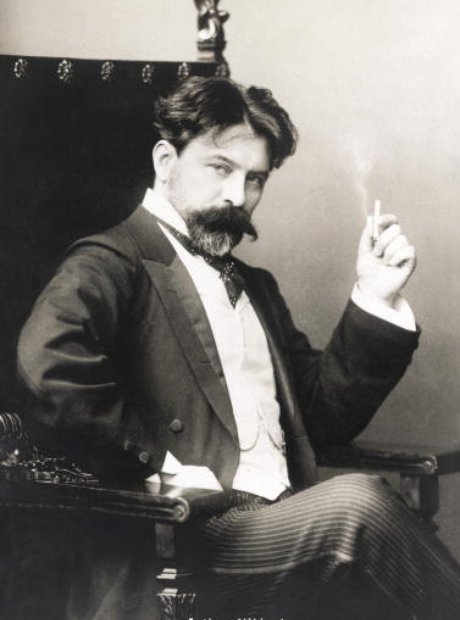
Pictured here the much younger Arthur Nikisch
The first theme slips back to the tonic, for a restatement which again modulates to the dominant (1:22 of track 1). The second subject which starts in b major, wanders through several keys, generating a strong sense of forward movement (2:46 of track 1). It is important to bear in mind that although Bruckner’s music has a tendency to be slow, and interpretations have a tendency to be even slower, there is still often a feeling of steady forward propulsion. The music builds to a climax resolving on the key of b minor (a dark and solemn key). A theme with a new rhythm now begins in b minor, passing through several keys til it leads to a fanfare and the music dies away softly in b major (5:51 – 7:44 of track 1). This comprises effectively the exposition (the section in which the themes are first presented), and now it is time for the development. Bruckner inverts many of the movement’s themes for this section (this means the ascending intervals of the melody become descending intervals and vice versa), presenting for example, a beautiful inversion of the second subject played cantabile by the cellos (9:16 of track 1). A crisis point is reached in which the inverted version of the opening theme is presented menacingly in c minor (11:18 of track 1). Effectively any strict recapitulation in which the opening material is presented securely in the tonic, has now been severely undermined by this outburst so near the end of the development.
A traditional recapitulation was not in fact what Bruckner had in mind at all. Although, we do eventually hear the main theme in e major, and although this is felt by the listener as the home-key, it is far from a secure and solid resolution (13:06 of track 1). Again the theme modulates to b minor, which leads to what is the greatest crisis in the movement, as the music floats into dark and mysterious harmonies, beautifully orchestrated (14:13 of track 1). Bruckner’s wandering second subject again reaches a climax, but this time we arrive with the new rhythmic theme in g major, not the dominant, which provides the impetus to bring about the long-delayed resolution of this movement as the key of b has lost its pre-eminence (16:58 of track 1). Again the music passes through several keys, before it settles down for what is without a doubt one of the greatest codas in the entire symphonic repertoire. On a pedal point (a technique originating in organ music) in the bass over which the rest of the orchestra plays wandering harmonies, the music rises to a crescendo (18:25 of track 1 onward). The music gradually resolves to e major for what is, at last, the resolution we have been looking for throughout the entire movement, accompanied by glorious fanfares in the brass.
Anton Bruckner at the organ (he was best known as an organist for much of his career)
The second movement is marked adagio. Bruckner’s adagios are often seen as being at the heart of his symphonies, and this is especially true here. The seventh’s adagio is probably one of the greatest slow movements of any symphony, let alone any Bruckner symphony. It begins in the relative minor to the home key, C-sharp minor (a key hitherto not touched upon), and with a theme of sombre feeling (first heard at 0:01 of track 2). Apparently Bruckner was inspired to compose this theme because he realised that Wagner was not far from his dying day. Wagner was in fact to die during the period in which Bruckner composed the symphony. The movement’s structure is a set of variations upon two themes. The second which begins in f-sharp (first heard at 4:57 of track 2), has been described beautifully by Bruckner expert and conductor Georg Tinter as:
something which transcends ordinary sorts of feelings. You can’t even say ‘Is it jolly?’ ‘Is it sad?’ ‘Is it that?’ ‘Is it that?’. You can’t say that with a late Beethoven tune either. It is above these things
The adagio utilises 4 Wagner tubas, an instrument designed to be used in Wagner’s Ring Cycle. Half way through the movement during the first recurrence of the first theme, the music reaches a climax in g major, which prepares the audience for the movement’s most important moment later on. That in turn is reached following a long crescendo, which climaxes in C-major accompanied by one of music’s most famous cymbal clashes, supported by a triangle (19:15 of track 2). This was apparently suggested as an addition by Nikisch, a change Bruckner agreed to. In the manuscript this addition is marked as invalid, but not in Bruckner’s writing. The fact that a similar passage is accompanied by a cymbal clash in the adagio of the 8th symphony suggests that Bruckner did want to retain this part for percussion in the 7th contrary to the manuscript’s direction. Some performances will include this use of percussion, others not. After this climax the music dies away and ends in funeral character.
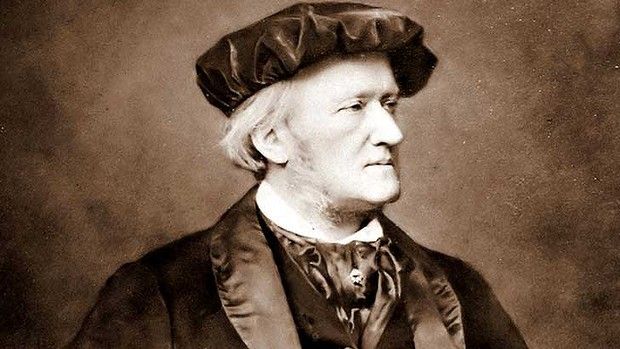
Richard Wagner
The third movement scherzo is based on a driving dance theme in A minor with an octave leap (first heard at 0:02 of track 3), while the contrasting trio section has a slower tempo (3:25 of track 3). The latter is full of beautiful orchestration in the brass and woodwinds. Overall, this movement is the perfect foil for the immensely moving and sombre second movement. The finale is an odd mixture of the sublime and the light-hearted, it begins with a theme of jaunty character which has some resemblance to the opening movement’s first theme, and which is again accompanied by tremolo strings (0:01 of track 4). The second subject of the finale is a more serious chorale theme (1:00 of track 4), while the third subject takes up a more menacing mood in the minor mode (2:56 of track 4). In the recapitulation, the themes are presented in reverse order (just one of the factors that make this movement difficult to define in terms of form)! The coda features the jaunty theme alongside the opening theme of the symphony, climaxing with an E-major chord ablaze with glory (10:49 of track 4 onward)!
With this ending, Bruckner had capped off a work which would bring him fame and renown for the first time in his compositional career. In one of the great ironies of music history, the timid, shy, and deeply conservative catholic composer, with an awed reverence for music of the past, would become the new poster-child for progressive modern music. Anton Bruckner, the peasant from upper Austria, had secured his place in the great pantheon of German music, a position from which not even Hanslick could dislodge him. In some ways it is not exactly surprising that it was the 7th symphony that brought him this recognition, its lyrical and moving themes continue to have charms for audiences to this day. The long-delayed resolutions and slowly built climaxes contained within will forever deserve our special attention, representative as they are of that most Brucknerian quality: his sacred patience.
By Nicholas Jenkins
Here is the recording upon which the timings are based, you are more than welcome to choose your own performance but please note the timings could be very different if you do:
Note: I have made references throughout this blog to timings for certain highlighted moments (e.g 0:03 of track 1) – this is in relation to a recording of the work I will provide a link to below (follow along should you so desire).
Places can store up memories for us, which when we return come flooding back to us. The region situated along the banks of the Rhine must have been just such a place for the composer Johannes Brahms. It was there in October 1853 that he first made the acquaintance of Robert and Clara Schumann at their Düsseldorf home. Robert who was deeply impressed by the young man’s music, would soon lionise Brahms in a famous article that championed him as the next great composer in German music. But sadly things did not remain rosy for long. In February 1854 Robert would throw himself off a bridge into the Rhine in a desperate suicide attempt. As a result he was committed to an asylum and would die there just two years later in 1856. Meanwhile, Brahms and Clara would find themselves falling hopelessly in love as they comforted each other in the wake of this tragedy. Even so, following Robert’s funeral, Brahms fled the scene and left the newly widowed Clara to tend to her young family alone. Ultimately, marriage scared Brahms who would become a perennial bachelor, he must have also felt conflicted because of his friendship with Robert.*
Picture from let to right: Clara Schumann, a young Johannes Brahms, and Robert Schumann
When Brahms returned to the banks of the Rhine to stay at Wiesbaden nearly 30 years later, after celebrating his 50th birthday, it is easy to imagine these difficult and painful memories would once again be brought to the fore of his mind. There, over just a matter of three months, he would complete his third symphony, a work of consummate formal brilliance, yet also an intensely personal work. The symphony would begin with a kind of musical motto with resonance for Brahms and his circle. Musical mottoes (used to represent people) were common at that time, Brahms’ friend and fellow bachelor Joseph Joachim, for example, had the motto of the notes F – A – E (Frei Aber Einsam – free but lonely – in other words single but lonely). Indeed, Brahms, Robert Schumann, and Albert Dietrich had each composed a movement on the basis of this motto for what would become the F-A-E violin sonata dedicated to Joachim. Brahms, being the able ironist that he was, took Joachim’s personal motto and created his own: F-A-F (Frei Aber Froh – free but happy). It is with this motto (albeit with the A moved a semi-tone lower to A flat, creating a minor interval) that the symphony would begin (0:02 – 0:08 of track 1).
This motto is of immense significance for the symphony, it will recur throughout the movement in many different guises, and will serve as the germinating idea for many of the themes of this symphony. Its first recurrence follows immediately as it forms the bass line underneath which the first theme proper is built (listen out for it in the double basses and brass). The first theme, in fact, begins on the third note of the motto and so a close connection is established from the beginning (0:08 – 0:30 of track 1). The theme itself has a striking resemblance to a phrase from the middle of the first movement of Robert Schumann’s famous Rhenish (or Rheinische) symphony composed as a tribute to the Rhine and the Rhineland region (7:40 – 7:48 of Schumann track). Strictly, speaking Schumann’s theme is a varied version of his movement’s main theme, but Brahms seems to have cottoned onto this version and used it in his symphony, adding to it a passionate weight. By doing so he was referencing Schumann and the memory of his departed friend in this work which had already begun with the Brahms’ own personal motto. The theme switches from major to minor from measure to measure, a technique learnt from Franz Schubert, which creates ambiguity and tension in the music.
Picture of the Rhine valley
First movement of Robert Schumann’s Rhenish Symphony in E-Flat major
The second theme, which is in A-flat major (1:24 of track 1 onward), follows a transition in which the orchestra is pared down, so that when we arrive at this theme it almost has a chamber music feel. It sounds like the sort of rustic melody Brahms might have heard while conversing with friends in one of the many cafes of Vienna. Brahms does elaborate and develop this simple theme in the exposition but notice the extraordinary way he transforms the melody in the development section, now in the minor and taking on a far darker character (6:32 of track 1 onward). The drama of this part is enhanced by a transitional section, which takes us from the repeat of the exposition to the development, filled with syncopated rhythms typical of Brahms’ music (5:47 -6:31 of track 1). Just before the recapitulation we are provided with a broad almost elegaic version of the opening motto by the solo horn reflecting the oft-spoken autumnal feel of this symphony (7:26 -7:37 of track 1). Following the recapitulation, the music gently subsides to a quiet peaceful conclusion in the coda. We hear at the end of the movement the opening motto followed by the first theme, now combined as if they were one theme.
The second movement begins with another simple folk melody in the clarinet with the orchestra providing an accompaniment (0:01 of track 2 onward). Listen out for how the clarinet and orchestra each hint at the opening Frei Aber Froh motto. Clara described this part of the symphony as a “pure idyll” in a letter to Brahms. The second theme has a greater intensity and melancholy about it, suggesting as always with Brahms, that not all is mere bliss, and it leads to a rather mysterious chromatic passage (2:25 – 3:40 of track 2). The recapitulation follows on from the development so seamlessly that is easy for the likes of me to miss it (4:58 of track 2). In this revised sonata form movement, the first theme is heard again in the recapitulation (as is the chromatic passage) but not the second. This theme will in fact be kept back for later. Once again the movement ends quietly and mysteriously.
It had become common since Beethoven for the third movement of a symphony to be a scherzo, that is a quick and sometimes jocund movement of dance music in 3/4 time. This style of movement did not suit Brahms’ temperament, and after composing works such as the piano quintet in F minor (which has a marvellous scherzo), he favoured movements he termed intermezzi which were generally slower and more contemplative in character. Although this third movement only has as description the tempo marking ‘Poco Allegretto’, it has strong a resemblance to movements from other works termed intermezzi. The opening melody is one of the most beautiful in all of music and should be brought up immediately whenever any swine tries to claim Brahms was not a gifted melodist. A favourite passage of mine is when the solo horn takes up the melody (3:39 of track 3 onward). The horn or Waldhorn was intimately associated in German culture with the forest and therefore with mystery and Romanticism. Throughout, this movement there emanates a supremely autumnal atmosphere. For the third time in this symphony there is a quiet conclusion.
Caspar David Friedrich – the Evening (a typical example of German Romantic Painting)
The finale begins with an opening theme which is heard first in the Phrygian mode before its accompaniment reveals it to be in F minor (0:01 – 0:31 of track 4). This theme leads to a return of the second subject from the second movement but now in the form of a brooding chorale, or hymn-tune (0:32 of track 4 onward). The return of the movement’s opening theme in tumultuous fashion follows which leads to a transition to the second subject heard in the cellos and horns (0:55 – 1:29 of track 4). This second heroic theme in the major acts as a contrast to the rest of the movement’s material which for the most part is dark and intense (1:30 of track 4 onward). Indeed, it is soon followed by a new dramatic theme which returns the movement to its predominantly storm-filled character (1:57 of track 4 onward). The opening theme comes back once again this time quietly in the woodwinds for the start of what forms the development section of this modified sonata form movement (2:54 of track 4 onward). As the opening theme grows quieter, the chorale theme returns in an eruption of sound, which is followed by a recap of the other themes including the heroic second theme and the dramatic third theme (3:59 of track 4 onward). The movement’s coda begins with the opening melody which slowly unwinds and modulates to F major (6:36 of track 4 onward). Throughout, in the mystical quality of its orchestration, this coda reminds me of the Forest Murmurs from Wagner’s Siegfried (6:36 – 9:08 of track 4). The opening Frei-Aber-Froh musical motto is heard several times once again, followed by the chorale theme which has now become broad and majestic. Afterwards, the Frei-Aber-Froh motif is combined with the opening theme from this movement. Finally, the impassioned Rhine theme derived from Schumann returns now far less intense and in a mesmerising fashion with shimmering strings, concluding the symphony pianissimo.
How ultimately are we to make sense of this work? One view is that this is Brahms at his most formally terse and concise. It is the briefest of his symphonies, with each movement being the same length, and each being closely interrelated thematically. Another valid view, is that this is Brahms at his most personal, referencing himself in the opening musical motto and his mentor Robert Schumann in the first movement’s opening theme. Then, there is the fact that each movement ends quietly, which was totally unique for the time. I began this blog with a discussion of the dramatic events which had moulded Brahms’ early manhood and which took place almost thirty years before the composition of the symphony. Those memories must surely have been on his mind when he wrote this symphony at Wiesbaden, with the Rhine so nearby. One possible speculative interpretation is to view in the final peaceful resolution of this work a kind of personal resolution for Brahms, a putting away of memories that had haunted him since he first left the Rhineland. Whatever the case may be, the manner with which the finale ends is exceptional and highly moving. Leonard Bernstein spoke of this ending as ‘magically healing’ and a moment of ‘sweet resolution and repose’. Indeed, in the mystical manner with which this symphony concludes I am reminded of these famous lines by Prospero from Shakespeare’s The Tempest:
Our revels now are ended. These our actors,
As I foretold you, were all spirits and
Are melted into air, into thin air:
And, like the baseless fabric of this vision,
The cloud-capp’d towers, the gorgeous palaces,
The solemn temples, the great globe itself,
Ye all which it inherit, shall dissolve
And, like this insubstantial pageant faded,
Leave not a rack behind. We are such stuff
As dreams are made on, and our little life
Is rounded with a sleep.
Written by Nicholas Jenkins
Here is the recording upon which the timings are based, you are more than welcome to choose your own performance but please note the timings could be very different if you do:
Footnotes
* Brahms and Clara would, nevertheless, continue a passionate friendship over a long period of regular correspondence.
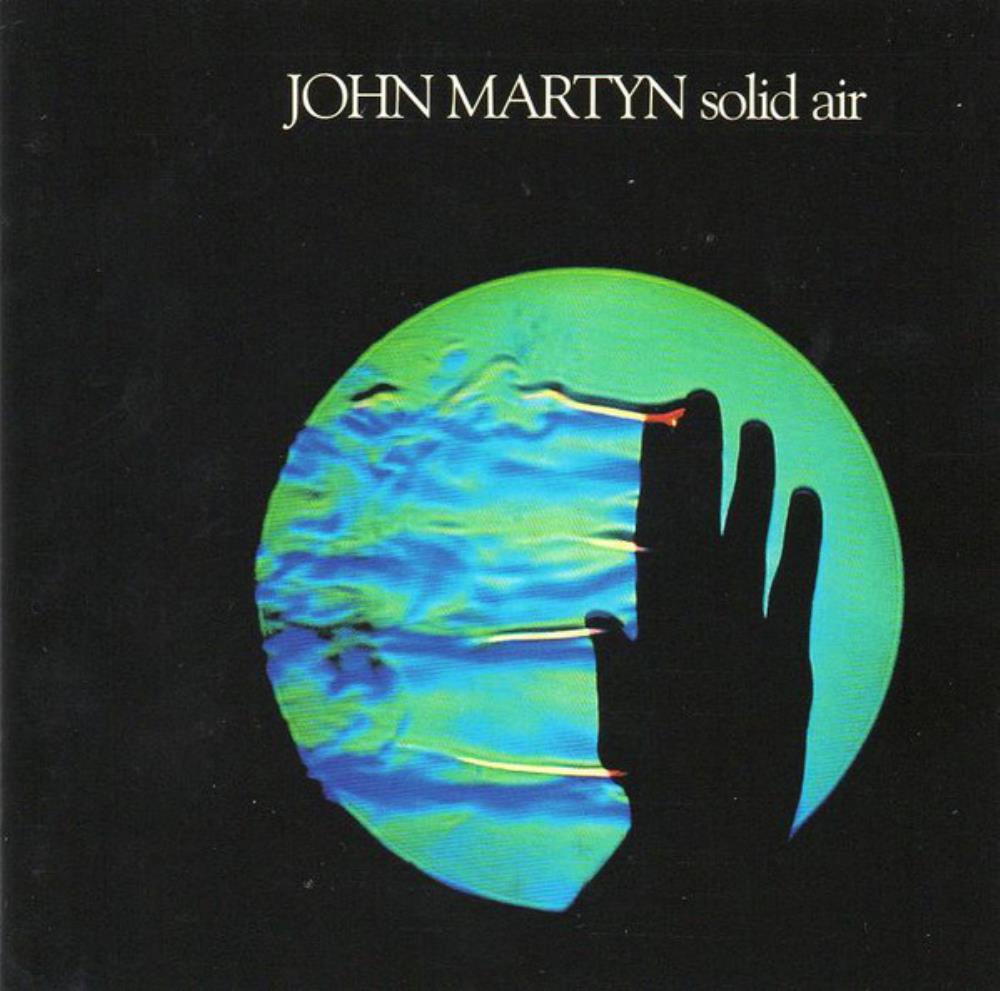
Once again I have the tremendous honour of contributing to the prestigious ‘Album Of The Month’ category here on Cedric’s blog. You may recall from my post of May last year, I chose to discuss ‘Fives Leaves Left’, Nick Drake’s debut album, which was my ‘gateway drug’ to what can in the broadest sense be defined as ‘pop’ music. If that album was the ‘gateway drug’ then I suppose the one I am about to discuss today represents a slightly stronger intoxicant and a further step for me towards appreciating a wider variety of music. John Martyn was a friend and early supporter of Drake and his music, as well as a fellow recording artist on the Island label. It was through this connection with Drake that I discovered Martyn and his music and came to appreciate this album. So without much further ado, on with the review.
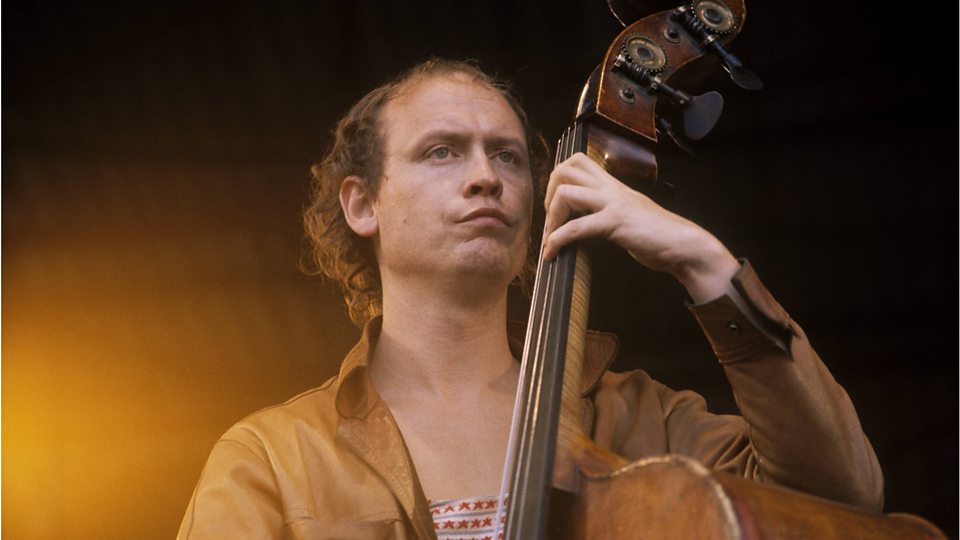
The year Martyn came to record this astonishing album was 1973. Following a period in which he had released successive albums with then wife Beverley Martyn, his last album had been a solo effort. That album, ‘Bless the Weather’, had also marked the beginning of his collaboration with legendary upright bass player Danny Thompson. Thompson would move on to play a pivotal role in the album under discussion today.
“If John Martyn had been the only person I had ever done music with, it would have satisfied all of my musical ambition” – Danny Thompson
High praise indeed from Thompson (who recorded and performed with the likes of Roy Orbison, Pentangle, Nick Drake, Richard Thompson, the list goes on…), and it reflects the immensely fruitful musical relationship the two must have had. This close connection can be heard throughout this album, and it was through such a strong, intuitive relationship that some truly inspired music was created. We already glimpse this in the opening title track, where Thompson’s bass is simply sumptuous and fits perfectly with Martyn’s cool, somewhat slurred, but deeply-felt vocals and his percussive acoustic guitar playing. Notice Thompson’s mesmerising use of glissandi in this song and throughout the album. Also featured on this song are Tristan Fey on vibes and Tony Coe on Saxophone who weaves in and out, providing a jazz-like feel to the track.
Danny Thompson
‘Solid Air’ was written by Martyn about his friend Drake and the latter’s struggles with depression, which the song movingly equates with the difficulties of living life through solid air. A particularly touching line occurs midway through the song in which Martyn confesses that:
I love you
And I can be your friend
I can follow you anywhere
Even through solid air
Elsewhere in the album there is some wonderfully poetic use of language. Above all in the opening track from side two, ‘Go Down Easy’, in which Martyn invokes his lover to:
Curl around me
Like a fern in the spring
The manner with which this track opens is superb, first we hear an improvisatory passage from Thompson on the upright bass, followed by Martyn’s guitar and finally his falsetto voice, all drawing the listener in for this hypnotic number. The way Martyn vocalises certain words in the song, for example ‘eeeeasy’, provides for a deeply sensual feel. It is the perfect way to press the reset button musically after we had ended side one with Martyn’s dark and psychedelic cover of Skip James’ ‘The Devil Got My Woman’ (titled on the album ‘I’d Rather Be That Devil’). For that track Martyn makes frequent use of reverb and echoplex. The trippy closing section is fairly astonishing and no doubt even more impactful if one chooses to make use of some of the substances Martyn was particularly fond of.
Some of the best tracks on this album are more warm and folky, such as ‘May You Never’. This became a staple in Martyn’s live performances, and you can hear why, it has to be one of the greatest invocations of friendship ever put to music. The track must have caught the attention of Eric Clapton who later recorded a cover of it in his 1977 album ‘Showhand’. The third track on the album ‘I Don’t Wanna Know’ starts off in a similarly simple, low-key mood, before it drops into a groove, and a fender-rhodes joins the instrumentation followed eventually by the use of multi-layered vocals. That track follows on from ‘Over the Hill’ which has unmistakably bluegrass feel to it. The song features Richard Thompson, of Fairport Convention fame, strumming away on mandolin. Apparently ‘the hill’ referred to in the song is the West Hill in Hastings which Martyn had to walk over to get to his home from the station.
John Martyn
Cedric has improved my appreciation for the importance of track sequencing in albums, and I think Martyn does an exemplary job of this throughout the album. At times there are great contrasts, for example, the choice of following the hard-edged ‘Dreams by the Sea’ with the much softer ‘May You Never’. Other times the tracks seem to follow on from one another with great ease, for example the manner in which ‘The Man in the Station’ carries on from ‘May You Never’. Overall, I think this a superb album, with elements of folk, jazz, and blues combined effortlessly to create a greater whole. I am sure the somewhat rough and ready, down to earth Martyn would probably have thought I was a pretentious tw*t, but regardless I have gained such a lot of enjoyment from this record that it would have been unthinkably crass of me not to have paid tribute to it. I hope you will gain the same pleasure from this superb album as I have done.
Note: I have made references throughout this blog to timings for certain highlighted moments (e.g 0:03 of track 1) – this is in relation to a recording of the work I will provide a link to below (follow along should you so desire).
Music has a long-running debate which has seemingly for time immemorial caused division amongst its adherents. Should it be viewed purely and absolutely through the lens of its own intrinsic elements (harmony, counterpoint, rhythm, thematic and motivic development etc.) or is it capable of conveying ideas and narratives outside of itself or in other words to paint pictures in sound? In the 19th century this debate raged on, at times ferociously, as the music of central Europe was divided into two rival camps, one comprising the so-called ‘conservatives’ Johannes Brahms, the critic Eduard Hanslick and their circle who preached the gospel of absolute music; the other being composed of the ‘progressives’ Richard Wagner and Franz Liszt (with his tone poems) who believed music should now be entwined with narrative and influences from other art forms. But what of the much younger Gustav Mahler, who came of age during this era of rival visions?
“A Symphony must be like the world – it must encompass everything”
Or so Mahler is famously reported to have said to the Finnish composer, Jean Sibelius, during their meeting. This seems like quite a bold claim to say the least, but in essence what Mahler meant by this was he wanted his symphonies to be more than just musical forms with their own internal logic but rather works capable of reflecting ideas, feelings, and even places to such an extent that they could encompass the whole world. So, it would appear at least from this quote that Mahler was not strictly speaking in the absolutist camp. He did of course continue to utilise traditional musical forms (while stretching them to their limit), after all, the piece I will discuss today is a symphony not a tone poem. One thing, though, is undeniable, Mahler appeared to make a conscious effort in all his symphonies to bring in sounds and references that drew listeners outside the realm of the concert hall and into the world at large. As such I will attempt to incorporate these references in my discussion of his 3rd Symphony in D minor. Ultimately, many will dislike such an analysis that draws from extra-musical themes, but I feel with Mahler it is absolutely necessary to do so.
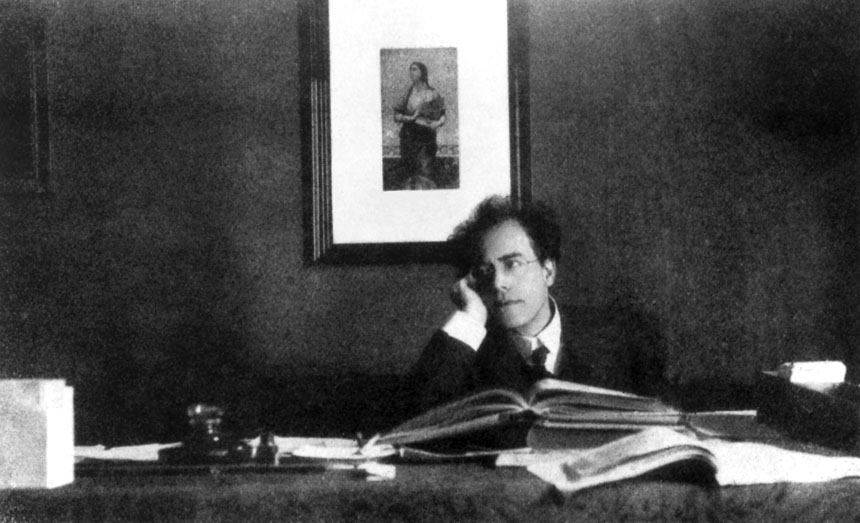
Wagner and his father-in-law Liszt Brahms pictured bottom right sat next to Hanslick Mahler pictured in 1881
But first another enlightening anecdote, this time from the memoir of Mahler’s protegee Bruno Walter, describing an incident on the latter’s visit to Steinbach am Attersee where the composer had a villa and composing hut:
“I arrived by steamer on a glorious July day; Mahler was there on the jetty to meet me, and despite my protests, insisted on carrying my bag until he was relieved by a porter. As on our way to his house I looked up to the Höllengebirge, whose sheer cliffs made a grim background to the charming landscape, he said: ‘You don’t need to look — I have composed all this already!”
More on the Höllengebirge later, for now it suffices to say that Mahler clearly acknowledged a close connection between the work he was composing at the time of this anecdote (in fact his 3rd symphony) and the landscape around Steinbach am Attersee. To truly grasp this one must really visit the Salzkammergut region and the lake and town in question, but pictures provide a good impression of what might have inspired the music, if still a tame one in comparison to the real thing.
In our interpretation of this work, we are aided by the fact that Mahler originally constructed a programme for the symphony. It seems to illustrate a story arc from an initial awakening of nature, through a description of the many aspects of creation, before concluding with a vision of divine love:
1. Pan Awakens – Summer Marches In
2. What the Flowers and Meadows Tell Me
3. What the Beasts of the Forest Tell Me
4. What the Night Tells Me
5. What the Morning Bells Tell Me
6. What Love Tells Me
Movement 1. – Pan Awakens – Summer Marches In
The symphony begins with a statement by 8 horns in unison, a kind of incantation to bring the symphony to life (0:03 – 0:28 of track 1). Then, begins a descent into a slow introduction, which sounds like the first elements of matter groping towards a more substantial existence (1:20 to 5:10 of track 1). Indeed, Mahler described to his confidante Nathalie Bauer-Lechner the ‘eerie’ way in which the music illustrated ‘life gradually’ breaking ‘through, out of soul-less, rigid matter’. The score indicates this passage should be ‘Schwer und Dumpf’ (heavy and stifling), and throughout motivic fragments played by different instrument groupings struggle to break out into full melodies. In a letter to the soprano Anna Bahr-von-Mildenburg, Mahler entitled the first part of the movement ‘what the stony mountains tell me’. Perhaps, he was inspired by the stony cliff face of the Höllengebirge that could be viewed from his composing hut when he wrote this turgid, primordial music.
Two of the themes of this movement seem oddly out of place in a formal 19th century symphony. The first is a jaunty melody, which would have perhaps been more at home in the popular music of Mahler’s time (first heard at 5:28 of track 1). Indeed, it has a surprising but probably coincidental affinity to the ‘Be our Guest’ melody from Walt Disney’s ‘Beauty and the Beast’ (1946). The other is like a march for a military band, no doubt similar to marches that were performed in the town square of Mahler’s hometown of Iglau, Bohemia (first heard at 10:02 of track 1). Both illustrate Mahler’s tendency to absorb music from other areas of life and utilise them in his symphonies. The effect of this is a music which at times is unusually raucous for a symphony, for example in the passage (from 20:04 – 23.24 of track 1) immediately preceding the recapitulation! Overall the movement appears to chart the struggle for life to break free from inanimate matter or to use another metaphor: for the chaotic, Bacchic forces of Summer to overcome those of stupefying winter.
Movement 2. What the Flowers and Meadows Tell Me
What do the flowers tell us? They tell us that the world is born again each spring anew in purest simplicity. Flowers represent beauty and life at its most transient and frail, but also its most irresistibly lovable. They are a source of gentle consolation in our lives made tired by work and worry. So, after the gigantic first movement, Mahler now offers us a respite both musically and pictorially. Broadly speaking there are two alternating and contrasting subjects, the first a relatively static and graceful minuet (first heard at 0.02 – 2:16 of track 2), the other comprising a series of frenzied kaleidoscopic episodes which seem to run wild like blossoms blown in the wind (first heard at 2:16 – 3:09 of track 2). This movement reflects Mahler’s superb orchestration and his command of the vast forces at his disposal which he is able to use at times as if they were a chamber ensemble. It is Mahler’s tribute in music to one of the simplest but most precious forms of life. The composer who spent much of the year hard at work as a conductor coping with the great demands of the concert season must have had a special place in his heart for the alpine blooms that greeted him on his summer composing retreats.
Movement 3. What the Beasts of the Forest Tell Me
Mahler composed almost exclusively in two forms: the symphony and song. Song is one clear way in which music can take on meanings outside of itself as it is fitted to texts which express concrete ideas and narratives. But one further way is to reference these songs in purely instrumental music. Mahler frequently made use of themes from his songs in his symphonies, as a way to subtlety aid interpretation. In this scherzo movement, simply brimming with playful energy, Mahler makes use of the melody from one of his earlier songs ‘Ablösung im Sommer‘ (see below video). The song is a classic example of Mahlerian irony, the words tell with nursery rhyme innocence of how the cuckoo has died and been replaced by the Nightingale. The theme of death then is introduced to this symphony almost mockingly. In this way Mahler adds an extra level of grotesqueness to this scherzo which rampages on much like ‘the Beasts of the Forest’ might, without a care in the world for the cuckoo who has died.
The composer’s masterstroke in this movement is to include as a contrasting section the famous ‘Posthorn solo’ (first heard at 6:18 of track 3). The Posthorn was an instrument carried by mail carriers in the Austro-Hungarian Empire, and its sound would have been well known to the symphony’s original audience. Mahler specifically calls for use of the Posthorn, an instrument foreign to the concert hall (most modern performances will utilise either a muted trumpet or a flugelhorn). The composer calls for the Posthorn to be played off stage and to be heard as if from a distance. The effect is a contemplative passage which emanates wistful nostalgia, and provides a tremendous contrast with the rest of the movement’s hurly-burly. It is possible that the inspiration for this section was Nikolaus Lenau’s poem ‘der Postilion’, which tells of a carriage guide who continually sounds his Posthorn at the gravesite of a departed friend. This, then, is perhaps humanity’s perspective shown for the first time, a species with a unique comprehension of its own mortality. The Posthorn solo twice interrupts the main scherzo material, but the latter section returns each time, before the movement concludes with a startling orchestral eruption (from 16:53 of Track 3 onward). The tension remains unresolved.
Thomas Hampson performing ‘Ablösung im Sommer’
Movement 4. What the Night Tells Me
We have seen so far how this symphony has charted a path in music from inanimate and turgid matter, through to the world of plants and flowers and finally to the beasts of the forests. We had seen the first signs of conscious life with the Posthorn solo in the third movement, which illustrated an awareness of suffering and mortality. It is at this stage that Mahler introduces the human voice for the first time in this symphony. The movement begins with utmost mystery, before the alto soloist delivers a text from Friedrich Nietzsche’s ‘Also Sprach Zarathustra’:
Original German
O Mensch! Gib Acht!
Was spricht die tiefe Mitternacht?
“Ich schlief, ich schlief —,
aus tiefem Traum bin ich erwacht: —
Die Welt ist tief,
und tiefer als der Tag gedacht.
Tief ist ihr Weh —,
Lust — tiefer noch als Herzeleid.
Weh spricht: Vergeh!
Doch all’ Lust will Ewigkeit —,
— will tiefe, tiefe Ewigkeit!”
In English
O Man! Take heed!
What says the deep midnight?
“I slept, I slept —,
from a deep dream have I awoken: —
the world is deep,
and deeper than the day has thought.
Deep is its pain —,
joy — deeper still than heartache.
Pain says: Pass away!
But all joy
seeks eternity —,
— seeks deep, deep eternity!”
Mahler had mixed views about Nietzsche to say the least, he later told his wife, Alma, to burn her copies of the philosopher’s books, but at the time of composing this work he appears to have been highly influenced by his writings. In fact he considered giving the symphony a title of the ‘Joyful Science’ (after Nietzsche’s work of the same name). The text used in this movement describes how sorrow is deep, but joy deeper because sorrow seeks only annihilation while joy seeks a deep eternity. Throughout the movement Mahler has the oboes mimic bird calls which he has marked in one sketch as ‘Der Vogel der Nacht’ (a bird closely associated with the theme of death).
Movement 5. What the Morning Bells Tell Me
From this warning addressed to man at midnight, we now enter the joyful world of angels at the dawning of a new day. The composer sets a song (‘Es Sungen drei Engel’) from ‘Des Knaben Wunderhorn’ (or the ‘Youth’s Magic Horn’, a collection of folk songs assembled at the beginning of the 19th century which were close to Mahler’s heart) for a children’s and women’s chorus and the alto soloist. The children’s chorus imitate the sounds of bells by singing ‘Bimm Bamm’, while the song’s text is divided between the women’s chorus and alto soloist. The text describes the importance of faith in gaining forgiveness. It is not clear whether or not this setting of the song is meant to be entirely sincere, but considering Mahler indicates in the score that it should be ‘keck im Ausdruck’ (‘cheeky in expression’) it appears probably not. The composer was, after all, not to convert to Catholicism until a year after he completed this work in 1897 and then only to gain the directorship of the Hofoper in the notoriously anti-Semitic Vienna. This movement, then, forms the perfect light prelude for Mahler’s true spiritual thoughts which are to be expressed not in words at all but rather in music alone.
Movement 6. What Love Tells Me
It is pointless to attempt much of a description of this majestic movement which unfolds over a series of variations in which conflict must play its part, but which nevertheless must end in the most triumphant D Major. Mahler expressed the meaning of this movement in one simple phrase:
“Father, look upon my wounds! / Let no creature be lost!”
Postscript
Mahler decided to not publish the programme in the end. He concluded that although it had served as a useful scaffolding device for himself, ultimately it should not constrain listener’s interpretation. Bearing that in mind, how should we approach all the detail I have discussed in this blog. I would suggest read it, absorb it, allow it perhaps to form as a useful outline in your mind, but do not let it constrain your interpretation of this music.
Mahler would increasingly move away from programmatic music, he did not design programmes for his later symphonies. That is not to say he ceased to bring musical elements traditionally deemed unsuitable for the concert hall into his music. He always was and would remain a radical. But, unlike, his friend Richard Strauss, he had never completely turned his back on abstract music and the symphony. In fact it was through his redesign of the symphony that the form was brought into a new century. For this reason, along with many others, Mahler must be considered amongst the very greatest composers.
Written by Nick Jenkins
Here is the recording upon which the timings are based, you are more than welcome to choose your own performance but please note the timings could be very different if you do:
On Bank Holiday Weekend, I found myself mulling over what I should do to celebrate Grace Jones’ birthday on May 19th. While out on a walk, the heavens opened and I was drenched. I interpreted this as an omen. Walking in the Rain is the opening number on Grace Jones’ monumental album Nightclubbing, you see. It is thus superstitiously than I decided to write the following review. Grace Jones is a personal icon of mine, if not my greatest inspiration, so forgive my gushing in parts.
In 1980, Grace Jones decamped to Compass Point Studios in Nassau, Bahamas where she worked with producers Alex Sadkin and Island Records’ president Chris Blackwell, as well as a crack team of session musicians rooted by the rhythmic reggae force of Sly & Robbie. Across three critical and commercial hit albums, with 1981’s Nightclubbing as her pinnacle, Jones reinvented herself while also altering the face of modern pop. Pitchfork
Five of the nine songs on the original album are covers. The album opens with a cover of Flash and the Pan’s Walking in the Rain. From the very beginning, Sly and Robbie’s talents are put on full display. Their understanding of beat and rhythm is unparalleled in pop. Grace emerges triumphant singing “feeling like a woman, looking like a man”, one of the defining features in her image. Listen to the bass guitar supporting Jones’ unique vocals. Here, she is the embodiment of power and freedom. There is an otherness to Grace the person and Grace the musician. This is carried through wonderfully in Nightclubbing’s opening number. Jones employs a glacial tempo with haunting equally cold vocals.
Pull Up To the bumper is of course Grace Jones’ most famous song. It is no surprise it was a Top 10 Single. What do you think the song is really about? I’d tell you my opinion but this post will go live before watershed, so I’d better not. In any case this track has a glorious recurring motif and an infectious rhythm, to which we are the slaves, as it were. Listen out for the percussion in the background. It is no wonder, with such a wide arsenal of brilliance, how she inspired so many after her.
Fashion, art, and music all converged in the form of Mrs. Jones and looking out at the 21st century musical landscape, it’s easy to see her influence: Lady Gaga, Rihanna, Nicki Minaj, M.I.A., Grimes, FKA twigs, and more. Beyond that, there’s an entire subset of alternative music that draws on the template set by Jones and her Nassau backing band: Massive Attack, Todd Terje, Gorillaz, Hot Chip, and LCD Soundsystem all emulate those rubbery yet taut grooves of Sly & Robbie and cohorts, a hybrid that amalgamated rock, funk, post-punk, pop and reggae. Pitchfork
Interestingly, Use Me is a cover of a Bill Withers song. If you hoped it would be anything like the original, you’d be mistaken. Grace does not pay homage to the original composers of the tracks she covers, she tears at the song book with her teeth. There is a single mindedness which ties her tracks together. The bass in this track is inspired, as are the lyrics: “I’m gonna spread the news, that if it feels this good being used, keep on using me ’til you use me up”.
The final track on side 1 is a cover of non other than Iggy Pop (of the Stooges). Now I won’t go on about how great the Stooges’ album Funhouse is, but you really should listen to it. Nightclubbing’s powerful and insistent piano underpins this track. Grace Jones is really “what’s happening”. You may be interested to know that Hollie Cook sampled Nightclubbing in her 2014 album Twice. Overall, Grace exhibits her raw power here with her commanding vocals.
I think at this point it is worth mentioning the cover. Jones was then styled by her beau Jean Paul Goude (French legendary photographer – does the artwork for Galleries Lafayette in Paris, among hundreds of others). Jones is seen in a beautiful black tailored Armani jacket on a background of light brown to accentuate her obsidian skin. She looks the epitome of detached with a cigarette loosely hanging from her lips.
And well, that cover. Black, blue, cropped into angles that would actually cut you if you got any closer. That cigarette, hanging there. The genuine ‘don’t **** with me’ article. Terrifying and entrancing at the same time. In pop music, it takes a lot of effort to look effortless, yet in Grace, Jean-Paul Goude had very little to do really. The Quietus
Side 2 of the album offers us Art Groupie, in which Grace asserts “I’ll never write my memoirs, there’s nothing in my book. this is the title of her auto-biography, of which I have a signed copy. I met Grace at a signing event in Picadilly in my second year at university. She was every bit as statuesque and foreboding as you can imagine. NB: she was about 65 when the cover for the book was taken.
I’ve Seen That Face Before was another outstanding track. This channels Astor Piazzola’s Libertango, while featuring Grace’s signature foreboding haunting vocals. The accordion in this track is inspired. Listen to the arrangement here, the way all the instruments and vocals are perfectly placed to evoke the overall theme of the track. This is a testament to Alex Sadkin’s production genius. I also cannot overstate how much I appreciate her use of French. “Tu te prends pour qui? Toi aussi tu détestes la vie”. Grace Jones first sang in French on her first album, 1977’s Portfolio. La Vie En Rose was the sign Chris Blackwell needed to recognise Grace’s talent and potential future. She made four albums between this and Nighclubbing, two of them disco albums produced by Disco legend Tom Moulton. But the essence of that epic Piaf cover is present here. Sting’s incredible lyricism is evident throughout this track: “I’m a walking nightmare, an arsenal of doom, I kill conversation as I walk into the room”. I suppose there are some positives in being from Newcastle.
Demolition Man is a cover of the Police original. I wonder what Stuart Copeland (the missing Beatle) made of this! I seldom ask myself which instrument I am hearing. The insistent deep instrument in the background of Demolition Man is likely a bass guitar but I may have been mislead by the synth stylings of Wally Badarou, a classically-trained synth session man who’s C.V. includes, but is not limited to, M’s “Pop Music” and Level 42’s “Something About You.”
The album adds with the beautifully remorseful Done It Again, a song that showcases Jones’ exquisite vocals. A love song that should be remembered with the greats of the genre. Louder Than War
Ending the album with Done It Again was a masterstroke in sequencing. After putting us through the tumult of the other 8 tracks, we land safely and serenely.
Overall, Nightclubbing is a masterful and essential album. Grace Jones changed the face of pop with the three major Compass Point Studio albums (Warm Leatherette, Nightclubbing and Living My Life) and immortalised herself as a seminal pioneer of music. This truly launched her and led to the torrent of cultural references beyond music for which we know and love her now. I leave you with this wonderful quote from The Quietus:
Nightclubbing made Grace Jones Grace Jones – the Harty-beating, Conan-starring, James Bond baddie, car-swallowing creature that followed. She could quite simply do whatever she liked after this, and did. It demands a place in everybody’s record collection whatever their allegiance, and you’ll never really want for anything more than this exhaustive and vital package. What was perfection has become even more perfect. The Quietus
For those who didn’t know, Rush is comprised of official Canadians, Geddy Lee, Alex Lifeson, and Neil Peart. Neil Pert recently, and very publicly, passed away. This lodged a little seedling into my mind that I absolutely had to dedicate one of the AOTMs to Rush. Doing my preliminary reading around the issue has revealed that my knowledge of Rush is dwarfed by almost everyone I have read. To save myself the tedium of bringing myself up to speed and you, dear readers, the impression that I don’t know what I am talking about, I shall remain where I am comfortable for the duration of this review. I encourage you to read the reviews hidden behind hyperlinks spread around this review.
The music is complex and flowing with a lush production. Like the previous four studio album, Hemispheres was produced by Terry Brown. Influenced by progressive rock bands like Yes and King Crimson, the group set out to make more complex music, stretching the maximum potential of three rock musicians to be replicated in live situations. Lead vocalist and bassist Geddy Lee added Minimoog synthesizer and bass pedals to his arsenal while guitarist Alex Lifeson experimented with classical and twelve-string guitars, often using a holder stand to easily switch between guitars live. Peart continued to add diverse percussion to his ever-growing drum set, including timpani, blocks, orchestral bells, chimes, and melodic cowbells. Classic Rock Review
Hemispheres opens with a follow up from the last track on Farewell to Kings; Cygnus X1 Book II: Hemispheres. This 18 minute long track which takes us on a whirlwind tour of the Greek mythology of Apollo, the god of reason, and Dionysus, the god of love. This pseudo-classical offering is exemplary of Rush’s progressive rock leanings at the time of Hemispheres. This was to change for their next album, Permanent Waves, which I have on vinyl somewhere. In all, Hemispheres is a singular track which blew me away with its technical brilliance.
As Bowman writes: “Rush deployed what had now become the standard conventions of their composition strategy; multiple key signatures, ambiguous tonal centers, tritone relationships, shifting meters (at various points in the piece they play in 12/8, 9/8. 7/8, 5/4 and 4/4), multiple themes that reoccur at significant distances often in different guises, substantial changes in dynamics, atypical melodic patterns, and the juxtaposition of Lee’s rich baritone and strained counter tenor voices, all executed with virtuosic, extraordinarily precise musicianship.” Consequence of Sound
Circumstances might be my favourite track on the album. This is largely due to the fact they sing ‘Plus ça change, plus c’est la même chose’, one of my favourite French idioms. Neil Pert supposedly wrote this song about the monotony of not succeeding as a rock drummer. Indeed many of us will feel ‘trapped by circumstances’ at the moment and this song is wonderfully liberating. This is Rush at their best. Pert’s drumming is extraordinary, Lee’s Rickenbacker Bass is stunning and Lifeson’s vocals are just high pitch enough for you to enjoy trying to sing along.
The philosophy continues with “The Trees”, a parable on socialism and collectivism. Here, Lifeson takes center stage from his classical acoustic intro through the incredible movement through differing guitar textures. Like “Circumstances”, there is another mid-section which starts with some synth and percussion motifs before breaking into a full band jam, which brings the tune to a fevered conclusion with an ironic lyrical ending. Classic Rock Review
I love Trees. I love the inventiveness of writing a song about Maples wanting more light from Oaks. This can be seen as a grand metaphor for justice and liberty or fighting for the rights of the oppressed but in truth it has no meaning at all. Pert noted the following in the April/May 1980 edition of Modern Drummer: “No. It was just a flash. I was working on an entirely different thing when I saw a cartoon picture of these trees carrying on like fools. I thought, ‘What if trees acted like people?’ So I saw it as a cartoon really, and wrote it that way. I think that’s the image that it conjures up to a listener or a reader. A very simple statement.” Watch out for the percussion intermission in the middle of this track.
La Villa Strangiato is titled after a melding of the Italian and Spanish words for strange (Strana and extraño – strangely, the adjective has a masculine ending though it follows a feminine noun). The song is split into 12 movements as follows:
I– Buenos Nochas, Mein Froinds!,
II– To Sleep, Perchance To Dream,
III– Strangiato Theme,
IV– A Lerxst in Wonderland,
V– Monsters!,
VI– The Ghost of the Aragon,
VII– Danforth and Pape,
VIII– The Waltz of the Shreves,
IX– Never Turn Your Back on a Monster!,
X– Monsters! (Reprise),
XI- Strangiato Theme (Reprise),
XII– A Farewell To Things.
This instrumental masterpiece is the perfect way of closing Hemispheres. Pert once joked that he spent more time on this one track than on the entirety of Fly By Night, one of the band’s earlier albums. It is easy to see why. Following on from the pseudo-classical theme of the first track on this album, we finish in splendid fashion with this divine composition.
Overall, Hemispheres is a much treasured album which will be listened to time after time, never losing its lustre. I highly encourage you all to hear it.


 Painting of Anton Bruckner
 Pictured here the much younger Arthur Nikisch
 Anton Bruckner at the organ (he was best known as an organist for much of his career)
 Richard Wagner



 Danny Thompson