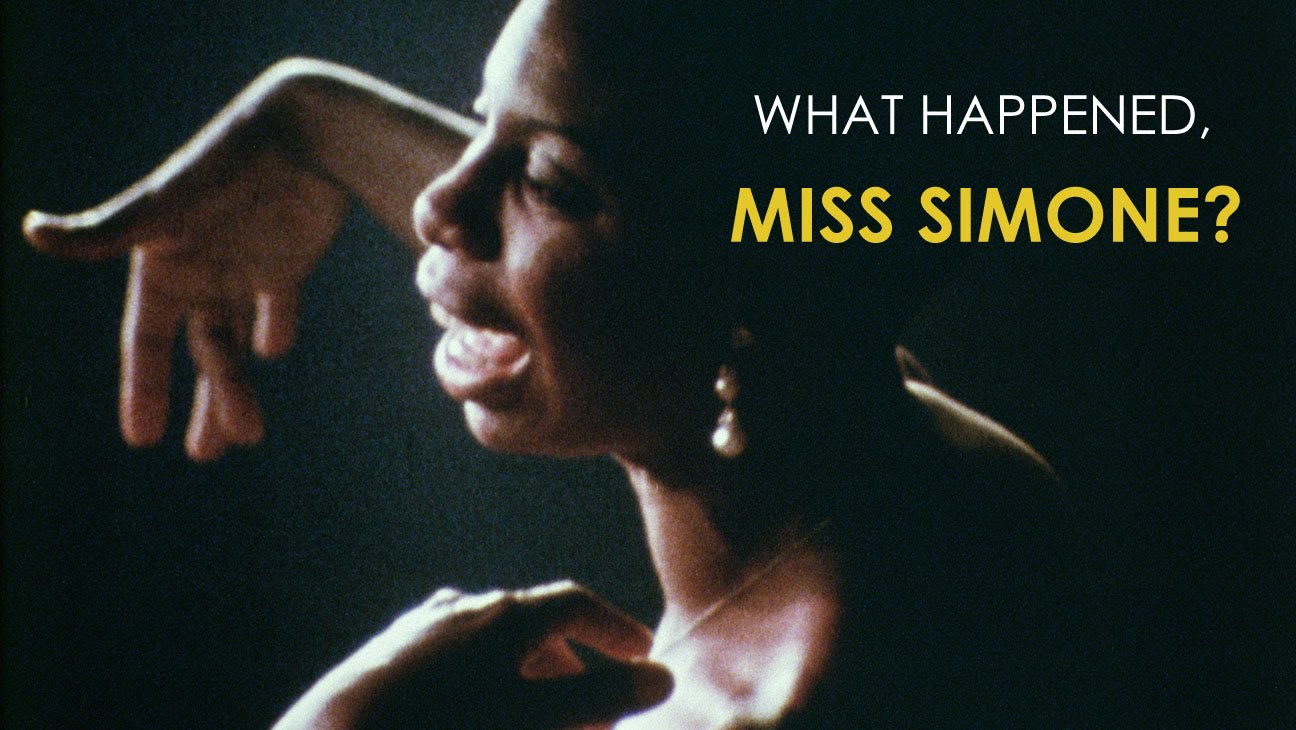
My favourite artists include Grace Jones and Todd Rundgren, this much is evident to anyone who has dared ask me the question. But, of late, I have become enamoured of Nina Simone. Many know her only for ‘Feeling Good’ or ‘My Baby Just Cares for Me’ but her repertoire and indeed the impact she has had on the music industry as a whole is staggering.
What Happened, Miss Simone? takes its namesake from a poem written to her by Maya Angelou. In essence, it is a 2015 biographical film which opened the Sundance Film Festival of the same year.
The film was nominated for six Primetime Emmy Awards, including Outstanding Documentary or Nonfiction Special and Outstanding Directing for a Nonfiction Program, winning the former. Wikipedia
The film covers Nina’s life and career and gives unrivalled insight into how she became the icon and star that she is today. This, friends, is not an easy film to watch. It covers unpleasant topics such as domestic abuse and, of course, racism. The fact is that Nina was 25 at the release of her debut album in 1957 and schools in America were only de-segregated in 1954. This means her childhood in North Carolina was peppered with discrimination. One particularly poignant moment in the film for me was when Nina described one of her early recitals, aged 8, when her parents were asked to sit in the back on account of their skin colour. Nina fought back saying she would not play unless they were in their allocated seats in the front row. This is a powerful and potent image which set the scene for how Nina’s life would unfurl.
What I didn’t know was that Nina Simone was a civil rights activist as well as a wonderfully talented recording artist. She regularly involved herself with the civil rights movement in the 1960s and sang songs like Mississippi Goddamn and Young Gifted and Black to protest injustices and bring to light the beauty of people of colour, something which had not been done at the time. This was detrimental to her career, as the film explores, but she found fame once again in her later years after a brief absence from the industry.
In short, my admiration for Nina Simone has deepened by watching this film. Director Liz Garbus has really achieved something, showing us who Nina was and why, while placing her in the context of the times which moulded her. This film is phenomenal and I am not surprised it has been nominated for so many awards. Please watch it and learn something of the woman behind the music. Nina’s soul is so often bared through song without us realising what went into making her the icon she is.
Music has the onerous and often overwhelming power to move us. Call it a primordial instinctive response or learned appreciation, we all have the potential to truly appreciate music for what it is: a great gift. I am moved to tears more often than I’d like to admit by the awesome beauty of music and how fortunate we, in the developed world, are to be able to enjoy it so effortlessly. To that end, I will attempt to describe this momentous work, Little Girl Blue, and hope that you, too, shall be awed by the never ending talents of Ms Nina Simone.
Simone was a classically trained concert pianist (Julliard) but because of the overt discrimination at the time, her career was stymied. She began playing jazz in Atlantic City and New York clubs and recorded this album at age twenty five. AnalogPlanet
From start to finish, Nina’s musical prowess is evident. Gus Wildi, the founder of the Bethlehem/ Analogue Production label on which this album is released, gave Nina complete creative control to make Little Girl Blue as she wanted. The arrangement is undeniably fine, from the syncopations in Plain Gold Ring to the improvisation in Good Bait, Nina shows herself to be an authority on Jazz piano. On a side note, her cover of Tadd Dameron’s Good Bait is nothing short of a miracle. The transformation from the original, combined with the astonishing prowess with which Nina grips you from the first note make for a truly superb piece.
She’s backed by Jimmy Bond on bass and Al Heath on drums and that’s all that’s needed as she idiosyncratically covers familiar territory like “Mood Indigo”, “Don’t Smoke In Bed”, “Love Me Or Leave Me” and “Porgy”. AnalogPlanet
Nina’s rendition of Porgy also stunned me. Few know but many should be able to guess, that Gerwshin is my favourite composer. To see an artist of Nina’s calibre take on Porgy and do it so well is mesmerising. Her gripping, almost haunting vocal range and sensitivity to the vision of the overall piece in her piano playing combine to make this version almost etherial.
Overall, this is an album of sensational scope, beginning with Duke Ellington’s Mood Indigo, which speaks of depression, going straight into Don’t Smoke In Bed, a ballad about leaving one’s lover. Thence to He Needs Me to Love Me or Leave Me, which take us on Nina’s journey of shunning indecision in love. From My Baby Just Cares For Me to the astonishing Porgy as the final track, we see a theme of more poignant stability. In all, this album feels like a quasi warning to those who mess with Nina and, above all, a tale about one’s potential journey through love. I hope you’ll be moved as much as St Nick and I were.
When I think of Birmingham, I often consider the many times I’ve been screwed over my small bald men, hit by cars and generally been poisoned. I do not, however, think of science museums. I doubt any other Brummie often associates the city with science, or indeed me with the city. In any case, the Think Tank came as a great surprise to me. Let’s delve into it some more, shall we?
Your journey of thought will begin on the second floor, bizarrely. Here is contained the Our World exhibition. There’s a splendid wildlife collection with interesting facts about each frightening stuffed animal. There was also an exhibition called Medicine Matters. His personal highlight was the Brain demonstration part of the exhibition. It showcased the areas of the brains responsible for different emotions when you turned a knob, which is prescient to be sure.
Going up one floor, we enjoyed the Planetarium and watched a short film celebrating the 50th Anniversary of the Moon Landings this year. The Planetarium theatre was vast and the chairs all leaned backwards which gives viewers the best chance of catching the full show. The Future Exhibition outside the Planetarium was quite interesting too. They have a range of robots which swear at you on demand.
The scale model of Birmingham, on the third floor was also a sight to behold. I likened it to the one at Legoland on the other side of town. This one is much more expansive in tis coverage, but notably lacking in its detail by comparison.
Other notable exhibitions in this museum include the We Made It, on the first floor. This is a floor wide exhibition celebrating human craftiness. Of course, my favourite part of it was the fountain pen section. Of course, those of you with a keen interest in fountain pens and their history should head over to the Pen Museum in the Jewellery Quarter.
The ground floor is filled with some of the most impressive exhibits, including the world’s largest working steam engine. My personal highlights were the train in the featured image, the lighthouse to the left of the above picture and the Spitfire suspended from the ceiling.
In all, this was a wonderful day out for my friends and I and I hope you’ll be able to enjoy it in equal measure.
Few of you will appreciate what a mammoth task it is to gather six people in one place, even for a simple lunch. Our fabulous meal at PureCraft represented a milestone in organisational hosting, as well as culinary quality. We were a tad pressed for time, having barely made it in time from Mass, so each had a main before jetting off to our next destination, but what we ate certainly fed our desire to return to PureCraft in the near future.
Louise, in her grand and monstrous piety, ordered the waiter to make her a salad, even though none were on the menu. This was a pain, to be frank. Not Louise, one could never accuse her of being painful, until she slaps you. The pain came from Birmingham’s decidedly unhealthy culinary leanings. It was nigh impossible for me to find a restaurant which served a salad and could seat six. All these little instagram-able salad bars are all good and swell for the busy commuter, but not for the decent group of friends who are burdened with the desire for a slimmer frame.
I ordered a wonderful Saddleback sauerkraut beef burger. Now, it has to be said the meat was a bit dry. Maybe the cook was having a bad day. I am always willing to give them the benefit of the doubt. The Russian dressing and sauerkraut (a definitive weakness of mine) combined to make something of a heavenly burger. The brioche bun, too, was a marvel. Not to mention this was very pleasantly filling. Often one’s burger leaves them feeling bloated and queasy. This one made me feel fabulous, which is always a plus.
Two of my esteemed luncheon partners ordered the Sunday Roast, which this week consisted of beef. Cooked beautifully, presented flawlessly and paired with a sizeable Yorkshire, this roast was one for the ages. And don’t even get me started on the red wine gravy. This was truly an amalgam of the best of British and I thoroughly recommend it to you. The cauliflower cheese side was absolutely divine also, its picture is below.
Overall, I would say PureCraft is a distinguished eatery, providing quality food in a terrific location. The price is relatively cheap for the centre of Birmingham and the decor is remarkable. By that I mean remarks can be made about it. It was a bit plain for this reviewer. But every restaurant can’t be Sorrento, after all.
Here’s a little number I tossed off recently at the Academy
I wrote a paper on AI’s effect on the legal industry, which I thought might be of some interest to the more officious and future-proofing minded out there. Do have a read if you have the time.