Vaccines are an integral part of ensuring immunity against diseases that have wrought havoc on human populations prior to today. Some of the most famous vaccines include Smallpox, MMR (Mumps, Measles, and Rubella), HPV (Human Papilloma Virus), and polio. Typically vaccines contain an inactive or weakened form of the pathogen (disease-causing agent), allowing us to develop an immunity to the disease with minimal side-effects and symptoms. The COVID-19 (SARS-CoV-19) Pfizer vaccine differs, in that it is an mRNA vaccine, more on that later. This will attempt to provide a brief explanation of how the vaccine was developed so fast, what it contains and how it induces immunity.
How was it made so fast?
Many people are alarmed by the speed at which the COVID-19 vaccine was developed. However, this needn’t be a point of worry. COVID-19 research has perhaps been one of the most well-funded area within medical research, of our time (Ball, 2020). This is due to both private and public funds being donated to stop the spread of the virus which has robbed us, for the most part, of our freedom. As a result, the speed at which research could be conducted increased, due to funds to afford laboratory reagents. It is important to note also, that clinical trials could be conducted on a mass scale with the huge uptake of volunteers. Therefore, the combination of funding and uptake of volunteers decreased the time it would have taken to develop the vaccine. In America, at the 1 million vaccination point only 3 have demonstrated an allergic reaction, so this shouldn’t be seen as a threat. Furthermore, there are guidelines in place to prevent and treat anaphylaxis (severe allergic reactions), should it occur (Cdc.gov, 2020).
What is in it?
Sometimes, the ingredients of vaccines are more intimidating when left as is. Minimal explaination can dispel anxiety regarding the contents of a vaccine. The ingredients disclosed on the FDA website (Fda.gov, 2020) are as follows:
mRNA – message to tell our body to produce the COVID-19 spike protein
Lipids – helps the mRNA enter our cells – our cell’s membranes are also lipids
Potassium chloride – KCl – naturally found in the body
Monobasic potassium phosphate – found in the body
Sodium chloride – NaCl – table salt – also naturally found in the body
Dibasic sodium phosphate dihydrate – found in foods and water softening treatment
Sucrose – Table Sugar
As you can see from above, the components of the vaccine are not as intimidating as thought. Many of the components are found in our everyday life, and in many cases, we consume more of some components in our diet than in a vaccine.
What does it do?
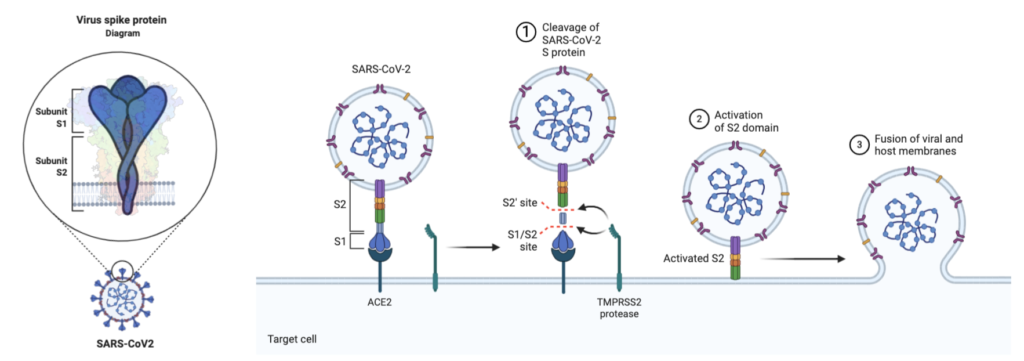
The vaccine, as mentioned before, works differently in our bodies. Traditional vaccines trigger resistance through exposure to the pathogen. In the case of the Pfizer COVID-19 vaccine, it introduces mRNA, which our body turns into the COVID-19 spike protein (the protein responsible for COVID-19 recognising and infecting our cells, Figure 1; Huang et al., 2020).
Figure 1 – BioRender schematic showing the COVID-19 spike protein (Diana Sofia Mollocana Yanez), and the use of the spike protein to enter our cells during infection (Hartenian et al., 2020).
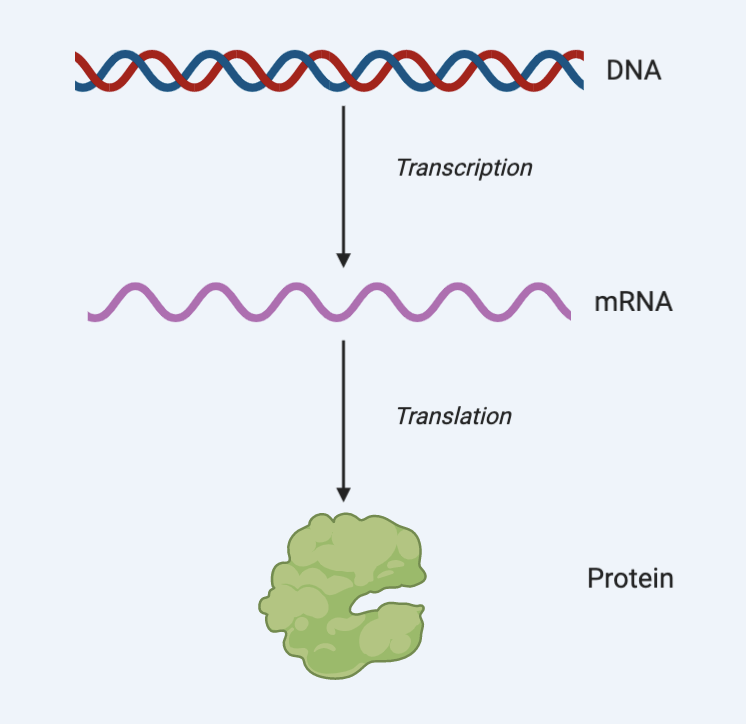
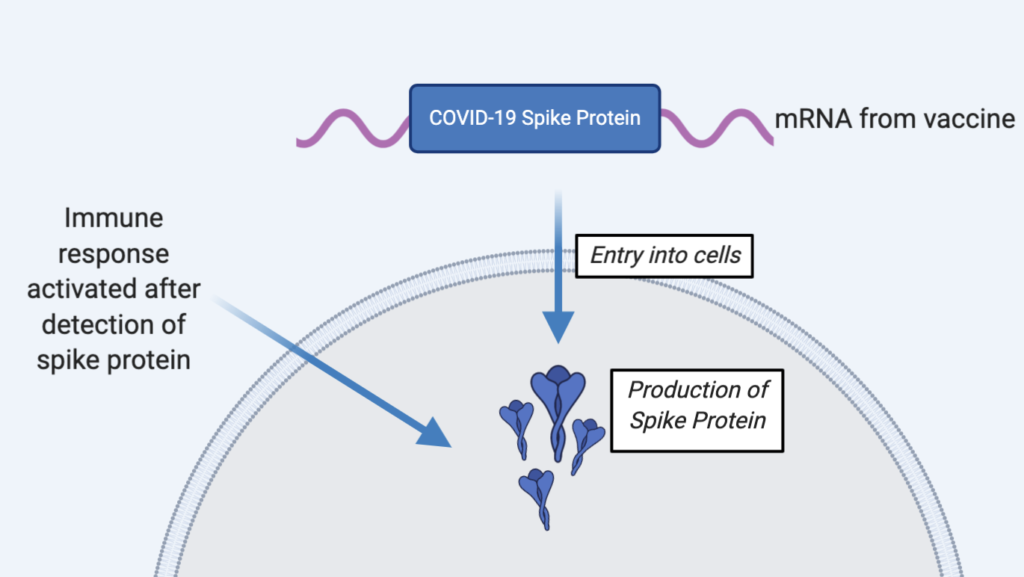
mRNA is naturally found in our cells and is made from our DNA as a message which is made into a protein that usually performs a function, or results in a trait (Figure 2A; Hargrove and Schmidt, 1989). Therefore, this vaccine is using a process our body performs all the time. However, when the COVID-19 spike protein is made from the mRNA in the vaccine (Figure 2B), the body recognises it as non-self, starts an immune response and we generate immunity as a result.
A B
Figure 2 – A) Normal process of protein production in our cells B) Process of spike protein production through vaccine’s introduction of mRNA which tells the cell to produce the spike protein, which triggers an immune response, and subsequent immunity. Schematics made on BioRender.
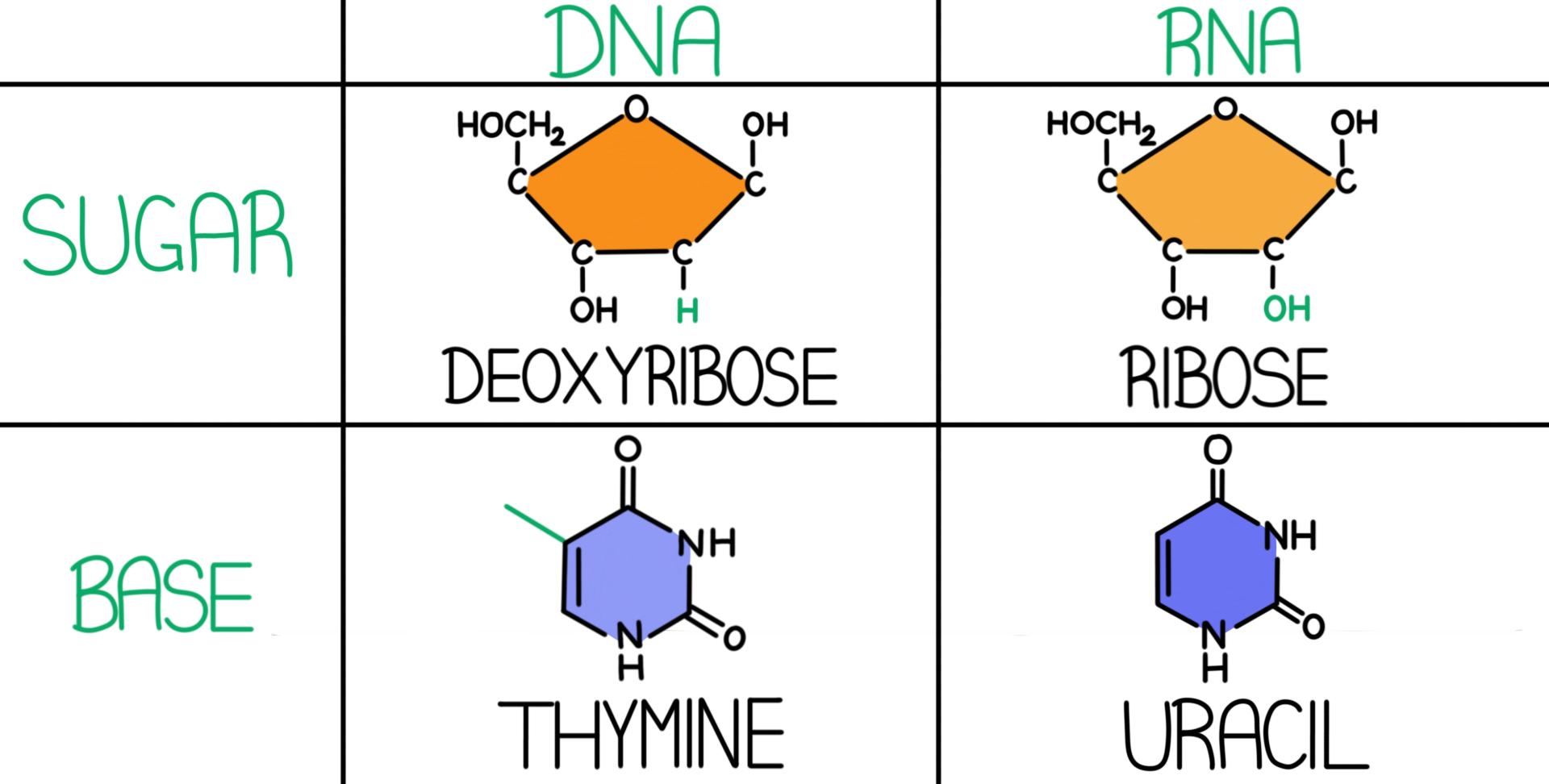
There are some common conspiracies, that this vaccine enters our genome, or it contains a chip for government tracking. To dispel these, mRNA cannot enter DNA (thus, our genome), as DNA and RNA are similar, but different molecules, which cannot stably co-exist as one. Furthermore, RNA cannot become DNA without an enzyme not found in our body. Also, in the impossible circumstance, it does become DNA, it cannot enter our genome without identical DNA sequences on either side of the gene. As for the chip, there is nothing more I can say than this is false. If you are concerned, however, your smartphone tracks your GPS, your internet searches, and monitors who you contact, the government already has the means to track you, so a chip in a vaccine would not be efficient. It is concerning that people are turning against vaccines which have helped to increase life expectancy, and are the right first step in ending the pandemic and returning to everyday life.
Figure 3 – Schematic demonstrating the molecular difference between DNA and RNA, in this case RNA has a riobose sugar with a hydroxide group (OH) on the 2nd Carbon. Whereas, DNA’s deoxyribose has a hydrogen (H) at the 2nd Carbon. Additionally, DNA and RNA contain the bases: Adenine, Guanine, and Cytosine. However, DNA contains Thymine, whilst RNA, contains Uracil – an altered thymine. Image taken from (Slizewska, G., n.d)
Bibliography:
Ball, P. (2020), ‘The lightning-fast quest for COVID vaccines-and what it means for other diseases’. Nature.
Cdc.gov. (2020). ‘Management Of Anaphylaxis At COVID-19 Vaccination Sites’ | CDC. [online] Available at: <https://www.cdc.gov/vaccines/covid-19/info-by-product/pfizer/anaphylaxis-management.html>
Fda.gov. (2020). ‘FACT SHEET FOR RECIPIENTS AND CAREGIVERS’. [online] Available at: <https://www.fda.gov/media/144414/download#:~:text=The%20Pfizer%2DBioNTech%20COVID%2D19%20Vaccine%20includes%20the%20following%20ingredients,)%2C%20potassium%20chloride%2C%20monobasic%20potassium>
Hargrove, J.L. and Schmidt, F.H., (1989). ‘The role of mRNA and protein stability in gene expression’. The FASEB Journal, 3(12), pp.2360-2370.
Hartenian, E., Nandakumar, D., Lari, A., Ly, M., Tucker, J.M. and Glaunsinger, B.A., (2020). ‘The molecular virology of Coronaviruses’. Journal of Biological Chemistry, 295(37), pp.12910-12934.
Huang, Y., Yang, C., Xu, X.F., Xu, W. and Liu, S.W., (2020). ‘Structural and functional properties of SARS-CoV-2 spike protein: potential antivirus drug development for COVID-19’. Acta Pharmacologica Sinica, 41(9), pp.1141-1149.
Slizewska, G., (n.d). ‘DNA Vs. RNA — Differences & Similarities – Expii’. [online] expii. Available at: <https://www.expii.com/t/dna-vs-rna-differences-similarities-10205>
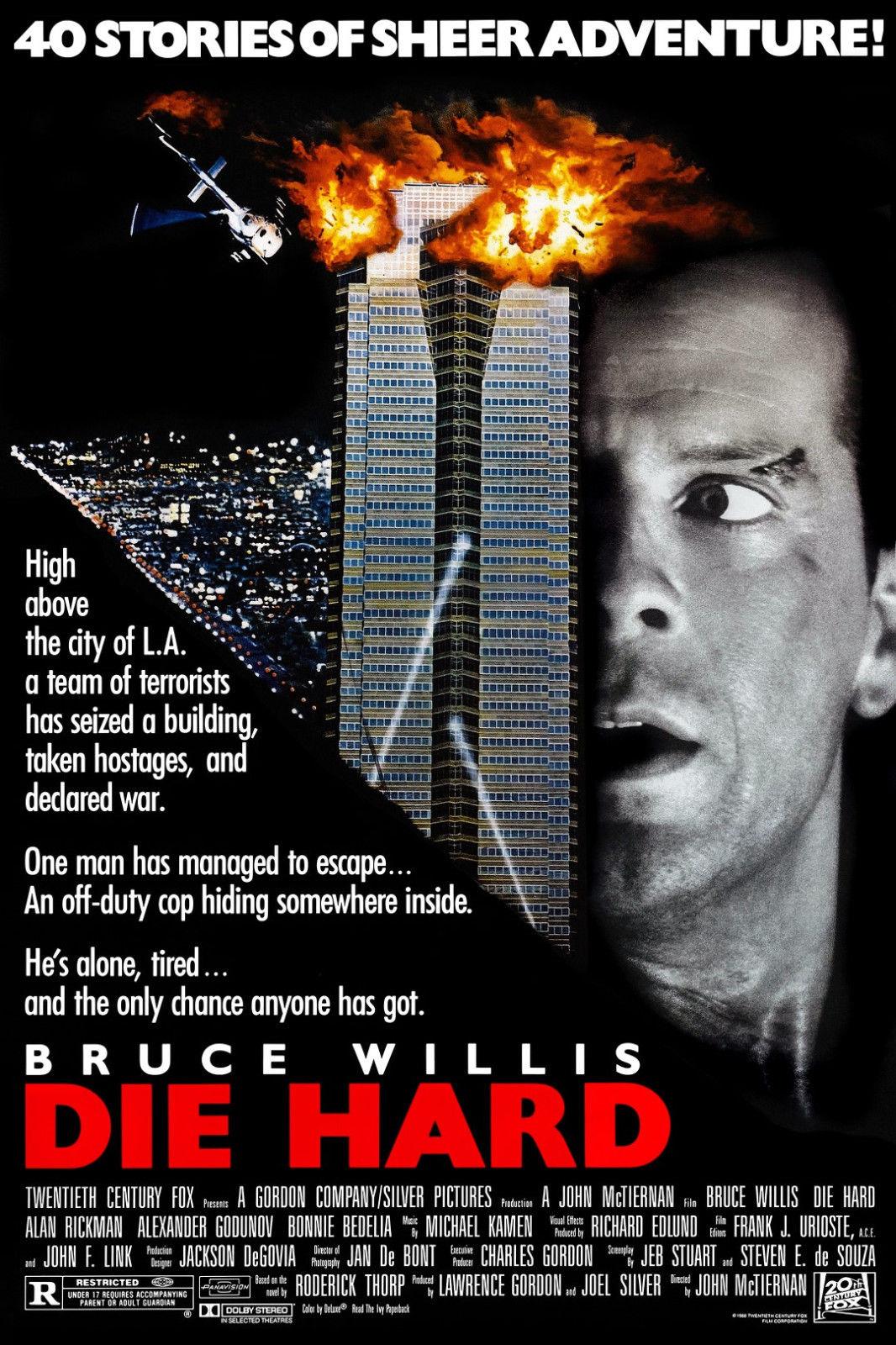
Die Hard for me was one of those films which I had heard of, probably seen at a younger age and paid no further mind to. Somewhere in the back corridors of my memory I remembered that this was supposedly a Christmas movie so I decided to watch it on Christmas Day. I will not exaggerate by saying this is probably the best action movie I have ever seen. If not, it is up there with Aliens, Predator, Terminator (1 and 2), The Matrix and RED, to a lesser but still large extent.
Bruce Willis … John McClane
Bonnie Bedelia … Holly Gennaro McClane
Reginald VelJohnson … Sgt. Al Powell
Alan Rickman … Hans Gruber
Paul Gleason … Dwayne T. Robinson
De’voreaux White … Argyle William
James Shigeta … Takagi
Alexander Godunov … Karl
Based on the 1979 Robert Thorp novel Nothing Lasts Forever, this 1988 masterpiece was directed by John McTiernan and written by Jeb Stuart and Steven E. de Souza. Die Hard follows New York City cop John McClane (Willis) as he attempts to deal with a terrorist takeover of Nakatomi Plaza while visiting his estranged wife (Bedelia). The terrorists are headed up by Hans Gruber (a stellar Rickman).
John McClane’s smartmouthed New York cop was a career-defining turn, mixing banter, action heroics and a dirty white vest to stunning effect. Acting up to him every step of the way is Alan Rickman, at his sneering best – but the script and cast are pretty much flawless. The very pinnacle of the ’80s action movie, and if it’s not the greatest action movie ever made, then it’s damn close. Empire
Without spoiling the plot which I imagine many of my readers will know well already, I was so impressed with the concept, execution and dialogue of this film. I remarked to M halfway through that this was a flawless film across many fronts and succeeds in cinematography, script, is visually stunning, has suitably menacing foreign (to the US) villains and more gripping, relentless action than I could have imagined possible. A particular highlight for me was Willis’ roof leap hanging onto a fire hose, shooting his way through one of the windows. I had to watch that again several times. Aside from being a brilliant piece of action movie making, it was just so damn cool.
In summation, Die Hard is a classic, all-American action feast which succeeds across every metric by which one measures a good film. I am no less than staggered by it in its entirety and cannot recommend it enough.
Rush were the true ‘find’ of this year for me. No other band or composer has succeeded in moving me so completely and so consistently as Rush. It just so happens that 2020 is the 40th anniversary of the release of this album, which adds some meaningless pomp to the occasion. Geddy Lee himself stated “I’ll be honest, I’m fed up that every time I turn around that it’s the fortieth anniversary of something we’ve done.”. Oh to have been alive in the heyday of Rush. As this album comprises of six tracks only, I shall discuss each in turn below.
(Speaking of Hemispheres, the preceding album) “We were falling into these patterns of writing — the repetition of these thematic things that occur over a 20-minute span,” bassist Geddy Lee told Rolling Stone in 2018. “They were starting to feel too comfortably organized in a way, like we weren’t thinking originally enough. That’s kind of a prog pattern. People associate prog-rock with a challenging style of music, and it certainly can be that. But if you’re starting to fall into past habits and develop a methodology that’s too comfortable, it’s not progressive. I think we started to feel that way by the time we finished that record.”
So for their seventh LP, Permanent Waves, the Canadian power-trio — Lee, guitarist Alex Lifeson, drummer Neil Peart — consciously trimmed their track lengths, embraced more personal subject matter and nodded to the sleeker sounds of the New Wave scene. (The album title is, fittingly, a playful “poke” at the genre, as Peart told the Chicago Tribune. “There are many New Wave groups we enjoy and respect, like Talking Heads and Elvis Costello and Joe Jackson,” he said. “Really, the joke was aimed more at the press, especially the English rock press that is inclined to write off any band that was around last week and go for whatever’s happening this week.”) Ultimate Classic Rock
The Spirit of Radio
My father and I were discussing this recently and he told me he was first introduced to Rush while listening to this track on the radio which I can only imagine must have been electrifying. This was his first purchase. I’ve had this album on vinyl since I inherited father’s collection when I was 14 but did not fully appreciate it’s beauty until now.
One likes to believe in the freedom of music
But glittering prizes and endless compromises
Shatter the illusion of integrity, yeah
Invisible airwaves crackle with life
Bright antenna bristle with the energy
Emotional feedback on timeless wavelength
Bearing a gift beyond price, almost free
The above lyrics, written by Neil Peart as a love letter to the magic of radio, have and continue to give me goosebumps whenever I listen to this record. The track itself crackles with life and energy. The late great Neil Peart’s drumming and lyricism skills are on fine form here. The track moves from jazzy drumming and cymbals to reggae and back to prog rock effortlessly. The snippet of the live show after the lyric “concert halls” is electrifying. The Geddy Lee guitar solo is absolutely show stopping. And this is just the first track.
Freewill
This track is humanist and anti organised religion. This track is one of the strongest on the album and the symbiosis between the “three virtuosos” as Nick calls them, is as evident as ever. Lee, Lifeson and Peart are as one in this track and the result is staggering. The guitar and bass solos give me goosebumps. The drumming is mathematical and precise and the whole track is a phenomenon.
You can choose a ready guide in some celestial voice
If you choose not to decide, you still have made a choice
You can choose from phantom fears and kindness that can kill
I will choose a path that’s clear;
I will choose free will
Jacob’s Ladder
The bass at the beginning of this track is foreboding. The symbiosis between Peart and Lifeson is exemplary. Geddy Lee’s entry and early solo – just superb. The low ebb towards the middle of the track followed by a staggering final phase made me feel as though I were climbing the ladder with Jacob. The transitions between phases of this song are excellent.
Entres Nous
Translated from the actual French as ‘between us’, this wonderful track is about individuality, loneliness and isolation which has spoken to me in this tumultuous year. The virtuoso trio (quote, St Nick) have wowed me again with the French Canadian connection, first showed in Circumstances on their previous album. The lyrics are just great:
We are planets to each other
Drifting in our orbits
To a brief eclipse
Each of us a world apart
Alone and yet together
Like two passing ships
Just between us
I think it’s time for us to recognize
The differences we sometimes feared to show
Just between us
I think it’s time for us to realize
The spaces in between
Leave room
For you and I to grow
The riffs throughout are exceptional and I was particularly impressed by the bass around the 2.44 mark.
Different Strings
This is my favourite Rush track. Out of their prolific catalogue this stands out as one of the most finely arranged, musically perfect and deeply felt tracks. I would say this is one of their crowning masterpieces. The symbiosis again is so clear here. The isolated guitar work at the beginning gives goosebumps, followed by the drums and piano, heard for the first time in the album. It speaks to unity and solitude in a deeply moving lyrical feast.
All there really is
The two of us
And we both know why we’ve come along
Nothing to explain
It’s a part of us
To be found within a song
What happened to our innocence
Did it go out of style?
Along with our naivety?
No longer a child
Different eyes see different things
Different hearts
Beat on different strings
Natural Science
After Different Strings, one is bound to be disappointed. The beginning of this track, I argue, panders to this theory. The beginning is intentionally weaker for you to recover somewhat from the previous track. But then, from the guitar solo 2 minutes in, it picks up beautifully. There are clear movements, for what of a better expression, in this track.
Wheel within wheels in a spiral array
A pattern so grand and complex
Time after time we lose sight of the way
Our causes can’t see their effects
…
The most endangered species, the honest man
Will still survive annihilation
Forming a world, a state of integrity
Sensitive, open, and strong
This track sums up the brilliance of this album very well, showing the three virtuosos on top form and displaying a musicianship bordering on the divine.
A seminal bit of Rushness – Pater
My overall impressions of Permanent Waves are as follows:
Three uniquely talented virtuosos
Symbiotic and united musicianship displayed at all times
I could listen to the isolated tracks for each instrument at any point in this album and be as impressed
This is a staggering album which has its correct place in my personal pantheon of perfect albums. I hope it will find its way to yours.
The time has come again for Almost Album of the month, a collation of the albums which have marked me this year but for a number of reasons could not hold the title of album of the month. See below 6 albums (as I no longer have enough time to write 12 like last year) which I consider to be uniquely splendid.
Headspace – Levitation Room 2019
The above was my most played track of 2020 and it is not difficult to see why. This album is one which I played over and over and over throughout the year. It is wonderfully inventive, cohesive and offers a very strong sound. This is the height of ‘nondescript modern’ pop.
Marillion – Clutching at Straws 1987
Marillion are a powerhouse British punk/progressive rock band to which my father introduced me while I went to France in the summer, in between quarantines. You will be aware that Misplaced Childhood was album of the month in July and with good reason. I could have chosen any of Marillion’s other albums with Fish as lead singer as well as FEAR with the new singer Steve Hogarth. Fugazi, Script For a Jester’s Tear, or FEAR could have been chosen but I listened to Clutching at Straws most. It is a masterpiece. Please do listen to it.
Steve Harley – Timeless Flight 1976
This album is one which would fit into the album of the year category. I have not in my possession words to describe the masterful work of beauty that is Timeless Flight. It is only not album of the year because the album I have picked this year shook my musical foundations and I have been listening to Timeless Flight since I was 14 and got my first record player. Nothing is Sacred is one of the most beautiful songs I have ever heard.
Nina Hagen – NunSexMonkRock 1982
This marvellous 1982 offering is a splendid and oftentimes confusing album can be categorised as psycho-germanic experimental pop. Rolling Stone called it the “most unlistenable” album ever made, while others praised its experimental nature and Hagen’s theatrical vocals. If you can get past the gauche title, I highly recommend this album which has brought me much joy over the last year.
UB40 Live – 1983
UB40 Live is another excellent example of Birmingham brilliance in pop. This album sees the Brummy band perform songs from its first three studio albums, Signing Off, Present Arms and UB44. I am a fan of UB40 so this album really appeals to me. Nick, Louise and I tried to visit their bar, The Garden Lounge in Zadar, Croatia (in the Before Time) but it was closed at the time. Watch out for tracks such as One In Ten, Folitician, Tyler and the mega Sardonicus, which gives me goosebumps still.
Telekon Live – 2008
2020 was the year of the live album for me. Peter Gabriel’s Plays Live being the crowning jewel of live albums. I have also enjoyed The Allman Brothers’ At Fillmore East, B.B. King’s Live in Cook County Jail, Peter Framton Comes Alive (wonderful), Kiss! Alive, Sparks Live at the Record Plant 1974 (mega for Sparks fans) and recently both of Thomas Dolby’s live albums. But none have knocked me over quite so conclusively as Telekon Live. I am a huge fan of Gary Numan and must have about ten of his records on vinyl. This album was released in 2008 by Mortal Records and is a recording of Numan’s 9 December 2006 Telekon concert at the London Forum, 26 years after it was first released. Critics have argued that Numan himself is the only weak link in the album and I am minded to agree. However, together, it is a wonderful contribution to the musical gene pool, as it were. The last track in particular blows me away every time.
Overall these are a few of the albums which have made my year more bearable. I hope they bring you some joy also.
George A. Romero will be remembered in cinematic circles for inventing the zombie horror genre. Night of the Living Dead is and remains the inspiration for the slew of zombie related horrors which follow. It is not without its unique issues, but these are more a product of the time in which it was produced, than serious indictments of the character of the film. The plot is thus: Barbara and her brother Johnny are laying flowers at their parents’ grave when suddenly a lone zombie comes up and attacks them. This spawned the iconic line “They’re coming for you Barbra” which I have included in the clip below.
Barbra escapes to a nearby farm house where she finds herself locked in with Ben, Harry and Helen Cooper, their sick daughter Karen and Tom and Judy, a couple. Will they escape intact?
Duane Jones … Ben
Judith O’Dea … Barbra
Karl Hardman … Harry Cooper
Marilyn Eastman … Helen Cooper
Keith Wayne … Tom
Judith Ridley … Judy
Kyra Schon … Karen Cooper / Corpse in House
As with all seminal horror films, we have become desensitised to the comparatively demure techniques used to evoke terror. However, it must be recognised that this was the first zombie movie and as such would have terrified audiences then. M and I wondered what it would be like for us to travel back in time and show the same audience The Conjuring. I suspect they would not have slept for many weeks. Romero established the core facets of zombification in this movie, that is to say the resurrection of the bodies from graves, eating the flesh of their victims, needing to shoot the zombie in the head to kill the brain and thus neutralise the threat. These all came from this film and can be seen featured invariably in the zombie horrors which followed.
An independent film shot in grainy black-and-white on a shoestring budget, Romero delivered a stark and subversive horror that established the most important facets of zombie lore (bodies returning from the grave, destroying the brain to kill them for good) and proved the director as a filmmaker adept at genre-infused social commentary. As Ben, Barbra and more hide away from the rising corpses in a rural farmhouse, Romero reflects ideas of racism in the USA, the ongoing trauma of the Vietnam War, and the American public facing up to the realisation that their greatest enemy might actually be themselves. Empire
I was somewhat concerned at the portrayal of Barbra as an incapable, panic stricken mess throughout the film. I suppose this is again a product of the time of the film. I was impressed by the consistent drama between the guests of the house, namely Ben and Mr Cooper (the latter of which obsessively insisting that everyone would be safer in the basement of the house – they were not). This drama and the tendency for Ben to be correct more often in his strategic thinking leant itself to some stellar drama and dialogue.
Overall, without spoiling any of the surprises of this film, I must admit it ended exactly how I suspected it would. I am deeply impressed by this movie and encourage you to watch it to gain an understanding of all the zombie films which followed. Please see below a more modern trailer for The Night of the Living Dead.
Housed at the extraordinary Museo Nacional Thyssen-Bornemisza, Madrid, Boy in a Turban Holding a Nosegay is a masterpiece by Michael Sweerts (1618-1664). Sweerts was a Flemish painter most recognised for his allegorical and genre paintings as well as portraits and tronies (common type, or group of types, of works common in Dutch Golden Age painting and Flemish Baroque painting that show an exaggerated facial expression or a stock character in costume.) Sweerts was rather a busy painter, having worked in Rome, Brussels, Amsterdam, Persia and India (Goa). It may interest the reader to know I have been to all of these places except Persia, but the night is young. Equally I did go to Bruges rather than Brussels in the Before Time but these are small details.
Boy in a Turban holding a Nosegay has been associated with the group of paintings that Sweerts executed at the end of his Amsterdam period. The subject of the present painting and the sex of the figure have been the focus of debate and have given rise to different interpretations. The gentle, delicate features and the turban hiding the hair make it difficult to define the subject precisely, and the canvas was previously entitled Figure in a Turban. It was only in 1958, when the painting was included in an exhibition on Sweerts in Rotterdam, that the sitter was described as a boy, a reading that has been maintained in the present day.
The fact that the boy is holding a nosegay has led to the suggestion that this is a representation of the sense of Smell. Sweerts executed two, now dispersed, series on the Five Senses. In one series, which uses a similar format to the present painting, five male figures in exotic dress hold objects and animals related to the senses. Museo Thysen
When I was last in Madrid I did not take the opportunity to visit this museum preferring instead to go to the Prado and the Royal Palace where I saw a miniature version of my favourite sculpture in the world, which can be found in the Cappella Sansevero in Naples. See the miniature below, which I first beheld in the Carlos III. Majestad y Ornatos exhibition.
But I digress, see below the painting which is the subject of this post:
This for me is absolutely astounding work. The clarity of the skin is lovely, the light falling on the turban is particularly gorgeous. If you look at the eyes you can see them watering slightly. The strands of the patterned undergarment of the turban is exceptionally well done.
The highlight of this painting for me is the nail depiction. The flowers in the nose gay are a little crude in comparison to this. But with the overall impression this has left on me I can forgive Mr Sweerts. The nails are just immaculate. The colour is perfect, the shape is perfect, the sheen is extraordinary. And the shade from the nose gay onto the hands is a particularly fine detail.
Why have I chosen this as my birthday post, I hear you ask? Well this painting has given me a reason to reminisce about the wonderful time I spend in Madrid and made me consider a future trip with M. Equally it is undeniably a masterly work of supreme skill from my preferred period in art. I cannot but appreciate the overall excellence of this painting. In short, it has made me rather happy. And being rather happy is all I want on this most special milestone in my headlong journey towards the grave.