On account of this wretched pandemic, Bonehead Chicken only allows you to order their divine food through Uber Eats. One is not yet allowed inside the fine establishment so please forgive my photographs for not being of the usual quality one might expect on this blog. I have had to pinch photographs from blogs which visited in person in the Before Time.
I would like to first draw your attention to the exquisite waffle fries which were a gift from Heaven. Their consistency was delightful, just turgid enough. Their size was just enough for a mouthful. The level of seasoning was superb. They were also cooked to perfection.
The Buffalo Soldier –
Fried Chicken Thigh, Buffalo Hot Pepper Sauce, Blue Cheese Sauce, Shredded Lettuce & Pickle.
This photograph was pinched from Independent Birmingham, a superb app/ website which promotes local independent restaurants, bars and pubs in the city. I urge you to look into it and sign up. It has made my life immeasurably better. The Buffalo Soldier was a hellishly good burger. What amazed me the most about both burgers was that they held together wonderfully.
I won’t include a picture of the Bonehead Burger because it does not look nearly as delicious as the one above, however I can confirm it was some of the most beautifully cooked chicken I have had in months. The seasoning was not all together present in the latter and the former was greatly enhanced for its blue cheese sauce.
Overall I found this to be a most excellent venue and I hope to return soon after my next pay day. I am most impressed by its location, delivery time and robust burgers. But equally deserving of praise are its wonderful waffle fries, which I shall be devouring more of as soon as possible.
van Gogh (1853-1890) was a master of oil painting who changed the post-impressionism movement, as well as painting holistically, forever. He was largely self taught but was inspired by Gauguin, Pissarro, Monet, and Bernard, living with Gauguin in Paris for a time. To say van Gogh was troubled would be an understatement especially with our cutting edge understanding of mental illness. He dedicated himself to his art and developed a vivid instantly recognisable style which influenced Expressionism, Fauvism and early abstraction and much more besides.
Working at an often furious pace van Gogh produced more than 2,000 works of art, including around 900 paintings and 1,100 drawings and sketches in his 10-year career. However, he sold only one painting during his lifetime and did not become successful until after his death. Artable
I was struck by this piece which was mentioned as an aside in one of the excellent National Gallery videos which explored van Gogh’s devastating sunflowers. What stole my attention first was the vivid nature of the combatting colours in this piece. The blue swirling sky as contrasted with the cloud and the leaning Cypresses. That against the rolling plains, bushes and block represented grass creates a vortex of emotion which pulled me right in. It is no small wonder he painted this at the Saint-Paul psychiatric institution in Saint-Remy, when admitted there for a year in 1889. What must he have been feeling at this time?
The second aspect which stole my attention was the masterfully depicted motion in the painting. This is supported in part by the third aspect which impressed me, that is to say the trademark use of as few and obvious brush strokes as possible. The impressionists tried largely to hide as many brush strokes as possible to give the impression of realism, but quite the opposite can be said of van Gogh.
Van Gogh regarded the present work as one of his “best” summer landscapes and was prompted that September to make two studio renditions: one on the same scale (National Gallery, London) and the other a smaller replica, intended as a gift for his mother and sister (private collection). Met Museum
Van Gogh also produced a study of the Wheat Field with Cypresses in reed pen drawing, which he sent to his brother. This must have been the preliminary study for the final painting and perhaps in part the reason he was able to produce the latter with such speed. Observe the magnificent motion he creates without needing to use elaborate brush strokes or colour. This is truly the work of a master, whose (essentially) sketches evoke almost as much emotion as the final piece.
On 8 May 1889, after months of hospital treatment in Arles, Vincent allowed himself to be committed to the Saint-Paul de Mausole psychiatric institution in Saint-Rémy de Provence. He was treated by Dr Théophile Peyron. In between attacks, Vincent made numerous paintings and drawings, first in the asylum and its gardens and later beyond, among the olive gardens and cypresses, in the Alpilles mountains and in the village. Saint-Rémy served as the setting for many of his most famous works. Van Gogh Route
In the end, Wheat Field with Cypresses is a wonderfully emotive piece in which one can see van Gogh’s fragile emotional state and reflect on what must have been his personal experience during a troubled time in the Saint-Paul institution. But also, in the end, art is to be enjoyed for its own sake as well as within its own context. This is a hopelessly beautiful piece, even when all context is stripped away.
The more textured piece I have reviewed is the Wheat Field with Cypresses which was painted in July 1889, and can be found at the Met Museum in New York.
The below, less defined but no less beautiful, was painted in September 1889 and can be found in the National Gallery in London.
Self deprecation is a go-to for comics, this much goes without saying. In her first Netflix special, Nanette, Gadsby blew up the form of comedy and took self deprecation to its logical conclusion. Comedians will often address humorously crippling anxieties and life struggles in order to satirise them but Gadsby went further, using her platform to address directly the mechanisms in place which allowed for her suffering to occur in the first place. This is something which is seldom done in comedy for the purest reason that it is seldom funny. But it isn’t meant to be. Gadsby realised this and repeated the formula of her last show in this one, Douglas, where she once again taught all of us who appreciate comedy a stern lesson.
[It’s] a more approachable set than its predecessor. Gadsby is obviously having fun – which isn’t something you could say about Nanette – but it’s in no way a climbdown. The show (her 1oth – but also her “difficult second album”, she admits) is perfectly judged, a 75-minute set that proves self-deprecation is a thing of the past for Gadsby, that blazes with well-earned confidence, and that hitches her crusading, patriarchy-bashing humour to great jokes, meticulous set-building – and a new cause. The Guardian
I will applaud Gadsby for in the first instance, doing something which I have never seen in comedy – she told us exactly how her set was going to go. The initial 12 or so minutes of the set were an instruction guide on what was to come, and one joke in particular which we were all to look out for (the one about Louis CK). This is a big ‘stuff you’ to the form and exemplifies why Gadsby is a cut above the rest.
Another highlight for me was her announcing she was diagnosed with Autism in 2015. This, she tells us, was to be an excellent joke coming up in the show! This deferential blasé style of comedic writing is so excellently delivered by Gadsby throughout that she is a real pleasure to watch.
But overall Gadsby manages to provide us with her difficult second album which I am sure will be a hit. Her style, delivery and breadth of subject mater are unique and vast. She is a law unto herself and weaves art history into her sets seamlessly, with a disparaging twist which is so fun to watch. Please go to Netflix as soon as you can and watch this masterful artist at work. You shan’t regret it.
The remarkable thing about this bakery is that it is hidden right in the middle of town, on New Street no less. While I have not yet had time to sample all of the deliciousness on offer, I have tried a fair bit and cannot but recommend this wonderful eatery and art gallery to you.
Medicine was born out of a discovery of abandoned space, of new possibilities and an inquisitive quality for creating something vital and diverse. An artisan bakery and kitchen, café and gallery, which is rooted in its heritage in both Birmingham and Wolverhampton, Medicine represents a new format of social space. It finds its niche through a carefully curated menu of ethical products, whilst offering a daily fix of cultural inspiration in an environment which promotes a debate about art and culture. Medicine
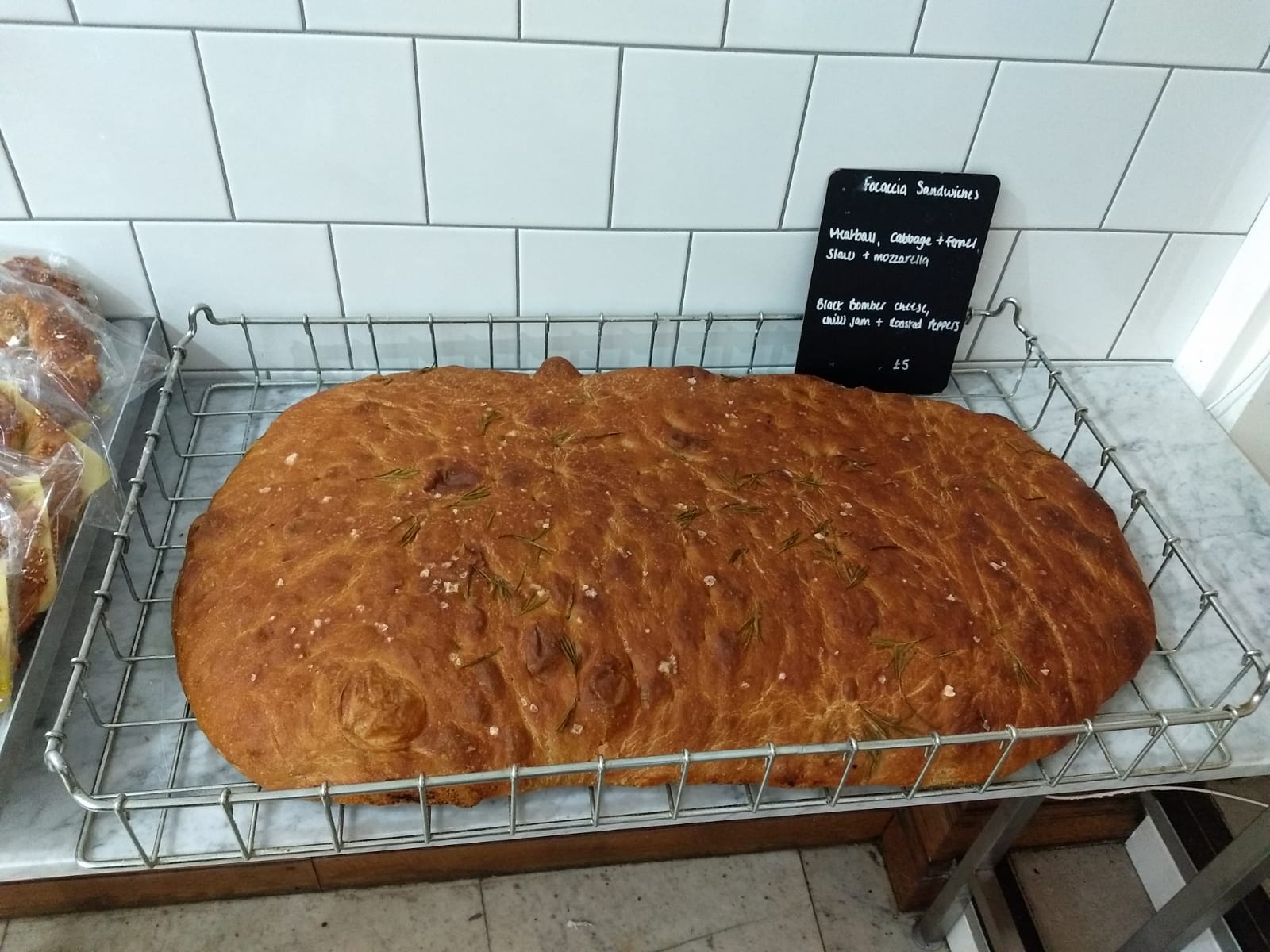
I must apologise, I have yet to take a photograph of the panoply of treats available all together. However, I have managed to capture selected goodies, for example this magnificent rosemary focaccia, made on the day. I bought three portions of this to make sandwiches which turned out quite spectacular. But one can also buy sandwiches from this bread made in store.
We feasted on these one Sunday lunch. The lower one was vegetarian, it had carrots, mushroom, salad and pesto which made for quite the sumptuous and healthy feast. Fibrous is indeed the word I would use to describe this wonderful sandwich.
Mine, however, was the meatball marinara. Biting into it was like taking a mouthful of beef ragú sauce. Just exactly correct. The sauce was so plentiful that it made the bread moist. There was just the right amount of fennel so as to not make the whole thing taste like wet dog. the red cabbage and Monteray Jack cheese was astonishing, though I would have preferred parmesan for consistency.
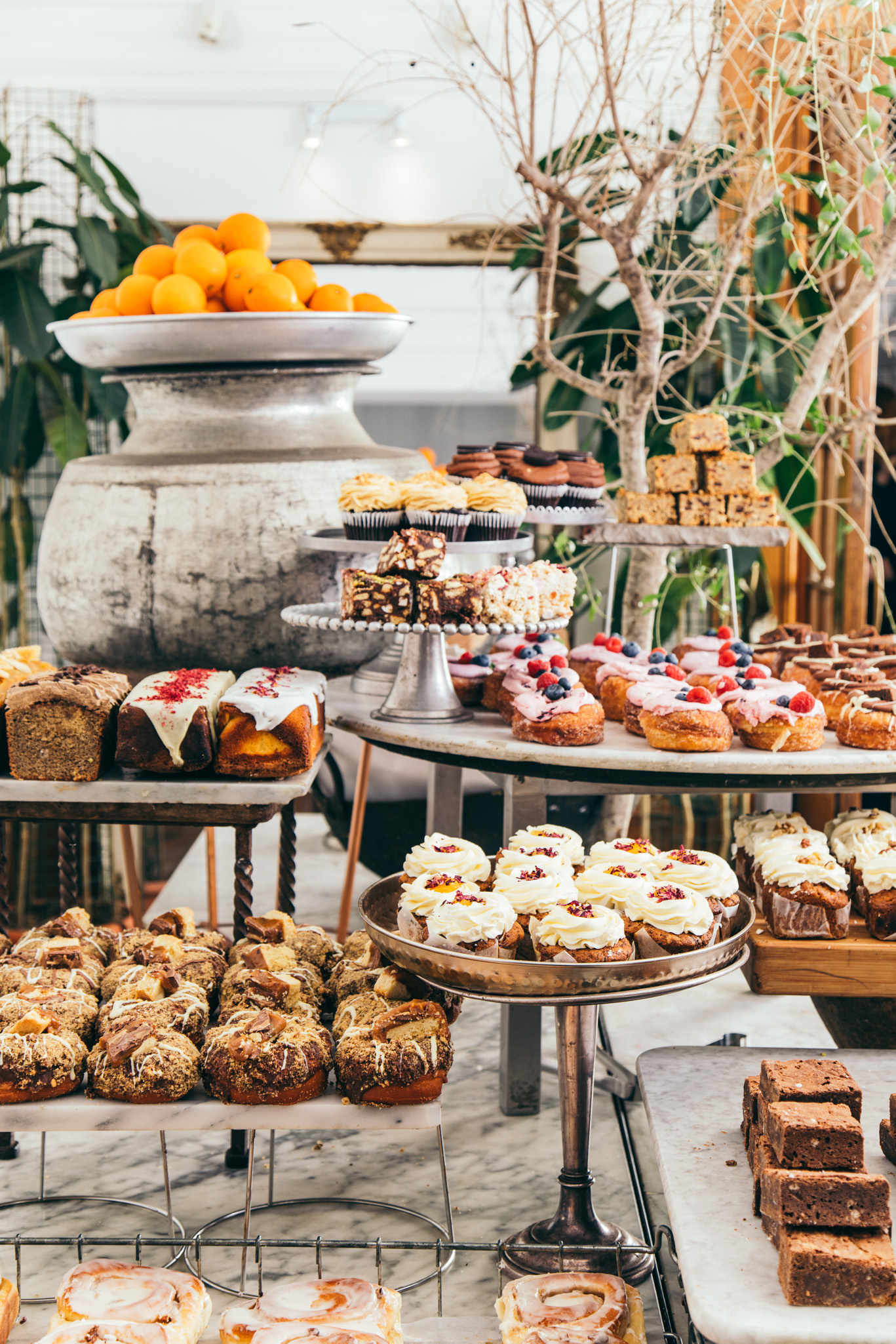
Take a look below at a photograph snatched from the Medicine website for an example of the fine sweet offerings at the bakery, which I shall come onto now.
As I say I have not managed to sample everything yet, but I have had one of their vegan donuts (a tad hard for me, raspberry jam filling mind-blowing), maple and pecan Chelsea Bun (amazing), Pizzant (pizza dough made of croissant with pesto, tomato and parsley topping – there are no words) and their speciality, the mighty Cruffin.
The idea of the Cruffin is that they have made a muffin out of croissant batter. Then Medicine have topped it with chocolate icing and filled it with a hazelnut ganache, not too dissimilar to a Fererro Rocher. This was a lesson in dessert. The flavour – astounding, subtle balanced. The texture – perhaps a bit dry but wonderfully croissant like. The look – ten out of ten. This was a stunning dessert which left me speechless.
I so look forward to sampling everything else Medicine has to offer. I may well do a second review in the coming weeks. Who is to say?
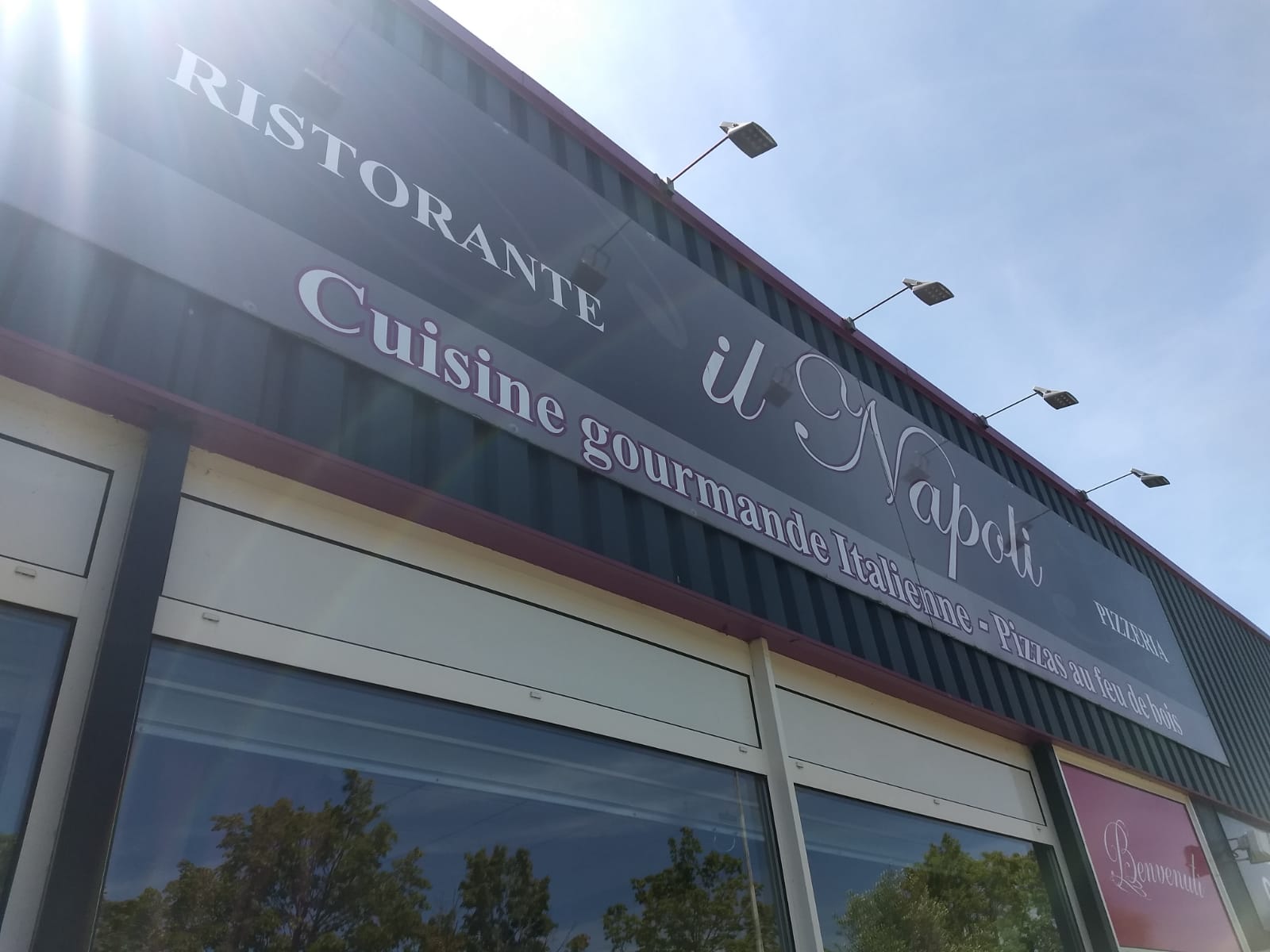
Tucked away in a suburb of Tours, Il Napoli proved to be an exceptional culinary experience. This is not someone would expect from a pre-fab building in the middle of an industrious suburb of a lesser known French town. But coming to Il Napoli with all the necessary reservations (pardon the pun) will ensure the greatest experience. You will not predict the feast you are about to ingest.
After a necessary gulp of artisanal cider, Mother ordered the Four Cheese, as is her wont. This included mozzarella, gorgonzola, farmer’s goat’s cheese and what I believe was grated pecorino. All together the semi acrid flavour of the four cheese exploded. The Four Cheese pizza is hard to do well because the four cheeses need to go well together. I found the balance here to be particularly pleasant.
I decided I had to taste the Suprema. This was topped with cream, wild mushrooms, mozzarella, Talegio cheese and raw onions. This was a little more bland than I expected, mostly on account of how sparing they were with the lardons. This is not Cedric’s home made pizza, sadly. But overall it was excellent and the crust cannot be lauded enough. More on this point later.
DEL MAR
Salade, tomates, saumon fumé, billes de mozzarella di bufala, câpres à queues, tomates confites, vinaigrette huile d’olive et balsamique.
One should mention father’s salad Del Mar which was a little light on the salad part, as you may be able to see. The toppings were legion and all quite delicious. I stayed away from the fish, as you can imagine, however I can confirm the buffala mozzarella was absolutely superb.
TARTUFATA
Crème, Gorgonzola, mozzarella fraiche, compotée d’oignons, magret de canard fumé, roquette, pignons de pins torréfiés, huile de truffes noires.
Goodness me, where to begin; mozzarella, gorgonzola, caramelised onions, pine nuts, magret of duck, roquette and black truffle oil. Magret refers to the breasts of ducks that have been corn-fed and raised to produce foie gras. The whole thing was so sublime that I shed a tear. I could not believe the intensity and novel flavour of this pizza. Put together with the outstanding thin, crispy base, this was a dish to die for.
The tiramisu was extraordinary. It was light and not terribly filling which is how such a dish should taste. The coffee was not overpowering either which came as a great relief.
The show stopping dessert for me was the pear and ice cream mille feuille seen above. The ice cream was fresh and presumably home made, the pear was seasonal and local and the pastry was divine. The pastry was light and full of flavour which only French restaurants of great repute seem to be able to achieve.
Overall, this hidden treasure was very much to our liking. I was astounded by the consistency of the excellent quality food and great, if not a tad slow, hospitality. I’d recommend this to anyone in the area ho wishes to get away from busy Tours centre and enjoy some fresh local cuisine.
1985 was a great year for music. One saw the likes of Rush’s Power Windows, Saint Kate Bush’s Hounds of Love (work of genius), Cupid & Psyche 85, Smiths’ Meat is Murder (see Barbarism Begins at Home), Propaganda’s A Secret Wish, and of course, Tears for Fears’ massive hit Songs From the Big Chair (personal favourite). But lurking in the shadows of these smash pop goliaths was a prog rock masterpiece by the name of Misplaced Childhood. I first heard this driving to and from the Saturday market in Loches, a charming French market town which boasts excellent almond croissants.
They were deemed so unfashionable in the era of The Smiths, the Mary Chain and The Cure that those who’d seen the light were only galvanized by the opprobrium. To hear Misplaced Childhood – the band’s masterpiece and biggest seller – now, out of context, liberated from playground peer pressure, is to recognise a truly great concept album. It’s one that believes 41 minutes of rock music can – like a film or book – aim for the stars and present a story full of emotion, poetry and, above all, drama. Prog Archives
The personnel on this remarkable album are as follows:
Fish – vocals; cover concept
Steve Rothery – guitars; additional bass guitar;
Mark Kelly – keyboards
Pete Trewavas – bass guitar
Ian Mosley – drums, percussion
Pseudo Silk Kimono kicks off the album in great Marillion style, lyrically dense and musically beautiful. The opening bars of synth are just majestic. Listen to the way that the keyboard punctuates the gorgeous lyrics. “Naked of understanding” is one of my favourite lines in the album. “The spirit of a misplaced childhood” is introduced at this stage in the album and is a theme which follows the album through. Listen out for the bass throughout this track.
And the misconception that prog is all about indulgent jamming and noodling? There’s zero fat here. Everything lasts exactly as long as feels right. Prog Archives
Kayleigh is of course a love song replete with longing and regret. The really impressive part of this is the seamless transition from the previous track. I almost didn’t see it happening. It was only because I was following the lyrics on the inside sleeve of the vinyl cover that I noticed at all. The balance of instruments here is key and hints at the excellent production value of the album overall.
Lavender follows, again seamlessly, and hits us with the wonderful lyric “IOU for your love”. Listen to the ingenuity of the lyrics throughout – “A spider wanders aimlessly…” – just superb. There is a beautiful languishing bridge between this song and the next.
Bitter Suite is made up of five movements five movements.
Brief Encounter
Lost Weekend
Blue Angel
Misplaced Rendezvous
Windswept Thumb
Each of these are unique and marked by a change in the musical style. This track has a strong focus on lyricism and a wide range of ingenious conceptuality made real by excellent musicianship and top class production. The prog sweep at the end of the final movement is so very Genesis.
Heart of Lothian closes side 1. Lothian is a region of the Scottish Lowlands, between the southern shore of the Firth of Forth and the Lammermuir and Moorfoot Hills, respectively. This is split into two movements (Wide Boy and Curtain Call) and is a love song in a way, to the rise and fall of the album’s central protagonist, heralding from this part of Scotland. This track is almost ballad like, but ends up a greatly felt and passionate piece of prog with, again, some superlative lyrics: “looking like an actor in a movie shot // feeling like a wino in a parking lot”
Waterhole opens side 2 in a distinctly more poppy fashion, perhaps rewarding us with something simpler after a tumultuous first side. Social commentary is as present as ever in the lyrics here: “Pattern merchants selling false impressions” and “wide boys wear love bites for their crimes” – terrific!
Lord of the Backstage has a really strong riff. Once again the transitions between the tracks are seamless. “I walk the backstage // a creature of language”.
Blind Curve is, again, split into five distinct movements.
Vocal Under a Bloodlight
Passing Strangers
Mylo
Perimeter Walk (one can almost feel the longing in this movement)
Threshold
The guitar solo and synth work are top shelf in this track. Each movement is punctuated by a change of music again. There is a real mastery of language throughout this album making the lyrics somewhat akin to poetry. Please note the excellently yelled “THE CHILDHOOD” in thick Lothian Scottish.
Childhood’s End is, to me, inspired by Rush in its beginning. The lyrics are especially heartbreaking here. Fish sings of finding direction after a woeful childhood and coming out stronger as a result, which bleeds seamlessly into the raucous final track, White Feather.
That cohesive thematic structure is mirrored by the arrangements, which flow elegantly from the artful synth-and-volume-pedal textures of opener “Pseudo Silk Kimono” to triumphant rock closer “White Feather.” Steve Rothery’s New Wave-y riffs give the album a decidedly ’80s sheen, but his Steve Hackett-esque solos keep the songs grounded in the prog idiom. Keyboardist Mark Kelly takes a similar approach, moving from breezy synth pads to intricate melodic runs. Ultimate Classic Rock
White Feather closes the show with a final seamless transition from the previous track. A real loud rock anthem-like closer which builds on the strength of the album as a whole. This is a really strong note to end on.
I’m proud to own my heart // This is my heart
These are our hearts // You can’t steal our hearts away
Overall, Misplaced Childhood is more than an album. It is both a journey and an experience. The production is flawless, the lyricism is groundbreaking and the musicality is outstanding. The sequencing cannot be praised enough – this album tells the story of a tragic journey from failure to success, musically and lyrically in a deeply moving way. Misplaced Childhood’s concept is huge and was pulled off exceptionally well. The skill of each player is on full display across the album.