Starting with nothing but dreams, Puerto Rican born Walter Mercado found tremendous fame as an astrologer and is responsible for the popularity of astrology which we see today. He brought astrology to the masses through extraordinary daily shows, viewed by millions. This docu-film charts his journey to fame, the plague of the greedy which surrounded him at his peak and his eventual recovery from his qualms. This ark is of course predictable and safe, however the presence of Walter Mercado himself makes this docu-film truly exceptional.
I was once a star, now I am a constellation.
Walter Mercado
Walter Mercado was and remains an icon. Not only because he was so flamboyant and extroverted but also because of what he represented. His life’s work was to spread as much love and light to other people’s lives as possible. This is why he ended all of his shows with the title phrase of the docu-film itself. Mucho mucho amor (much much love). Considering his message of love, one can also not help but notice how Other Walter was. He is noted in the film to have star quality and stopping power. Walter was striking not only in appearance but also in context. He was an affectionate explosive and bright loud character, starting his career in Puerto Rico of 1969. To be adored and almost worshipped in the following decades in such a regressive, as it was, hyper masculine environment is an astonishing achievement.
Costantini and Tabsch quickly dispense with the suspense. Within minutes, Mercado, now 86 and as handsome as ever, welcomes the camera into his home in San Juan, whose tangerine- and mango-painted Moorish exterior hints at the glamour within: oil portraits, costumes, awards statues, personalised Ken dolls and a doting assistant named Willie who fetches his vitamins and fixes his makeup. Says Willie, he’s not merely Mercado’s right hand, “I’m the left one, too.” Vanity Fair
Walter with Lin Manuel Miranda, writer and star of Hamilton
Throughout the docu-film we see many celebrity cameos, most notable Lin Manuel Miranda, whose admiration for Mercado was decades long. It is difficult for us Brits to understand the enormous effect Mercado had. He was on television and radio daily telling horoscopes to a captive audience of millions of people. He touched the lives of up to 120 million Latino viewers and at his peak, was broadcasted from Holland to Puerto Rico, achieving global celebrities. He met presidents and other notables. Throughout all of this he presented an image of light and a message of love.
I particularly admired Walter for his stance on religion. He takes parts from every religion and incorporates them into his shows, holding that no single religion should have the monopoly. In a way he is right. While I am a self confessed Catholic, I recognise that it is and must be an arrogance to believe there is one true God and we have found Him. All religions point to the same central tenet: be nice to one another and use your life well to the benefit of others. Walter recognised this and spread his message of love most wonderfully.
Walter at the opening of the HistoryMiami Museum
The docu-film culminates with Mercado at the opening of the HistoryMiami exhibition, celebrating 50 years since his first show.
Overall, this was one of the most moving, touching productions I have watched in a long time. Kudos to directors Costantini and Tabsch who managed to allow Walter an opportunity to tell his story in his own words shortly before his death, aged 87, in November 2019. Walter represented all that is bright and hopeful and spread a wonderful message. He was unabashedly Other but never discussed his sexuality. He defied expectations, gender roles and time itself. Walter’s body might be gone from this Earth but his spirit lives on and will always live. Please watch this wonderful heartfelt documentary and be enriched by a small glimpse into Walter’s world.
Le Bousquet was a choice find, in a cave, no less. This was indeed a welcome cool shelter from the sweltering heat outside. In fact, it was so gloriously temperate inside that there was a sort of greenhouse, pictured below, next to our table. This was one of the remarkable features of this restaurant. Another were the giant menus on planks of wood which had to be placed on chairs for everyone to be able to read their contents. This was an inconvenience but in the end likely a safer measure given we are in the midst of a pandemic. The food however, more than made up for this minor quibble.
Below you will find pictured my meal of choice. I picked a lamb and pork brochette. This meal for me runs the risk of becoming cold too quickly and the meat hardening. One should hold the metal prong and get the delicious morsels off at pace, proceeding to put them together on the plate to retain heat. This dish was absolutely delicious and filling, but not too much. The pork was the most astonishing of all, beautiful texture and an intense smokey flavour.
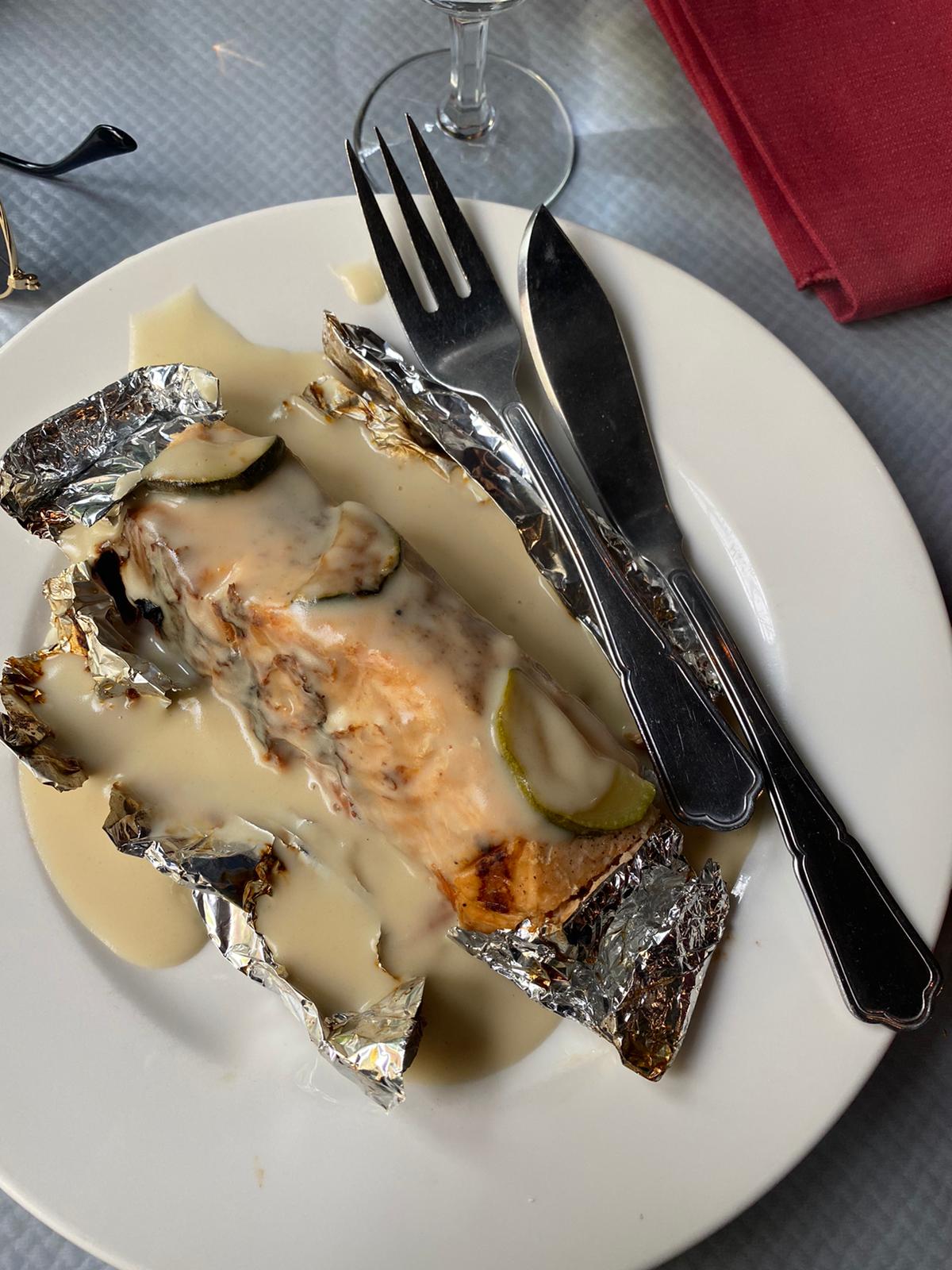
My sister opted for salmon en papillotte (a cooking technique where the salmon is wrapped in foil). Normally I cannot stand fish but this dish was really quite excellent. the fish was flavoursome and fondant.
Mother ordered andouillette to torture us. The contents of this dish do not bear thinking of, much less writing at length about so I shall spare you the agony.
Finally, father ordered the steak which was excellent. I had only a small morsel because the meat industry, beef in particular, is a huge contributor to global warming and should be regulated as a matter of urgency. While waiting for the legislative arm of government to wake up to a very imminent crisis, I choose to abstain from contributing to the beef industry. A morsel from someone else’s plate that I have not paid for is just fine, however. And I must say it was quite fine, tender and lovely. The garlic butter was the real standout here.
We had two desserts (between us not each). The first is pictured below. Home made profiteroles, filled with home made ice cream, as it should be. Everything was correct. The thickness of the pastry was exact, the flavourful ice cream and the rich fabulous chocolate sauce. Consistency, flavour and not straying from the traditional dish – this was a huge win.
Finally, the Tarte Tatin maison was also above par. The pastry tasted excellent and was by far the greatest achievement of this dish. It is difficult to fail in this dish when the base ingredient, namely apples, is freshly and locally sourced. Using seasonal vegetables as opposed to ones one can get all year round from the supermarket really took this dish up a level and made it quite extraordinary.
Overall, this restaurant was beautifully situated and beautifully decorated. In the middle of our meal, a band started playing songs. This in itself was a delight. Of course it was the typical woefully sentimental, soppy and predictable trite garbage tunes one expects in these circumstances but it was pleasant enough. A cave restaurant was an excellent idea on such a hot day and the food was of a devastatingly high quality. We all left satisfied and impressed.
It is New England in the 1890’s. Two lighthouse maintenance officers, Ephraim Winslow (Pattinson) and Thomas Wake (Dafoe) arrive on a remote island for a month long secondment which turns quickly into a nightmarish haunted and very wet situation. Their tenuous grip on reality slips away slowly in what I can only describe as one of the most brilliant and gripping horrors I have seen in a decade.
It is explosively scary and captivatingly beautiful in cinematographer Jarin Blaschke’s fierce monochrome, like a daguerreotype of fear. And the performances from Willem Dafoe and Robert Pattinson have a sledgehammer punch – Pattinson, in particular, just gets better and better. Guardian
Director Robbert Eggers (The Witch) has created something beautiful and maniacal here, deliberately intending to nauseate the audience. This film was shot in a nearly square 1:19:1 aspect ratio, and monochrome, which immediately throws one off. To add to this, most of the scenes are insular and claustrophobic. Their intensity increases incrementally which only adds to the excellence. Their roles are established quickly; Wake plays the stern weathered superior whose duty is to care for the prater Promethean light atop the lighthouse, whose enclosure Winslow is not allowed to enter. Winslow in the other hand is a ‘wickie’, a lower ranking officer who does all the menial tasks, including purifying the water and fending off rude seagulls.
The Lighthouse is itself a tall tale, the kind sailors might have once told over a frothy tankard of ale with a faraway look in their eyes. It is a folk tale deeply rooted in that tradition, soaked to the salty skin with superstition and sinister iconography. And yet… The Lighthouse is an altogether taller tale than most. There are plenty of moments where you’ll have no bloody idea what you’re watching. Other times it feels like an endurance test — like you’ve been stranded on an island in a storm with little chance of rescue. But surrender yourself to its strangeness and you might also find some enchantment in its light. Empire
The development of each character is masterfully portrayed, keeping one on the edge of an ever present precipice. The cinematography is bordering on art, with shots presented bluntly, without needing to resort to descriptive narrative or even words at times. My personal highlight of this movie was the scene where both Wake is talking down to a drunk Winslow, some time after a ship was supposed to come and pick them up for their next assignment. Of course, Winslow decided to beat a seagull to death, and seagulls contain the souls of dead sailors who revolted and created a storm so violent that no ship could reach them. The intensity of the scene and the way the camera looks up at Wake as he is berating Winslow gives us a really stunning perspective on both protagonists but also of the mastery of Dafoe’s acting capacity.
Dafoe’s mercurial movements, his rippling face and spooky smiles, dovetail beautifully, articulating Wake’s moods and adding to the destabilisation. He barks orders, sings a shanty, indulges in sentimentality and turns his yowling mouth into an abyss. NY Times
Overall this film scores a perfect ten for me. This is as much an inner as an outer horror. The direction, acting, cinematography, production and concept were all astonishing and tied together beautifully. The Lighthouse portrays the limits to which the isolated mind can be pushed, and the effects on those who go beyond those limits, making it a perfect film for our isolated times.
How long have we been in lockdown? Five weeks? Two days? Help me to recollect.
Can you believe I read the Guardian on occasion? I can’t. While perusing these hallowed pages, I happened upon a wonderful article about an old exhibition of Sorolla works at the National Gallery. I was instantly smacked in the face by Sewing the Sail, which I will discuss at length. I then did some more digging and was blown away by this master of light. Below are three paintings which stuck out to me as particularly inspired.
Sorolla (1863-1923) was a Spanish painter excelling in portraits, landscapes and works of social and historical themes. He is most known for extremely adept depictions of people engaged in various activities under the Spanish sun or near water, both of which feature in this review.
Sorolla was a child prodigy. Orphaned at two, he was raised by an aunt who recognised his gifts, bought him pencils and paints and got him work as a lighting assistant to a local photographer at a very early age. A breezy portrait of his beloved wife, Clotilde, from 1906, shows her focusing a brand new camera at the beach, and many of Sorolla’s paintings are lit and composed like snapshots. Guardian
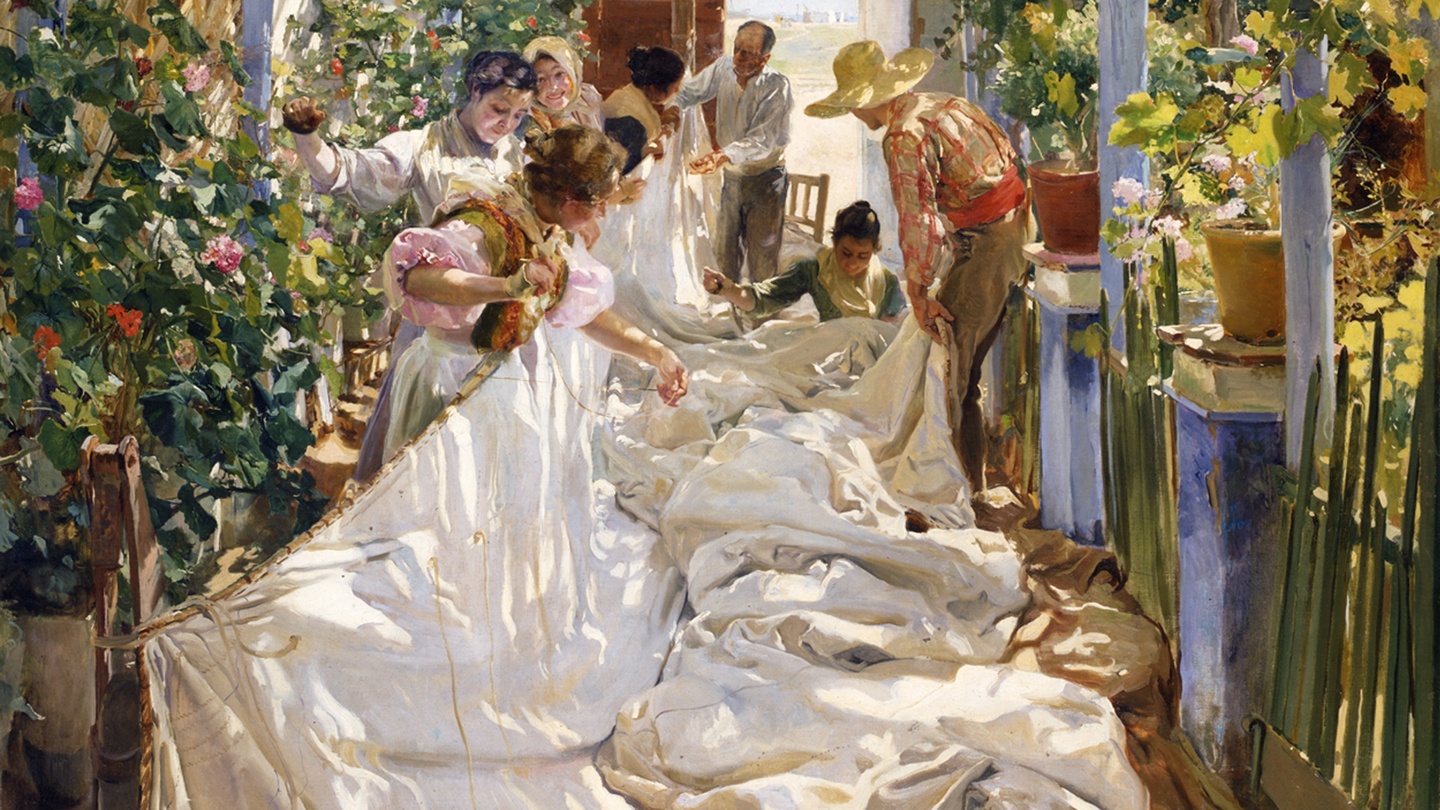
Sewing the Sail, 1896
This to me is the epitome of light depiction. I’ve been to Spain many times, in many disguises, and have seen (and felt) the startling effect of the Spanish sun. This almost folkloric depiction of Valencians coming together to sew a sail for a waiting ship captures the light in a way which baffles me. Think about it, Sorolla could very well have removed the plant pots on the gorgeous blue plinths, but he kept them there so the light was split up by the leaves and petals across the sail. Let’s not ignore the fact that paintings are not pictures, everything in a painting represents a decision by the artist, not happenstance. Sorolla chose to make this more difficult and the result of his heroic effort are astounding.
Further to this, there are more flowers on the opposite side of the sail, making for further splitting of the light within the leaves, rather than on the sail, giving the effect of a really wonderful bouquet of leaves, light and colour.
Moving onto the sail itself. The crumpling effect rendered here is exquisite. Have a look at your bedsheets next time you change them and imagine the skill it takes to capture all the light and shadow on them, now put a plant in front of the window. You’ll see what Sorolla was up against. Observe the seam of the sail on the left side, roughly rendered but no less clear.
And let’s discuss the people in this painting, with their varied expressions. The third woman on the left seems to be amusing her neighbour with a story. The first woman on the left is concentrating deeply on the work at hand. The man at the back of the painting seems to be inspecting the work of an unsuspecting fourth woman, who seems to be begrudgingly taking on his criticism.
Overall this is an astonishing piece which correctly grants Sorolla the title of Master of Luminescence which I have ascribed him.
Running Along the Beach 1908
Another aspect Sorolla was known for were depictions of water and the heavenly Spanish Summer. If you’ll excuse the child with bare ankles, this is really an excellent piece. I jest of course, while children are in all circumstances off-putting, this one is rendered quite exceptionally. One is given the impression he has just this instant come from the water and begun to chase the two young ladies in front of him. the depiction of the light and water on the skin is really extraordinary.
Observe the beauty of the water in this painting. The motion is shown so wonderfully. And also the varieties in motion, there are many different levels of wave crests here. These are all shown to be in motion at the same time which is truly an achievement to behold.
Observe the gorgeous way he has depicted water being absorbed into the sand. We see this in three or four stages. At the bottom right we see relatively dry sand. Moving closer to the sea there is a layer of freshly wet sand followed by a layer of water just receding, in which the reflection of the running children is reflected roughly to give the impression of motion. Finally we have the water itself receding back, ready for the next wave to crash. the crests of the waves are also exquisite.
Nude Woman 1902 (take on Velazquez, Rokeby Venus?)
Now this isn’t just any old nude woman, this is a portrait of Sorolla’s wife, Clotilde García del Castillo, painted in 1902, when she will have been around 37 years old. I’ll refrain from any lecherous comments on the aesthetics of his wife’s buttocks, focusing instead on the way that she has been lovingly and elegantly depicted here. The curvature of her spine and the sheen on her skin, the way she is admiring her ring, almost in adoration of the man who gave it to her (insert disparaging comment about the male fantasy here), are all represented beautifully.
The way that the light catches the silk/satin sheets is also extraordinary. Observe the plush duvet and the way the folds are almost running from Clotilde’s body. Also note the translucent patterned throw at the end of the bed, a wonderful detail to contrast with the solid silk.
In the title I make the comparison with the Rokeby Venus (also known as The Toilet of Venus, Venus at her Mirror, Venus and Cupid, or La Venus del espejo) because there is a school of thought which believes Sorolla’s Nude Woman is an ode to the Rokeby Venus by Spain’s most noted painter Velázquez. I will let you draw your own comparisons but I have included a very helpful video from the National Gallery explaining at length the sensational painting below.
This is the only surviving female nude painted by Velázquez. The subject was rare in seventeenth-century Spain, where overtly sensual images were met with disapproval by the Catholic Church. In spite of this the king, and wealthy Spanish art collectors in his circle, did own mythological paintings depicting nudes by artists such as Rubens and Titian. National Gallery
I won’t go into this marvellous work as I could devote an entire post to it. Please find below a great dissection of this painting by Francesca Whitlum-Cooper, Associate Curator of Paintings 1600-1800 at the National Gallery.
There you are, two nudes for the price of one. I must say when I started doing reviews in late 2017, I never thought I would be giving my two cents on 17th Century nude paintings. Life does take us in bizarre directions.
I hope you have enjoyed reading my thoughts on these masterpieces as much as I have enjoyed writing them. I get so much out of art reviews. I maintain that every alternative perspective understood helps us to become more well rounded individuals.
Omar Naim’s screenwriting and directorial debut gives us an inventive concept: the Zoe Chip, implanted in rich people’s babies’ brains and developing with them, records every aspect of their lives in glorious technicolour and Dolby Digital sound. Cutters’ (glorified morticians of sorts) jobs are to take the whole footage of a person’s life and create a promotion reel. Taking advantage of people’s grief to make money is a reprehensible pass time. This moribund and unsettling profession sees Alan Hakman (Robin Williams) as its stalwart champion.
In this chilly sci-fi fantasy, Mr. Williams’s character, Alan Hakman, is the go-to guy for people who demand the ultimate obituary. Alan works as a “cutter,” anthologizing the greatest hits from people’s memories into mini-movies that are marketed as Rememories. His digests of golden oldies splice together the happier, upbeat moments he selects from so-called Zoe Chips, nearly invisible devices implanted in people’s brains at birth that record a lifetime’s experiences. NY Times
Editing anyone’s life story, living or dead, to give a better impression is a disturbing idea. Especially so when relating to profiting from such an activity. But Williams brings his trademark effortless brilliance to the role. He plays it as one would expect any successful mortician to be played, morosely, humbly and consistently. The only times when we see him waver from this placated state is when he is talking to the daughter of a Mr Bannister, a recently deceased lawyer whose family commissioned a final cut for a ReMemory (pseudo-funeral). Bannister was also an embezzler and child molester. Here Williams is nice and friendly, rather than impenetrable and stoic. Of course, one criticism I would have of this picture is that it hints at deeper plot possibilities and then shies away from them. Hakman has seen all of Bannister’s life (somehow pinpointing these two huge moral turning points within seconds of each other). He could have done something to right this wrong but instead used the conversation to elicit information about a childhood friend of his whom he saw when watching her father’s Zoe footage.
Meanwhile, a growing movement of tattooed anti-Zoe activists, in which a former cutter and colleague of Alan’s (Jim Caviezel) has become a leader, wants to steal Bannister’s implant and expose his corporate crimes. Roger Erebert
This brings me neatly to another criticism I have of the film. There are several messy sub plots which distract from the plot and take away any momentum the plot has built up. The bizarre memory from Hakman’s youth where he and a friend walked across a shaky plank and his friend fell off, scarring Hakman for life, was an unnecessary distraction. The idea that from this, Hakman dedicated his life to correcting the wrongs of people’s pasts, somehow absorbing and absolving their sins, while corroding his own soul in a pseudo martyrial fashion is far fetched.
Robin Williams in “The Final Cut”.
There are several other sub plots which add precious little to the film, like the brief romp Hakman has with Delila (Mira Sorvino), an ex girlfriend of a client whose re memory introduced us to Hakman’s profession. There is also a group of protestors led by an anti-Zoe implant cabal who have strange tattoos which are not at all explained.
If you can ignore the numerous unnecessary sub plots and focus instead on the ingenious concept and Williams’ brilliant performance, this will be an enjoyable film for all.
A restaurant? What fresh hell is this? My thoughts exactly, dear readers, as I crossed the threshold of a bizarrely normal eatery. The tables were further apart than in the Before Time of course and the staff were wearing masks, as were the customers while travelling between their tables and the loo or to settle the bill, but otherwise the state of things were of an appreciable normality.
The first order of business was to obtain a half litre of cidre doux, or soft cidre, which is customarily consumed with crêpes in France. Thus graced by this sensational sweet treat, we awaited with eagerness our holy crêpes.
There is hardship in everything except eating pancakes. Charles Spurgeon
Pater’s Salade Baltique consisted of smoked salmon, marinated prawns, mustard sauce, honey and dill. Now as many of you know the sight sound and smell of fish repulses me more than cold showers or people named Josephine, so I did not attempt it. But Pater tells me that the quality was superior, especially that of such base ingredients as the salad leaves themselves. It is impressive what a little sunshine will do for one’s crops. Find below a delicious a beautifully lit close up shot.
This salad has restored my faith in tomatoes. Pater
My dish was rather less auspicious as I sought something a tad less rich for my first visit to a restaurant in a quarter year. I was worried that such an intake of rich food after months of eating healthily and exercising might explode my liver. Hence I opted for the Galette Fermière. Interestingly, if a crêpe is savoury, it is called a galette. Don’t ask me why, I don’t make the rules.
I am not sure whether the time elapsed since my last restaurant visit has made me impressionable but my galette was really quite exceptional. The texture of the pastry itself was wonderfully savoury and exactly crunchy. The filling, too, was divine. I am a fan of the melange of sweet and savoury. Hence the apple, honey, egg, Emmental cheese and goats cheese which filled this galette were quite excellent. I ignored the radishes as I detest photograph enhancing touches designed to appeal to mindless and/or young people who feel the need to share every aspect of their lives with individuals or groups instead of living and enjoying it for themselves. Life, and crêpes, are to be enjoyed for one’s benefit and enhancement rather than to give an impression of its quality to others.
“Darling, I keep my crêpes in check, so to speak, and I’m always filled and have my pastry done comme il faut” Arkadina, Act II, The Seagull by Chekhov
Mother’s galette was by far and away the best one on the menu. This was obvious from the outset. I managed to negotiate two small bites and was astonished at the effect. The Savoyarde consisted of raclette cheese, potatoes, bacon lardons and creme fraiche.
I will not shy away from saying that this galette was a masterpiece. The interplay between textures and flavours was just breathtaking. The fluffy nature of the potatoes as contrasted with the chewy lardons and fondant cheeses nearly brought a tear to my eye. The flavour of each ingredient was so pronounced as to be appreciable individually as well as holistically. This galette was a lesson in the making of a perfect dish. Five stars from me.
Overall, this was an excellent way to restart my culinary journey. I am elated to have had this opportunity and deeply impressed by La Crepicoise. I cannot recommend it enough to those of you in the area or thinking of visiting.