Choosing Rattus as album of the month this month was bold. Producing a review for this masterwork is rather very difficult. You would not believe it from first listening but this album was released in 1977, making it 43 years old at the time of writing. While the likes of ABBA, Fleetwood Mac and Barbara Streisand dominated the charts, the Stranglers thought they would unleash a torrent of dark punk energy on the world. And by gum, it worked.
With Hugh Cornwell on vocals and guitar; Dave Greenfield (RIP) on keyboard and vocals; Jet Black on Drums and Jean Jaques Burnel on Bass Guitar, this album features the classic old school Stranglers line up. Before I go into the music, I wanted to mention Dave Greenfield. He passed away, sadly, in early May 2020. This post is as much a tribute to The Stranglers as it is to the genius that was Dave Greenfield. I won’t claim to be an expert, and neither does The Guardian (who misattribute his death to COVID, when this was only a small factor in his cause of death, in typical mainstream media style), but they have written an excellent Obituary, which I encourage you to read.
Its distinctive combination of lyrical anger and organ-driven sleaze was both deeply confrontational and musically accomplished. This was an album that found considerable success by crossing barriers: those older music fans who found the minimalism of The Damned or the Ramones a little too off-putting could deal with the snaking arabesques of Hugh Cornwell’s guitar solos, Jean Jacques Burnel’s growling Fender Precision bass or Dave Greenfield’s frankly psychedelic organ arpeggios. Oh, and some great tunes. BBC Music
As well you know, I live and breathe music. I grew up with The Stranglers, despite being a teenager in the early 2010s. My Great Grandfather moved home from Haxby to Harrogate in North Yorkshire when I was about 14. Downsizing does require some sacrifices, as you can imagine. I got the old Sharp CMS 150 Hi-Fi which didn’t make the cut. It looked like the photograph below, with equally big speakers. This was my introduction to vinyl, as well as tapes CDs and FM radio (mostly BBC Radio 3 in those days, before I tired of the nasal pomposity and unattainable scope of knowledge they propagate). The first LP I heard was Men At Work, Business As Usual. Of course I wasn’t aware that there was a difference between 33RPM and 45RPM. I played this first LP on the latter setting and thought Ivan Doroschuk had taken rather a heavy dose of helium.
Eventually I riffled through Father’s vinyl collection and landed on Rattus Norvegicus. My understanding of the concept of music expanded irretrievably from then on.
You must understand that when your introduction to punk and rock starts with the album that features Down in the Sewer, nothing can ever be the same.
On the Rattus picture sleeve, French bassist Jean Jaques Burnel affected a lean, asexual allure that hinted at Roxy and Bowie: next to him, unfashionably bearded keyboard player Dave Greenfield could have been touring with heavy/prog rockers Uriah Heep. Behind them, drummer Jet Black (unfashionably old for punk at 35) and guitarist and vocalist Hugh Cornwell loomed like two faces who wouldn’t have been out of place working a London crime firm. On this form, The Stranglers skilfully implied danger rather than bellowed it. We Are Cult
Now to the music: the opening number, Sometimes, immediately puts the Stranglers in sharp contrast to their punk contemporaries by demonstrating that they can actually play their instruments. Immediately all three main instruments shine in their own light. The keyboard in particular is very impressive here. The lyricism is pure punk, spitting out anger leading up to a stunning solo from Cornwell. Please take note of the production value here and throughout this album. These are flawlessly produced tracks with seamless transitions between motifs and riffs, with a beautifully balanced sound where no instrument walks over another.
While IV [Rattus] may be ill-tempered and downright ugly in its misogyny at times, its anything but dull. Where most Punk bands were ranting against society, the Stranglers focused on inner conflict. IV is a frustrated, angry tug of war of sex, conscience and low self-esteem. It’s downright perverse in its sarcasm and nihilism. In short, it’s not a very pleasant place to be but like anything with a dark allure, you can’t resist going down that alley once it presents itself. Soundlab
Goodbye Toulouse used to be one of my favourite Stranglers tracks. It tells the story of Nostradamus’ prediction of the downfall of the city. I’m so drawn to a weird keyboard wizardry that Greenfield unleashes on us. It reminds me of Waltz in Black and the more choice experimental tracks on Side 2 of The Raven, which I love. One of Top Ten tracks ever is Lilies and Remains by Bauhaus – which is reminiscent of this Otherness which the Stranglers are so known for. Goodbye Toulouse itself features a relentless bass-line and, again, flawless production and balance.
London Lady (Why did you lay me? // Your head is crowded with the names you’ve hounded) is pure punk rock late 70s misogyny. If you’re revolted by this, good for you. Keep it up. I would encourage music listeners to separate the ignorance of times gone by from the merits of the musicality of a piece or track. Watch out for the cascading guitar in this track, which is just awesome.
‘London Lady’ follows and is a nasty bit of derision aimed at a female rock journalist […] Malicious and vengeful as it is, it’s all spat out with so much self-loathing, you’re inclined to think Cornwell may have richly deserved the slight that’s gotten under his skin. In other words, he makes no pretence of being any better than the bile he’s hurling. Soundlab
Princess of the Streets tells the story of a Regina George-like pack leader who is out to cause trouble. This features extraordinary bass and keyboard with solos flawlessly woven in.
Hanging Around remains one of my top tracks by the Stranglers. The characterisation in the lyrics is superlative (Big girl in the red dress // She’s just trying to impress us. Standing in the Coleherne // With the leather all around me). This is a reflective punk piece which takes pot shots at religion and the London club scene life. The solos are incredible.
Peaches (oh boy) doesn’t really need to be spoken about I think. It’s an excellent track and speaks to the typical beach gawking pervert and the perceived enormity of female bottoms. There is innuendo and plenty of lechery. This is overplayed in my opinion. Every band needs their most popular track but it is seldom their best musically. One should not trust the music taste of the general public.
Grip was my previous top Stranglers track (before Down in the Sewer and Walk On By changed my life). This track is a sharp contrast to the poppy stylings of the previous tracks. In my notes for this review, I have underlined ‘keyboard’ with a choice expletive. Greenfield is truly in his element here.
Ugly is once again a terribly misogynistic track which epitomises this dark punk rock energy. It is filled with vitriol and anger at the hideous subject but also at themselves for feeling this way. The synth and lyrics really stand out here (I would like to see a passionate // film between // the two ugliest // people in the world // when I say ugly, I don’t mean rough looking // I mean hideous)
Now, Down in the Sewer, where to begin? In my estimation this is inspired by the Doors’ Light My Fire. Indeed a lot of Greenfield’s keyboard stylings can be seen to stem from the wonderful musical stylings of Ray Manzarek. This track is an 8 minute masterpiece and is undoubtedly the crowning jewel of this album, if not the entire Stranglers repertoire. The lyricism, the central riff which holds the piece together, the cycling through solos – everything in this piece is aimed at letting the audience know who the Stranglers are and how good they are.
IT JUST TAKES OFF!!! Nicholas Jenkins (neé Saint)
They’ve got sharp teeth *clack clack clack* // Deep breath // And lots of diseases
I wish there were some way to describe the excellence of this track. It’s so suffused in brilliance that I find it difficult to talk about. The keyboard, synth, drums and guitar are all flawless and follow one another seamlessly (into the sewer?) into an insane crescendoing euphoric ending. The end bass is magisterial and reminiscent of the earlier bass during the first solo cycle. One reviewer noted the end of this track is like 1000 Rattus Norvegicus running all over your speakers. The track comes full circle and ends leaving you feeling breathless, needing a few minutes to readjust.
Rattus Norvegicus is the kind of album that will leave you feeling awed at the power of music and the sheer talent of those performing it. It is a jewel in the crown of punk and a deciding factor in late 70s English musical brilliance. I am constantly amazed by this album. It is over 40 years old but has not lost one note of its excellence. Why has this album survived? I believe in part due to the novel genius it displays. That spark of individual inspiration is so rare in music. Often one can dissect a new band using what came before. With the Stranglers, it is more difficult to see this. One can find their roots with ease but they branched out so far from them that they have become seminal artists themselves.
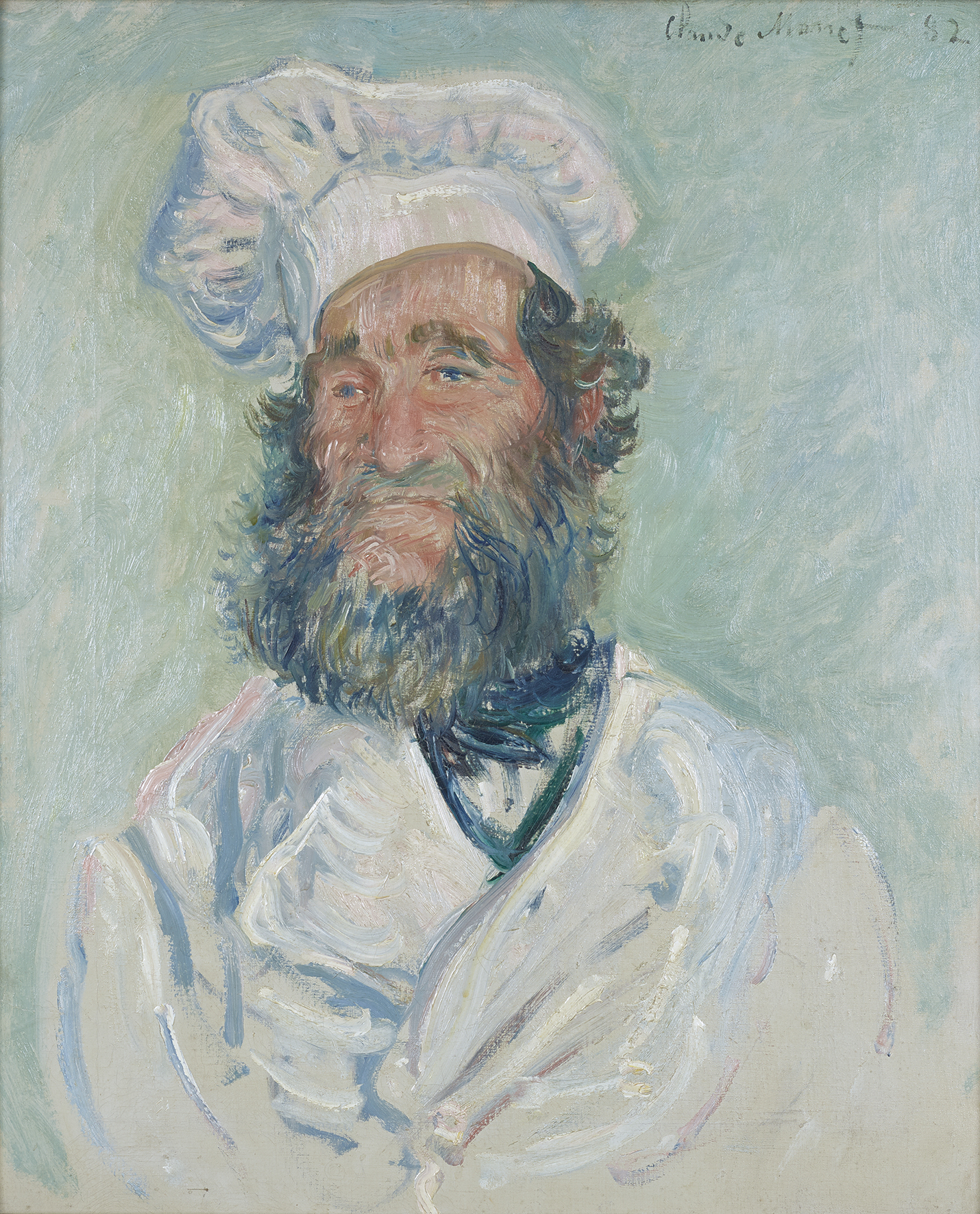
The Daily Art App, which I am now realising should be funding this blog, has once again thrown me an artistic morsel which I shall now chew on for your reading pleasure. Did you enjoy that mixed metaphor? I did not. Monet is one of the founders of the impressionist movement. On a side note, he was French. But that’s enough vulgarity for now. Monet painted this, one in a series of three, while staying at a hotel-restaurant in Pourville, a fishing village in Normandy, This is the owner, Paul Antoinne Graff, in his chef’s attire. Let’s delve into this a little deeper.
I love this portrait. These were so rare for Monet that the two he painted of Paul-Antoine and Eugénie with her lovely terrier (below) were a real testament to their close friendship. What I love about Monet is his confidence. In a time where artists went to great lengths to conceal their brush strokes in an effort to evoke an exact resemblance of what they are depicting. Monet paints in a way to deliberately show his brush strokes. This is part of my fascination with his portraits.
Observe the crude rendering of the beard, which is so wonderful to me. The curls in his hair and how Monet shows the grey hairs coming in sparsely is lovely. Look at how few brush strokes the artist has used to create a cooking jacket. Finally observe the minute swirl of brush strokes in the face to highlight the subject’s expression. I think this is very fine and worthy of much lauding.
As an aside, do observe this painting Monet made of Mme Graff, the aforementioned chef’s wife. Here she is looking longingly to the right while her terrier, Follette, looks directly at the painter. Now, what both of these portraits were designed to be looking longingly at a third painting – one of Mme Graff’s butter cakes!
This painting is worth another whole post in itself, but I am not so desperate for material as to subject you to that. Observe the extraordinary detail to showcase Mme Graff’s wrinkles! Her neck ribbon is also a delight to behold. And Follette is just adorable. Monet painted another portrait of Folelette by herself, but I will leave this to you to discover in your further research.
I’d like to close with the above, titled L’Alley Point, Low Tide, which money also painted in Pourville in 1882 during his stay with the Graffs. I am awe struck by this. The colours, the movement in the water, the people in the distance, the sky, the white rendering on the cliffs – every aspect of this is so masterful that I could not keep it from you, dear readers.
I hope you have enjoyed this short dissection. Please stay safe in this trying time.
On Bank Holiday Weekend, I found myself mulling over what I should do to celebrate Grace Jones’ birthday on May 19th. While out on a walk, the heavens opened and I was drenched. I interpreted this as an omen. Walking in the Rain is the opening number on Grace Jones’ monumental album Nightclubbing, you see. It is thus superstitiously than I decided to write the following review. Grace Jones is a personal icon of mine, if not my greatest inspiration, so forgive my gushing in parts.
In 1980, Grace Jones decamped to Compass Point Studios in Nassau, Bahamas where she worked with producers Alex Sadkin and Island Records’ president Chris Blackwell, as well as a crack team of session musicians rooted by the rhythmic reggae force of Sly & Robbie. Across three critical and commercial hit albums, with 1981’s Nightclubbing as her pinnacle, Jones reinvented herself while also altering the face of modern pop. Pitchfork
Five of the nine songs on the original album are covers. The album opens with a cover of Flash and the Pan’s Walking in the Rain. From the very beginning, Sly and Robbie’s talents are put on full display. Their understanding of beat and rhythm is unparalleled in pop. Grace emerges triumphant singing “feeling like a woman, looking like a man”, one of the defining features in her image. Listen to the bass guitar supporting Jones’ unique vocals. Here, she is the embodiment of power and freedom. There is an otherness to Grace the person and Grace the musician. This is carried through wonderfully in Nightclubbing’s opening number. Jones employs a glacial tempo with haunting equally cold vocals.
Pull Up To the bumper is of course Grace Jones’ most famous song. It is no surprise it was a Top 10 Single. What do you think the song is really about? I’d tell you my opinion but this post will go live before watershed, so I’d better not. In any case this track has a glorious recurring motif and an infectious rhythm, to which we are the slaves, as it were. Listen out for the percussion in the background. It is no wonder, with such a wide arsenal of brilliance, how she inspired so many after her.
Fashion, art, and music all converged in the form of Mrs. Jones and looking out at the 21st century musical landscape, it’s easy to see her influence: Lady Gaga, Rihanna, Nicki Minaj, M.I.A., Grimes, FKA twigs, and more. Beyond that, there’s an entire subset of alternative music that draws on the template set by Jones and her Nassau backing band: Massive Attack, Todd Terje, Gorillaz, Hot Chip, and LCD Soundsystem all emulate those rubbery yet taut grooves of Sly & Robbie and cohorts, a hybrid that amalgamated rock, funk, post-punk, pop and reggae. Pitchfork
Interestingly, Use Me is a cover of a Bill Withers song. If you hoped it would be anything like the original, you’d be mistaken. Grace does not pay homage to the original composers of the tracks she covers, she tears at the song book with her teeth. There is a single mindedness which ties her tracks together. The bass in this track is inspired, as are the lyrics: “I’m gonna spread the news, that if it feels this good being used, keep on using me ’til you use me up”.
The final track on side 1 is a cover of non other than Iggy Pop (of the Stooges). Now I won’t go on about how great the Stooges’ album Funhouse is, but you really should listen to it. Nightclubbing’s powerful and insistent piano underpins this track. Grace Jones is really “what’s happening”. You may be interested to know that Hollie Cook sampled Nightclubbing in her 2014 album Twice. Overall, Grace exhibits her raw power here with her commanding vocals.
I think at this point it is worth mentioning the cover. Jones was then styled by her beau Jean Paul Goude (French legendary photographer – does the artwork for Galleries Lafayette in Paris, among hundreds of others). Jones is seen in a beautiful black tailored Armani jacket on a background of light brown to accentuate her obsidian skin. She looks the epitome of detached with a cigarette loosely hanging from her lips.
And well, that cover. Black, blue, cropped into angles that would actually cut you if you got any closer. That cigarette, hanging there. The genuine ‘don’t **** with me’ article. Terrifying and entrancing at the same time. In pop music, it takes a lot of effort to look effortless, yet in Grace, Jean-Paul Goude had very little to do really. The Quietus
Side 2 of the album offers us Art Groupie, in which Grace asserts “I’ll never write my memoirs, there’s nothing in my book. this is the title of her auto-biography, of which I have a signed copy. I met Grace at a signing event in Picadilly in my second year at university. She was every bit as statuesque and foreboding as you can imagine. NB: she was about 65 when the cover for the book was taken.
I’ve Seen That Face Before was another outstanding track. This channels Astor Piazzola’s Libertango, while featuring Grace’s signature foreboding haunting vocals. The accordion in this track is inspired. Listen to the arrangement here, the way all the instruments and vocals are perfectly placed to evoke the overall theme of the track. This is a testament to Alex Sadkin’s production genius. I also cannot overstate how much I appreciate her use of French. “Tu te prends pour qui? Toi aussi tu détestes la vie”. Grace Jones first sang in French on her first album, 1977’s Portfolio. La Vie En Rose was the sign Chris Blackwell needed to recognise Grace’s talent and potential future. She made four albums between this and Nighclubbing, two of them disco albums produced by Disco legend Tom Moulton. But the essence of that epic Piaf cover is present here. Sting’s incredible lyricism is evident throughout this track: “I’m a walking nightmare, an arsenal of doom, I kill conversation as I walk into the room”. I suppose there are some positives in being from Newcastle.
Demolition Man is a cover of the Police original. I wonder what Stuart Copeland (the missing Beatle) made of this! I seldom ask myself which instrument I am hearing. The insistent deep instrument in the background of Demolition Man is likely a bass guitar but I may have been mislead by the synth stylings of Wally Badarou, a classically-trained synth session man who’s C.V. includes, but is not limited to, M’s “Pop Music” and Level 42’s “Something About You.”
The album adds with the beautifully remorseful Done It Again, a song that showcases Jones’ exquisite vocals. A love song that should be remembered with the greats of the genre. Louder Than War
Ending the album with Done It Again was a masterstroke in sequencing. After putting us through the tumult of the other 8 tracks, we land safely and serenely.
Overall, Nightclubbing is a masterful and essential album. Grace Jones changed the face of pop with the three major Compass Point Studio albums (Warm Leatherette, Nightclubbing and Living My Life) and immortalised herself as a seminal pioneer of music. This truly launched her and led to the torrent of cultural references beyond music for which we know and love her now. I leave you with this wonderful quote from The Quietus:
Nightclubbing made Grace Jones Grace Jones – the Harty-beating, Conan-starring, James Bond baddie, car-swallowing creature that followed. She could quite simply do whatever she liked after this, and did. It demands a place in everybody’s record collection whatever their allegiance, and you’ll never really want for anything more than this exhaustive and vital package. What was perfection has become even more perfect. The Quietus
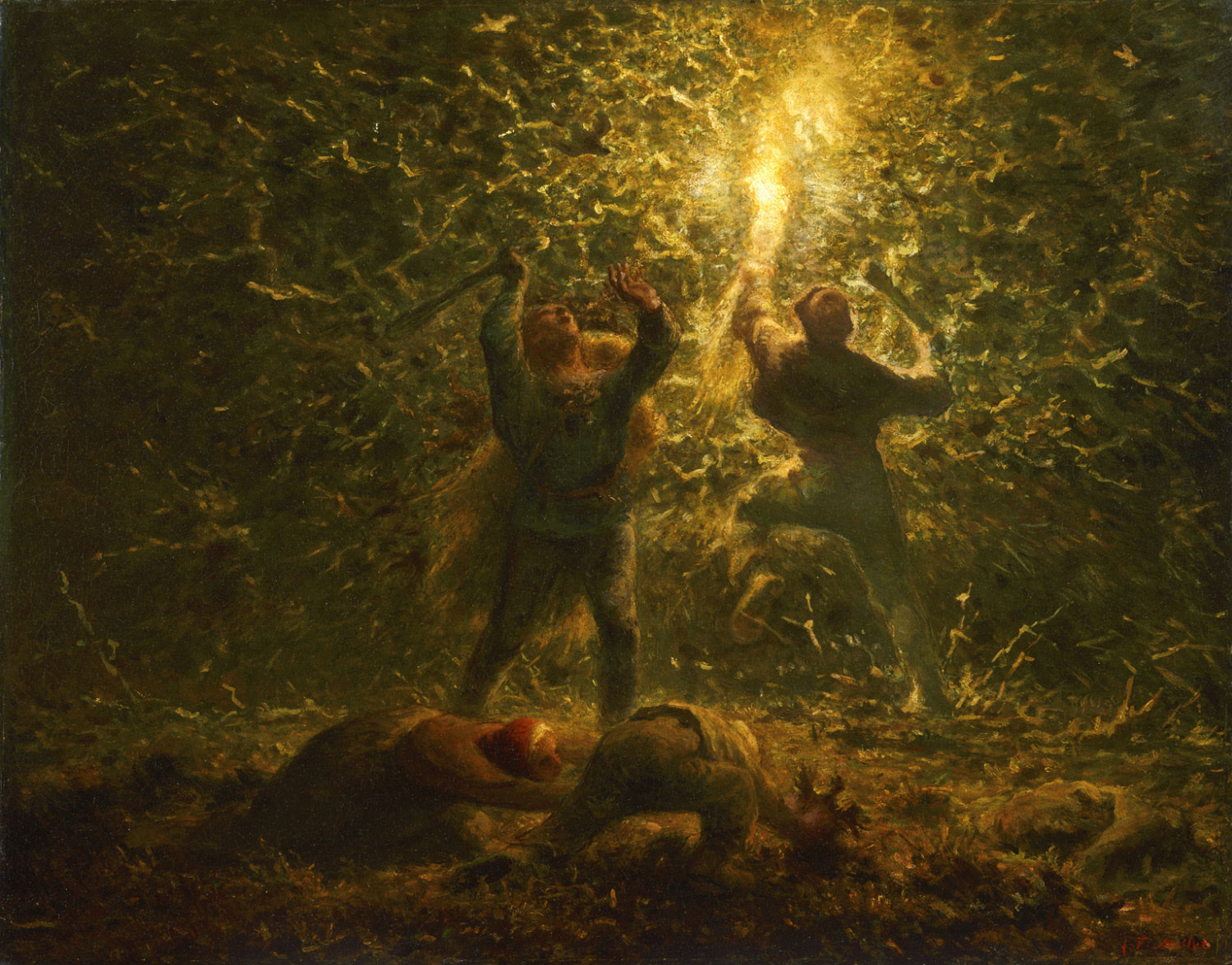
I came across Jean François Millet some weeks ago when my DailyArt app sent me The Gleaners, his 1897 masterpiece. I was so impressed by this that I dug a little deeper into the Millet catalogue and found Hunting Birds at Night, also known as Bird’s Nesters. Jean François Millet founded the Barbizon School, which was devoted to “accuracy in its depictions of rural peasant life and realism in landscapes (David’s Art of the Day)”. He was known for @soft lighting, scenes of peasant farmers, and devotion to visual and emotional realism (Ibidem)”. Let’s explore this painting further.
This 1874 painting is drawn from scenes from Millet’s childhood. At night, he would go out with members of his household to blind large flocks of pigeons, then club them with big sticks and collect the fallen fowl. This rather barbaric act of violence against poor innocent, but no less irritating, pigeons is depicted quite gracefully.
Many aspects of this painting jump out to me immediately and I’d like to discuss these. Firstly and perhaps chiefly is the use of light here. Light is the central theme of the painting but also of the act depicted in the painting. But look at how dramatic and explosive the lighting is. Observe how beautifully the light dissipates the further you get from its focal point and how well rendered the shadows of the flying fowl are against it. Millet does show us how massive the flock was and how panicked they would be during this barbarous act. David suggests this is done well by rendering the individual birds roughly rather going into infinitesimal detail.
Secondly note how graceless the two people on the floor are. They are desperately snatching at the fallen pigeons before they regain consciousness and perhaps fly away again. I love the immediacy and the hurried strained nature of their poses. I think the urgency the act requires is shown wonderfully.
Overall this painting is an excellent representation of rural life in the late 19th Century. Millet was excellent at this, as can be seen in the Gleaners, above, and will perhaps be explored in further posts. I hope this painting has shed some light in our own unfortunate situation. We should count our blessings that while we are isolated, nobody is waking us with a lamp and bashing us about the head.
I think of the reviews I have read, the Guardian (shock, horror) summarises this film most appositely:
Left for dead on the red planet following a scientifically anomalous but narratively necessary windstorm, botanist Mark Watney (Matt Damon, giving Cast Away-era Tom Hanks a run for his money) must hunker down for the long haul, knowing that any rescue mission is years away. Luckily, he is quite literally “the best botanist on the planet”, and after declaring that he’ll have to “science the shit” out of his Robinson Crusoe situation, he discovers that it is indeed possible to grow potatoes in his own poo. Guardian
In this strange and wonderful isolation time Netflix is our best friend. It pays to watch out for those special movies which come on every now and then in the deluge of vulgarity that Netflix spews out weekly. If you’ve managed to avoid such trite crass as Love is Blind (mocked here wonderfully by two discerning Drag Queens), The Martian offers a serious introspective into true isolation. If you thought the lockdown was bad, imagine not having access to shower facilities for 18 months.
For all of Scott’s visual prowess and Damon’s human centre, the unsung hero might be screenwriter Drew Goddard, lacing the storytelling with wit, energy and an approach to the science that is graspable without being over-simplistic. He also solves the book’s interior-monologue problem. Empire
The aspect of this film which most impressed me was that in spite of essentially being about one person on a deserted planet surviving for roughly one year and seven months, Ridley Scott kept it interesting and engaging throughout. This is no mean feat. Of course, Matt Damon being the star he is helped a great deal. The internal tribulations of the Director of Nasa (Jeff Daniels – Dumb and Dumber), as pitted against the desires of the crew who left Watney behind (lead by Jessica Chastain – IT Chapter 2) make for scintillating viewing. Another actor who knocked it out of the galactic park for me was Donald Glover (Community, writer and singer of This is America). Watch out for his nervous disposition providing a marvellous plot twist when you least expect it.
Also, I would like to draw your attention to Nick Mohammed who plays Tim Grimes in the Martian. See him in the below video having his bottom roundly kicked by two other discerning Drag Queens:
Overall, the Martian is an excellent, high concept, high budget experience. This is one of the few films I have watched all the way through without pausing or skipping. This is high praise indeed from someone as impatient as I am. See the trailer below and catch it on Netflix before they take it down in favour of another mind numbing dating show. Whatever will they desecrate next?
A scholarly look through the Metaphysics section of one’s library might not be the most prescient aspect of this wonderful painting, but I urge you to bear with me while I make up my mind on why I’ve chosen the above as a title to this post. Carl Spitzweg was a German poet and painter. This work was completed circa 1850, which you’ll know is my favourite period in art. This painting offers us a humour introspective into 19th Century scholarly Europe, let’s look at it in some more detail.
The painting is representative of the introspective and conservative mood in Europe during the period between the end of the Napoleonic Wars and the revolutions of 1848, but at the same time pokes fun at those attitudes by embodying them in the fusty old scholar unconcerned with the affairs of the mundane world. Wikipedia
In terms of context, this was painted two years after the 1848 European Revolutions, which “series of republican revolts against European monarchies, beginning in Sicily, and spreading to France, Germany, Italy, and the Austrian Empire. They all ended in failure and repression, and were followed by widespread disillusionment among liberals.” Britannica. (Apologies for the referencing, one can take the boy out of Warwick University…) So we can see this painting in its historical context was perhaps poking fun at this scholar for attempting to find solace and enlightenment in a dimly lit, untidy library. This is further hinted at by the faded globe in the left hand corner of the painting. The idea that the globe is shoved in a corner of the room, unseen and seemingly covered in dust shows our scholar had little interest in world events.
Looking at the detail of the painting, notice the central shaft of light showing us the focal point is indeed our scholar. I love a spotlight. At the risk of sounding self-referential, the use of light is rather reminiscent of the Pieter de Hooch paintings at the Prinsenhof gallery at Delft. Two further observations: firstly, observe how closely our scholar is peering at his current tome. Now look at how he is holding another in his free hand and a third in between his legs! I love this humorous criticism of our scholar. Finally, observe at how to gold spines of the books shine in the light. This I suppose highlights the high quality of the books from which our scholar is learning.
Overall I think this is a delightful painting which highlights the dangers of ignoring your global context. This painting says to me that there is importance in balancing one’s intellectual pursuits with awareness and contribution to more global issues. Indeed this insular insight into scholarly life reflects on all of us. I think it is a lovely painting and I hope it has brightened your day somewhat.