Lad from the Pub: Don’t tell anyone about this place.
Me: ok.
(scene from the Goodmanham Arms circa 2020 AD)
I fear I may be breaking the sacred pledge of a pub promise here, but my duty as a reviewer on the hallowed web-pages of ‘Cedric Suggests’ must, I feel, take precedence, and as such I am obliged to speak of the incredible things I have seen and tasted at the Goodmanham Arms (“the GA”).The above-quoted lad from the pub, being a decent and worthy sort of a chap, was probably conscious of the danger of gems like the GA becoming spoilt by the influx of newcomers. I sympathise with this position but would encourage any interested party to examine Cedric’s blog more closely before calling foul play on this review. You see, the chances of any of Cedric’s readers actually going to this pub are very low indeed. I imagine Cedric’s readership largely comprises of his extended Albanian family and the various good-looking trendy-types he has picked up through a life of cider-drinking and making an effort with his appearance. As such not the sort of people that would be interested in going to an old-fashioned pub in the middle of the Yorkshire Wolds.
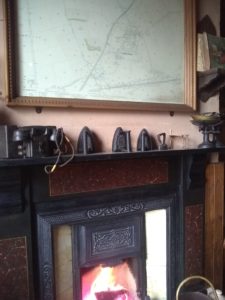
Anyway, on with the review. I had been cycling before I got to the GA, in rather inclement weather I might add, so the first thing that struck me about the place was the wood-fires. A very nice touch, and certainly useful to heat up one’s soggy clothes. Once seated and heated, I soon became aware of the superb décor. Slightly cluttered perhaps, but in the tradition of a gothic cathedral, not a student dorm room. Selecting the correct pub knick-knackery is a fine art, but I think the owners of the GA have got it down to a tee. Traditional, tasteful, and not at all off-putting.
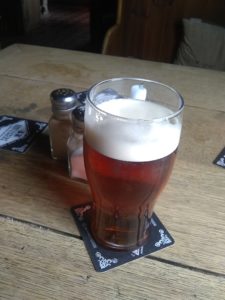
My attention was very quickly drawn away from these more trivial matters when I ordered my first pint and tasted one of their ales. The GA has a fine selection of real ales. I had two different bitters (the stallion, and a guest ale called Bass), but I also saw a porter there. Both bitters were very excellent indeed, the best I think I have drunk in the East Riding, and certainly a rival to ‘Pave’ and ‘the Whalebone’ in Hull. A good ale is perhaps not a work of art, but it certainly is a comfort and consolation in a world full of cider-drinkers.
“The landlord of the Goodmanham Arms is Vito Logozzi, who comes from Bari in southern Italy…. Vito looks after the pub, while Abbie [the other side of this husband and wife team] manages a microbrewery across the yard [currently not brewing]. Her brews include Peg Fyfe, named after a 17th-century witch who is now reincarnated in the form of a 3.6% mild, and an elderflower ale called, almost inevitably, Elder & Wiser. The pub’s generous portions and modest prices can attract a big crowd. “I’ve seen the beef run out at 10 past 12 on a Sunday,” one regular recalled. Get there early.” – Christopher Hirst, Daily Telegraph
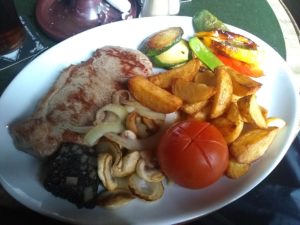
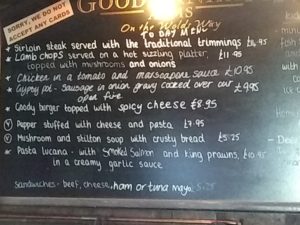
The food came quickly, I ordered the steak (rare). It came with peppers, chips, a black pudding, and a tomato. The chips were chunky (to my enlightened mind a disappointment), but certainly very respectable. On final reflection I think the pairing of steak and peppers was a very good one. While the food perhaps did not quite live up to the quality of the beer, it certainly was a wonderful accompaniment. The gypsy pot, which I didn’t go for, was supposedly a particular speciality, and it certainly looked like hearty comfort food. Please see below for the full menu.
Overall this was a model pub, a pub to which other pubs should aspire to be like. I think the owners must have sat and said to themselves let’s not just make something adequate that churns out money, let’s make this the best pub it can be. It rightly has a place in CAMRA’S Good Beer Guide 2020, although remember to bring plenty of fasht cash as they don’t take card. It was a real pleasure to dine there, just as it is a pleasure once again to contribute to Cedric’s weblog. I am ever grateful for his friendship, something I particularly noticed during my post-university move to Hull, and as always appreciative of his humour, loyalty and great kindness. I am mindful of the fact that I am the exception to the rule, that people take exception to, especially when it comes to his friends. I hope that I shall continue to be able to contribute reviews to this excellent blog. So, until next time, fair thee well.
Pardon the hideously predictable pun in the title of this post. Much like most readers of this post, St Nick and I stumbled onto River Beat quite by accident. This was a happy accident, of course. We had a few plates each and left feeling pleasantly full but not overwhelmed to the point of falling into the Tyne.
Our first Tapas were the oysters. Fun fact: St Nick mistook the salt positioning the oysters on the slate, as salt! Had the waiter not been extremely efficient I would have had to suffer his wheezing cough for the rest of the evening. Now, I did not partake in this abomination of a dish (I deplore fish) but St Nick grunted approvingly and didn’t sneeze so it must have been delightful.
Sticking with the seafood theme, our next dish was blurred prawn. Now I did have some of this dish as well as the smoked nuoc cham dip which went with it. The prawns were sizeable and suitably crunchy and the dip added a delightful layer of hazy sweetness to it.
The sweet potato bravas with sriracha mayonnaise were superlative. The red chilli and garlic sauce went beautifully with the sweetness of the potatoes. This was a filling tapas most welcome on our table. The ordinary potato chips were also delectable. Hand cut, chunky and just the right texture.
The East Java chicken Satay was a favourite of mine. Topped with crunchy roast garlic, sweet & sour salad and peanut sauce, it combined some varied flavours to make a wonderful amalgam. Though I will say I found the chicken a little overcooked.
The showstopper for me was the red braised pork belly with hoisin sauce. The crunchy outer layer of fat contrasted with the less seared middle layer of fat followed by the delicious soft meat at the bottom was a sensation. The hoisin sauce, comprised of soya beans, vinegar, sugar, garlic, and various spices, made my night.
Overall, this restaurant was relatively economical, well situated on the river front and generous with its portions. I do recommend it to you if you are ‘in the North’.
As anticipated, Part 2 of the suggestive highlights is here. Now I will confess to you that I clear out all the photographs on my mobile every few weeks and had quite lost the ones from my January visit to the museum. So I took it upon myself to visit the museum anew and bring you fresh out of the oven insight into my other highlights from this museum & art gallery.
Autumn, Joos de Momper the Younger (1564–1635)
This series of paintings represented the four seasons, this one being Autumn, shock horror. This is featured as one of the Lost Masterpieces, a 2019 television programme. I think it is safe to say that at least one has been found now. As this painting depicts an autumnal scene in an idyllic village, during the time where cider is being made, it must feature here. Observe the slant in the thatched roof in the centre, the motion in the trees and the hustle and bustle among the people. It is also worth noting how lovely the water to the right has been rendered and the detail of the dead falling branches. Equally wonderful is the lighting in this piece, showing clearly which trees have been obscured by the surrounding forest. A true delight of a painting.
The Pont Boieldieu, Rouen, Sunset Camille Pissarro, 1896
Pissarro was a Danish-French Impressionist painter. His importance resides in his contributions to both Impressionism and Post-Impressionism. Pissarro studied from great forerunners, including Gustave Courbet and Jean-Baptiste-Camille Corot. He later studied and worked alongside Georges Seurat and Paul Signac when he took on the Neo-Impressionist style at the age of 54 (Wikipedia).
What struck me about this painting was that the further away you walk from it the more cohesive it seems. The closer you get the more you are able to see each individual brush stroke and their contribution to the painting as a whole. The vision Pissarro must have had when painting this astonishes me. To know how beautifully the sunset, the reflection on the water and the shade case from the bridge would come through in the finished product. Even the motion in the water and the hubbub of people is done beautifully. I was struck also by the complexity of the smoke and the simplicity of the sky above as contrasted with what is occurring below. This was really quite spectacular to witness in person and I highly recommend going to the venue itself just to see it.
An Athlete Wrestling with a Python, Frederic, Lord Leighton, 1877
Lord Frederic Leighton (1830-1896), was one of the most famous British artists of the nineteenth century. The recipient of many national and international awards and honours, he was well acquainted with members of the royal family and with most of the great artists, writers and politicians of the late Victorian era. Frederic Leighton
I thought I would mix up my highlights with a sculpture. This is, as the name suggests, depicting an athlete fighting with a python. I’m sure we have all experienced this in our time. It was intended as a challenge to the story of Laocoön. His grisly fate was told by Quintus Smyrnaeus in Posthomerica, where the Goddess Athena (or in later versions Poseidon) sends two giant servants to punish Laocoön and his two sons. This sculpture is so masterfully rendered that it had to be a highlight. The photograph above and that below showcase some of the most sticking features of the sculpture, namely the extraordinary detail of the python’s scales, the vascularity of the protagonist’s arms and the protrusion of the knuckles against the skin where he is struggling against the python.
You can’t see it from these pictures, but the python’s tongue is actually on the athlete’s arm. Look at the veins in the neck bulging too! The anger in the eyes is so palpable. However, one criticism I would make is that if I were fighting a python, I should think to put on at least a pair of trousers before doing so.
The English Ship, Hampton Court in a Gale, Willem van de Velde II (1633-1707)
I have spoke previously, in my review of the Wallace Collection Highlights, of my admiration for the Van De Veldes. This is another masterpiece by the Van de Velde son. This is a piece in constant motion, everything here is moving and yet captured as a still in the most remarkable way. The ship is veering to the left, while fighting against the waves and , presumably, an imminent attack from the other ship in the distance. All the while, the wind has almost taken control of the sails. And finally, as represented by the close up photograph below, every crew member is in motion doing their bit to stabilise the ship. I was especially drawn to the three crew at the front of the ship wrestling with the ropes to get the sail under control. Look also at the way the flags move in the wind. This is a truly spectacular painting to see in person, where the colours are far more expressive.
This concludes Part 2 of my highlights from the Birmingham Museum & Art Gallery but I do not think I am quite finished in extolling its virtues. Please do go and visit this free museum and enjoy its many treasures, you won’t be disappointed.
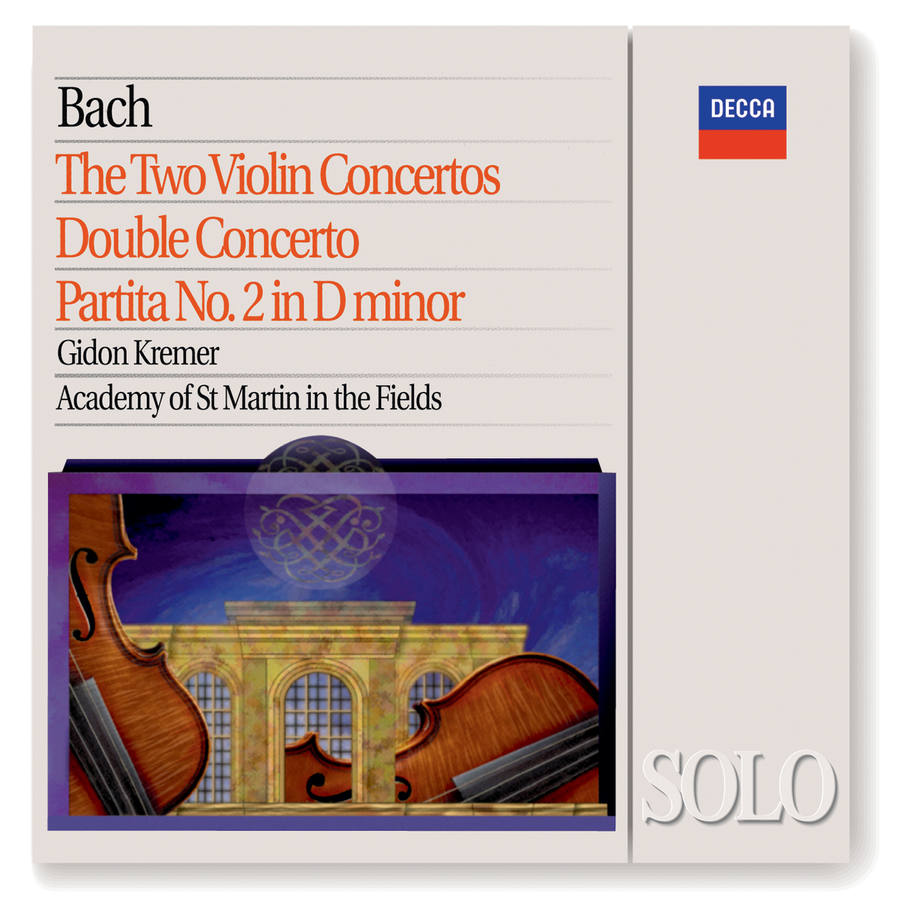
I hope you will forgive me for the almost mythical length in the title of this post. Equally I hope you will forgive this AOTM not being pop. At the end of the month, I reflect on which album has moved me the most. In February, it is this one. There is no doubt in my mind that what Gideon Kremer and the Academy of St Martin in the Fields (herein the Academy) have achieved is nothing short of miraculous. This review will be split into three sections because I believe each piece deserves to be considered in its own light.
The Two Violin Concertos
BWV 1041
Out of Bach’s vast body of work, only two Violin Concertos survive (BWV 1041-1042). Both are included here and played so beautifully by Gideon Kremer and the Academy of St Martin in the Fields. The first movement is all excitement and ebullience. Bach’s precision is at its most foreboding in the second movement of the first concerto, for me.
This second is the first evidence in this album that where we hear the violin’s voice. To me it speaks of sorrow, anger and impatience, with the central motif returning almost hauntingly towards the end of the movement. The final movement returns to a faster pace. The harpsichord is demanding of one’s attention from the outset. It is important we do not underestimate its power in all three pieces here.
The finale is described as ‘rolling and jolly’. Bach uses a technique for the violin soloist known as bariolage, “a special effect in violin playing obtained by playing in rapid alternation upon open and stopped strings” Meriam Webster. Pay attention near the end of the final movement, it is quite astonishing and almost overwhelming.
Most of these concerti date from Bach’s so-called Cöthen period from 1718-1723, a happy, productive time for Bach. His new employer, Prince Leopold of Anhalt-Cöthen seemed to be fond of the latest fad, the Italian-style Concerto, as typified by Vivaldi. The older German version had four movements, but Bach quickly adopted the Italian three-movement fast-slow-fast structure, the form that propelled it into the Classical period. Good Music Guide
BWV 1042
The second Violin Concerto opens with a simple melody which lures one into a false sense of security, following by a joyful burst of beautifully harmonised violins and harpsichord. This beautifully repeated melody is repeated and added to throughout the first movement building up to a really remarkable crescendo towards the end. Again, watch out for the importance of the harpsichord and the haunting use of double bass. Kremer plays with such magnificent vigour, bringing bursts of life into Bach’s composition.
The second movement is as compelling as it is haunting. The bassline is simple and repetitive but it underpins and lends support to the soloist and harpsichord. This is a crystal clear example of Bach’s ability to give voice to his instruments and create emotion through this voice. Listen to the second movement and ask yourself, what is Bach telling me? What was he thinking when he composed this? What was he trying to convey? I hear sorrow, passion and hope. Not to mention how impossibly beautiful this movement is. I find myself ready to shed tears at multiple points when listening to Bach’s compositions.
The final movement is once again a return to faster pacing. the second violin is imposing here, adding gusto the first violin, which leads the ensemble marvellously. This movement is an uplifting finale to a moving concerto.
The opening Allegro of the E major concerto is Bach at his most sunny and carefree. Podger and company exude joy, although they are occasionally a touch frantic: uplifting though their performance is, they never quite relax into the mellow composure this music needs. More effective is the soulful Adagio, contrasting dark intensity with sublime moments of golden light emerging from brooding clouds, and an ebullient finale. BBC Music
The Double Violin Concerto BWV 1043
This for me is the apex of classical music. The Double Violin Concerto is unquestionably the best piece on this album and perhaps of all time. If there were a classification system for masterpieces, this would surely sit near the top. Split into three movements; Vivace, Largo and Allegro, Bach masterfully conveys the violins’ unique voices speaking to each other and to us. A world of emotion is unveiled and conveyed so beautifully that I am reduced to tears every time I hear it.
Vivace
This first movement is enthralling form the beginning. Mathematically perfect, this movement combines the two violins and harpsichord to present an unstoppable onslaught of cohesion and remarkable beauty.
Opening with a Bachian fugue, each violin answering the other, rapidly alternating the melodic line, carrying different tunes yet so closely intertwined as to be inseparable, their combined voices miraculously greater than the sum of their parts. Good Music Guide
Largo
The Largo movement is sublime beyond description. this is uniquely illustrative of the fact Bach invented harmonisation for instruments. Never before had this level of communication occurred between instruments. Listening as I write, it is almost as though the two violins are speaking to one another in the style of a vocal Aria. Listen to the way it builds and falls with such keenly felt emotion. It is impossible for one not to be moved by this. The Largo is the pivotal movement in this concerto, providing . This movement is evocative, tender and deeply human.
Allegro
As though to shake us back to life after being emotionally pulverised by the Largo, Bach fills the third movement with a powerful recurring motif and solid recurring bassline. The insistence of each instrument to be heard is distinctively felt here. It washes over you in all its magnificence, all its mathematical perfection and all its impossibly complexity. The Allegro is almost a great architectural work, crowning the top of an already sound and extensive structure founded by the previous two movements. Kremer plays at his finest here and does not disappoint. I am agog that a piece of this level and concentration of beauty even exists. We are truly blessed to have access to this piece of music and, in addition, this extremely fine recording.
Partita No.2
Partitas are suites for solo instruments or chamber ensembles. They are unaccompanied. Here, Bach splits the Partita No.2 for Solo Violin into five parts, the Allemande, Corrente, Sarabande, Giga and Ciaccone.
Kremer faces the music nakedly and directly, without recourse to cohorts, gimmicks, clever arrangements, or anything other than the notes on the page. All Music
Kremer is left to play on his own here and delivers some of the most felt and emotional playing I have heard. These Partitas are complex to play and a challenge for any soloist. My personal favourite is the Giga. I believe the repetitive motif allows us to focus on the Partita as a whole and elicit from it a deep sense of humanity. The melody is remarkable, the recurring motif is intricate and the emotion is conveyed clearly and powerfully. It is no surprise that these partitas have become the go to for any violinist’s repertoire.
Kremer’s tone and expression are chimerical, unpredictable, and sometimes rawly emphasized, and it is sometimes hard to tell if he has deliberately marked out all his dynamics and bowings — as if parsing all those running sixteenth notes into motives and cells — or if he has merely left such decisions to the moment’s inspiration and spontaneously poured himself out in wave after wave of short, hiccuping phrases and exaggerated gestures. Ibidum.
Overall, this album completely staggered me. Beforehand I had known of classical music as an aide to revision and not truly appreciated its merit. It is thanks largely to St Nick and Louise that I have shed my ignorance. I was drawn to Brahms before truly hearing Bach and the genius he conveyed. I think Bach is now firmly my favourite. Nothing will compare to the Concerto for Double Violin. All of human sentiment is contained within and it is impossibly beautiful. The Largo is utterly sublime and I think will remain my favourite movement of classical music for some years to come. St Nick is right to say listening to Bach is a humbling experience and re-contextualises the world of classical music. He was the first to bring instrumental harmonisation to European classical music, previously only considered for vocal music. He was the first to give instruments a voice and make it heard. It is right that Bach is called the founder of modern classical music. I am in awe of Bach’s genius. There was no way that this album wouldn’t be AOTM.
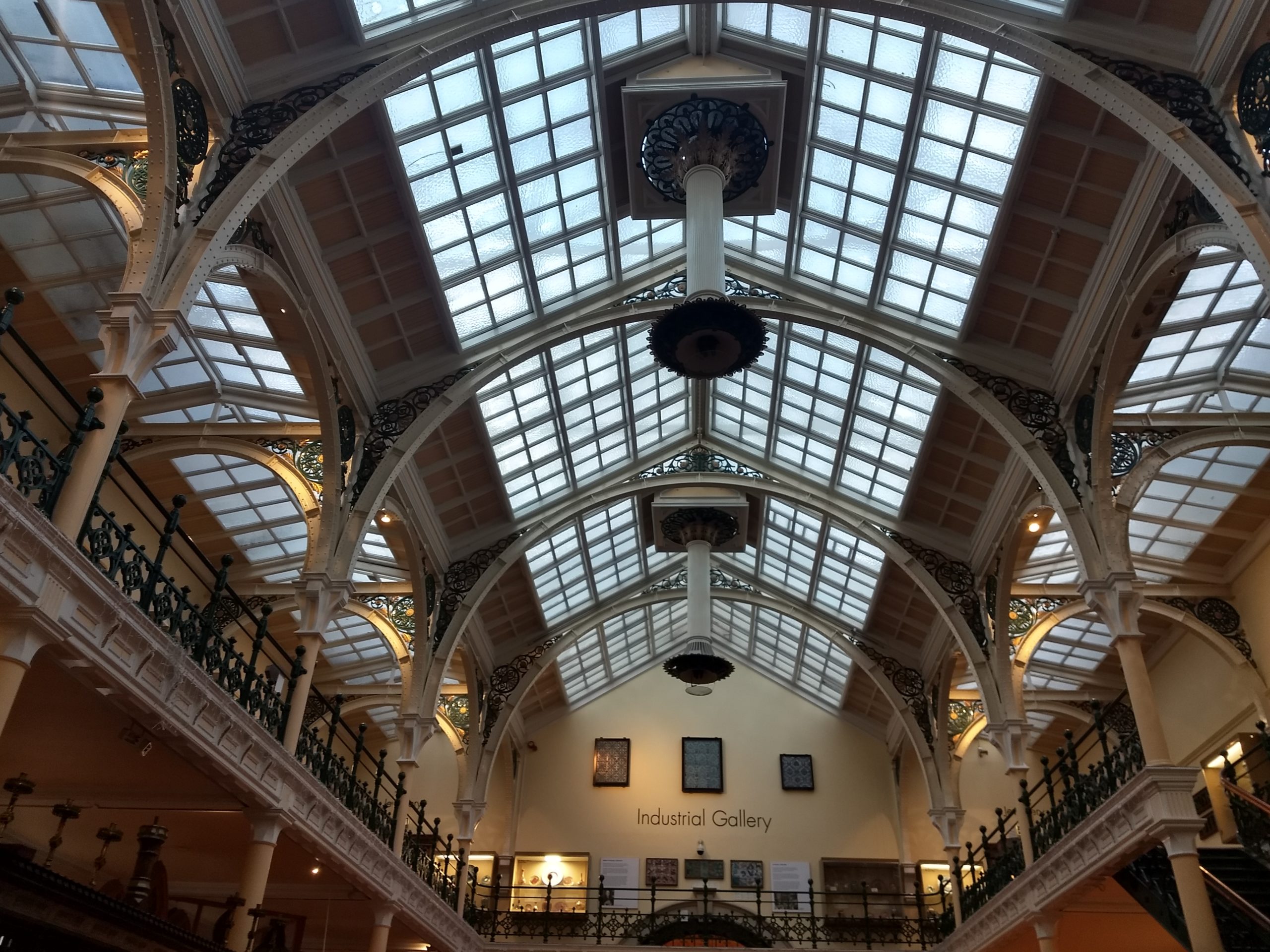
Birmingham Museum & Art Gallery is one of Birmingham’s crowning glories. It stands proud and easily recognise-able on the skyline of this our wonderful city. I’ve been meaning to review this for some time and find myself with two many highlights. consequently this post shall be split in two parts. This is the first, in case you were curious.
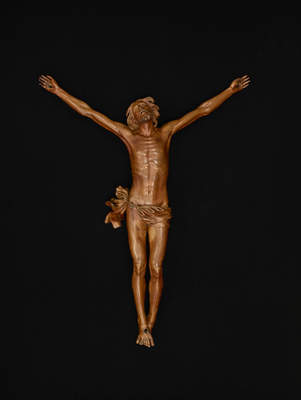
Andrea Fantoni (attributed to) – Figure Of Christ Crucified (Without Supporting Cross) circa 1690
Of course, following the recent theme, it would be remiss of me not to open with Catholic Iconography. This was presumably made by Andrea Fantoni, an Italian sculptor and woodcarver of the late-Baroque period trained under the auspices of Pietro Ramus. Andrea is most famed for the “confessional from the Basilica of Santa Maria Maggiore, Bergamo, and the Duomo of St. Alessandro in Brescia, as well as the pulpit in the Basilica di San Martino at Alzano Lombardo” (Wikipedia)
This piece was made from Boxwood which is a beautiful hard wood capable of being highly polished. This representation of Christ crucified is full of agony. This is beautifully represented in the facial expressions, stringing of the limbs and heaving chest cavity. The hair was also done marvellously. I was quite taken by this sculpture. Emotion is difficult to render in wood.
Benjamin Williams Leader (1831–1923) – February, Fill Dyke
Leader was a landscape painter whose early inspiration came from the Worcestershire countryside. In 1881, February Fill Dyke was exhibited at the Royal Academy to great acclaim and Leader was made an associate (ARA) in 1883, becoming a Royal Academician (RA) in 1898 (Wikipedia). This was by all accounts one of his most popular works.
I was struck by the composure of this painting. Depicting a wet November morning in Leader’s native Worcestershire, the colouring in the sky is beautifully reflected in the puddles. One can also see an elderly woman collecting wood for her fire and two children walking their dogs. I think this piece is intimate, beautifully conceived and immaculately executed. And, perhaps above all, quintessentially English.
John Brett (1831–1902), A North-West Gale off the Longships Lighthouse, 1873
The final piece for this post if from John Brett. What I look for in paintings with water is how motion is depicted. There is lots of it here, as with any turbulent sea piece. Brett has chose to keep this one free of boats, which means we can focus on the turbulence of the waves as contrasted against the relative calm of the clouds. These are united beautifully by the rays of sunshine, broken in parts by the spray of water from the clouds. This piece, with its small lighthouse at the centre, is quite superlative in its composition, subject matter and tasteful execution. It is only s shame the museum put it so high up on the wall!
He also studied with Richard Redgrave. In 1853 he entered the Royal Academy schools, but was more interested in the ideas of John Ruskin and William Holman Hunt, whom he met through his friend the poet Coventry Patmore. Inspired by Hunt’s ideal of scientific landscape painting, Brett visited Switzerland, where he worked on topographical landscapes and came under the further influence of John William Inchbold. Wikipedia
Stay tuned for Part 2 of my Birmingham Museum & Art Gallery Highlights.
If this isn’t the simplest recipe in the world, my name is not Chrystler Jennings the III. No I do jest, in all seriousness there are simpler recipes out there, such as not boiled egg. Pesto is among the simplest and least time consuming recipes I have ever made. Additionally, it is one which will keep well and last a long time after is made.
Ingredients
1large bunch of basil,leaves only, washed and dried
3medium cloves of garlic
one small handful of raw pine nuts (lightly roasted in a pan with no oil)
roughly 3/4 cup Parmesan,loosely packed and freshly grated
A few tablespoons of extra-virgin olive oil
Method
Some recipes ask you to hand chop all the dry ingredients with a mezzaluna knife, adding olive oil to the form a paste. While I understand the therapeutic and practical ramifications of such an act, I find it barbarously wasteful of precious time. While hand cut pesto is often better quality and allows one to separate the ingredients more clearly, my preferred method is to blend it with a machine
If you are lucky enough to possess a Moulinex or similar small blender, put all the ingredients in it and pulse it a few times. Then scopp out the pesto and put it in a jar, ready to be used at will. Easy as pie.
In Summation
Pesto is among the easiest dishes to make. I like to alternate the Parmesan with either Pecorino Romano or Chilli Pecorino to give it a bit of a kick and for better melting once added to your gnocchi. You are of course at liberty to use other pasta, but in so doing, you will secure your place at Broadmoor psychiatric hospital.